Hair & Scalp · Pattern hair loss in women
Female pattern hair loss: signs, stages, causes and treatment
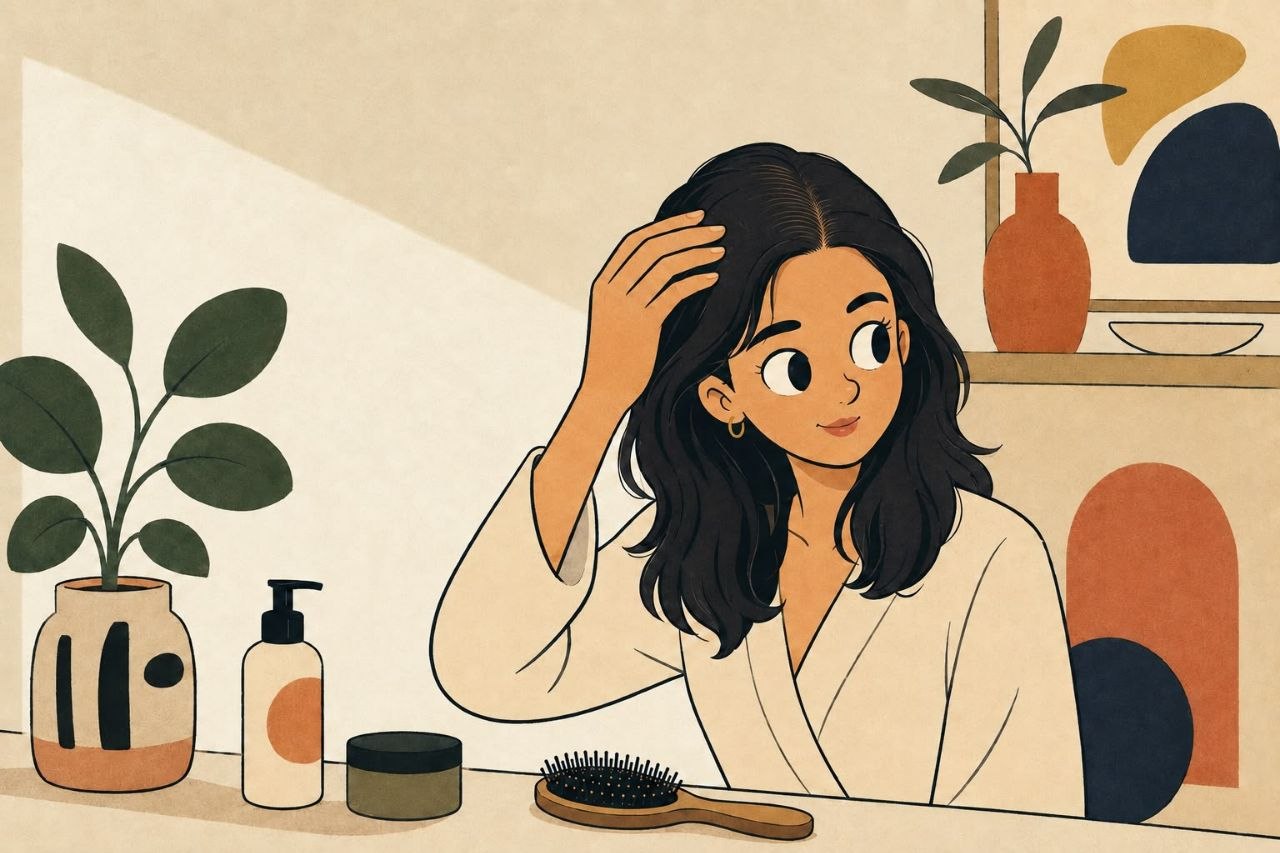
It starts with the parting. A line that used to be a pencil stroke is now a finger's width, and in the hard light of a bathroom mirror or a photograph taken from above, there is more scalp in it than there used to be. The ponytail feels thinner between your fingers. The hairline at the front, though, is where it always was. That combination, a widening centre with an untouched front edge, is what female pattern hair loss looks like, and it is the single most useful thing to know about it, because it tells you what this is and what it is not. What follows is how to recognise it, how it is graded, why it happens, what the blood tests can and cannot tell you, and what treatment realistically does at each stage.
Female pattern hair loss is a progressive, non-scarring thinning of the hair in which follicles across the central and upper scalp gradually miniaturise, usually widening the parting while largely preserving the frontal hairline. This page walks you through the signs, the stages, the causes, the blood tests and the treatment evidence, written for Indian women.
In brief
- It thins the top of the scalp from the centre outwards, widening the parting; the frontal hairline is usually kept, though Indian series record some hairline recession more often than the classic teaching suggests.4,2
- In a community study in Australia, 12% of women had detectable pattern loss by 29, 25% by 49 and 41% by 69. Indian population data do not yet exist; a 2023 Mumbai series of 90 women put the mean age of onset at 31.1,2
- Most women with it have normal androgen levels. The follicles are sensitive, the hormones are usually not high.4
- It is graded on the Ludwig scale (three grades) or the Sinclair scale (five), both of which measure the parting, and on a gender-neutral BASP system that also records the hairline.6,19
- Topical minoxidil has the strongest trial evidence in women. Oral anti-androgens and low-dose oral minoxidil are used off-label, and finasteride 1 mg showed no benefit in its placebo-controlled trial in post-menopausal women.9,11,14
- Treatment is better at slowing or stabilising the loss than restoring it, though some women achieve meaningful regrowth. The grade you start at largely sets the grade you keep.
What female pattern hair loss is Copy link
Female pattern hair loss is a progressive, non-scarring hair-loss disorder that shares its central microscopic feature with male pattern baldness: follicular miniaturisation. The two share the same histological hallmark: follicles in the susceptible zone progressively miniaturise, each hair cycle producing a shorter, finer hair than the last, until the terminal-to-vellus ratio drops below 4:1.18 But the female condition is not simply the male one drawn on a different map. The role of androgens in women is much less clear, the genetic architecture appears to be partly separate, and the visible pattern differs: men lose the temples and crown, while women lose density across the top from the centre outwards and usually keep the frontal hairline.4,20
The name changed for a reason. An expert committee of dermatologists and endocrinologists recommended in 2019 that "female pattern hair loss" replace "female androgenetic alopecia," because the older term implies that androgens are the cause in every case, and in women they often are not.4 That distinction runs through everything below: the hallmark is follicular miniaturisation, and it does not imply excess hormones, because a woman with a widening parting in most cases has entirely normal androgen levels.
What it looks like, and why the hairline matters Copy link
Three features, taken together, make the diagnosis most of the time. You can look for all three at home.
The parting widens. Hair density drops over the mid-scalp, so the line where you part your hair shows more skin than it did. In the Mumbai series of 90 women with biopsy-confirmed pattern loss, 96% had a widened mid-parting.2 The widening is gradual, over months and years, and is usually the first thing a woman notices, often in a photograph.
The front edge is kept. The frontal hairline is relatively spared. Some thinning immediately behind it is common and gives the so-called Christmas tree pattern, in which the thinned zone is broadest at the front and tapers backwards, but the line itself holds.8 This is the feature that most reliably separates pattern loss from the male version and from several other conditions. But the classic teaching deserves an Indian footnote. In the Mumbai series, 30% of women had some frontal recession, and when the same 90 women were classified on the BASP system, the commonest basic pattern, at 46.7%, was the M type, meaning bitemporal recession; the authors concluded that Indian women frequently present with recession at the temples alongside the central thinning.2 A receding edge therefore does not rule the diagnosis out here, and it is part of why newer Indian studies grade on BASP, which records the hairline, rather than on Ludwig, which assumes it is spared. The widening parting remains the anchor sign either way.
The ponytail shrinks. Because the loss is diffuse across the top, total volume falls before any one patch looks bald. A hair tie that used to go round twice now goes round three times. If you have noticed that, take it seriously. This is a useful early sign, and it is also why pattern loss is so often mistaken for shedding, which is the subject of its own section below.
What you will not usually see: bald patches, a smooth shiny scalp, scarring, pain, or a hairline that marches backwards at the temples. Any of those points elsewhere and deserves a dermatologist, and you should not try to name it yourself.
How common it is, and at what age Copy link
The most-quoted prevalence figures come from a population study in Maryborough, Australia, where a postal survey of 5,000 adults was followed by clinical examination of 396 respondents. Among women, 12% had clinically detectable pattern loss by age 29, 25% by 49, 41% by 69, and over half by 79. Only 43% of women aged 80 and above showed no sign of it at all.1 Those are Australian, largely European-ancestry figures, so apply them to yourself with care. Community surveys from China and Korea give much lower totals, around 6% across all ages, which tells you that ancestry matters and that a single global number does not exist.3
For India there is no population prevalence study, and anyone who gives you one is guessing. What exists is clinic data. In the 2023 Mumbai series of 90 women, the youngest was 17, the mean age of onset was 31, the mean age at presentation 34.7, and 91% had already reached established or advanced disease when first seen; in that cohort, women presented roughly three years after their reported onset.2 A South Indian referral series, cited by Singh and Makhecha, put pattern loss at 15.3% of women presenting with diffuse hair loss.2 Neither tells you how common the condition is among Indian women in general; both suggest that it starts in the late twenties and early thirties and tends to arrive at the clinic late.
Two things are worth noticing in that. The first is that onset is later than in men, whose pattern loss frequently starts in the early twenties, and the demand for treatment peaks between 25 and 40 in women.17 The second is that it keeps rising with age. Menopause is not a cause in itself, but the decade after it is when a large fraction of women first notice their parting.
Ludwig, Sinclair and BASP: how it is graded Copy link
Men have the Norwood scale. Women have three, because no single scale has satisfied everyone. Which one appears on your prescription depends mostly on where your dermatologist trained.
| Scale | Grades | What it measures | Where you will meet it |
|---|---|---|---|
| Ludwig (1977) | I, II, III | Thinning of the crown with a preserved frontal band. Grade I is perceptible thinning at the parting; II is pronounced rarefaction over the crown; III is full denudation of the top with the frontal fringe kept.6 | Most Indian clinic notes and most research before 2010 |
| Sinclair (2004) | 1 to 5 | Five photographs of the central parting from above. Grade 1 is normal; 2 is a slightly widened parting; 3 is a widened parting with loss on either side; 4 is diffuse loss over the top; 5 is advanced loss.5 | Trials of oral minoxidil and anti-androgens, and the self-assessment tool in many clinics |
| BASP (2007) | Basic L, M, C, U plus Specific F or V | A gender-neutral system: the basic letter describes the shape of the front hairline, the specific letter records density loss on the frontal scalp (F) or vertex (V).19 | Newer Indian and Korean studies; useful precisely because it records whether the hairline has moved |
Naturally, which scale your dermatologist uses matters less than that they photograph you under the same light at each visit, because the scales are coarse and the year-on-year changes are small. A 2016 European consensus produced a Female Pattern Hair Loss Severity Index that combines a Sinclair grade, a shedding score and trichoscopic findings into a single number, with 5 to 9 counted as early disease and 10 or above as established.7 It is the index the Mumbai study used to show that nine in ten Indian women arrive in the established range.2
Two practical points. Ludwig grade III, the stage at which the top of the scalp is denuded, is rare: it affects fewer than 1% of women.5 And at any grade, the finding that predicts treatment response is the parting width itself, because it is the single best proxy for how many follicles are still producing visible hair.11
What causes it Copy link
Why you? Genes first. Pattern hair loss runs in families on both sides, and a family history is the strongest single risk factor in every series that has looked.17 The inheritance is polygenic, which is why it skips people, arrives at different ages in sisters, and why there is no single test for it. Most of the genetic work has been done in men; four newly identified male susceptibility loci were tested in women in 2014 and did not associate, which is one reason the female condition is thought to have partly separate genetics from the male one.20
Androgens second, with a caveat large enough to deserve its own section. Follicles in the susceptible zone carry androgen receptors and the enzymes that convert testosterone to dihydrotestosterone, and in men that pathway clearly drives the miniaturisation. In women the picture is less settled: most affected women have normal androgen levels, anti-androgen responses do not track hormone levels, and how much of the female condition is androgen-driven at all remains an open question.4,17 Women's frontal follicles have lower levels of 5-alpha-reductase and of androgen receptor, and higher levels of aromatase, the enzyme that converts androgens to oestrogen, than men's, which is part of why the pattern and the pace differ.21
Third, factors that do not cause pattern loss but appear to travel with it. Metabolic syndrome is the best-studied of these. In the Mumbai series, 34% of women with pattern loss met criteria for metabolic syndrome, and those who did had an onset seven years earlier on average (30 versus 37.5) and a higher severity score; a waist circumference over 80 cm on its own associated with greater severity.2 The study had no control group and recruited mostly from lower-income patients at one public hospital, so it establishes an association without proving a cause. Studies from Korea and Egypt, tabulated by the same authors, found metabolic syndrome in anywhere from 29% to 69% of women with pattern loss, a spread wide enough to show how much the estimate depends on who was studied.2 All of this evidence is observational, so treat it as a flag on your risk profile and nothing stronger.
What does not cause it: washing your hair, oiling it or not oiling it, helmets, hard water, dandruff, stress in the ordinary sense, or wearing it tied. Several of those can cause a separate, temporary shedding, and tight plaits worn daily for years can cause a traction loss at the edges that is genuinely different and genuinely preventable, but none of them makes a follicle genetically sensitive to androgens.
Hormones, PCOS and the "high testosterone" assumption Copy link
The first thing many women are told, by relatives or by the first page they read, is that pattern hair loss means raised male hormones. For most women it does not. The 2019 Androgen Excess and PCOS Society committee, having reviewed the evidence to that date, concluded that isolated pattern hair loss in a woman with normal androgen levels should not be considered a sign of hyperandrogenism.4 Most women with the condition have normal testosterone and DHEAS, and respond to treatment regardless of whether their levels were high or normal at the start.11
The qualification is PCOS. Among women who have polycystic ovary syndrome, the same committee found pattern hair loss in roughly 20 to 30%, with the caveat that the studies are few and the estimates vary widely.4 In the Mumbai series, 83% of the women had at least one clinical sign the authors filed under hyperandrogenism, though the list they used included obesity and seborrhoea, which broadens it considerably.2 Should every woman with pattern loss have her hormones measured? The guidance genuinely disagrees, and it is fairer to tell you so than to pretend a consensus. Much dermatology practice reserves androgen testing for women who also have clinical signs, meaning irregular or absent periods, acne persisting into the late twenties, coarse hair on the chin or chest, or difficulty conceiving.3 The 2019 committee, by contrast, recommends measuring circulating androgens in women presenting with pattern loss, while grading the evidence behind that recommendation as limited.4 Both agree on this much: the combination of pattern loss with irregular periods, hirsutism, persistent acne or infertility should prompt evaluation for PCOS and other causes of androgen excess, any such cause is treated as a whole and not as a scalp problem, and thinning that favours the temples is one of the features that should prompt the same work-up.
Pattern loss or shedding? The distinction that decides treatment Copy link
Is your hair falling, or is it thinning? This is where most women are misdirected, because the two commonest causes of hair loss in women look alike on a pillow and are treated in opposite ways.
Telogen effluvium is shedding. Some trigger two to four months earlier, a fever, childbirth, surgery, a crash diet, a new medicine, a thyroid disturbance, pushes a large fraction of follicles into their resting phase at once, and they all release their hairs together. The result is dramatic, handfuls in the shower and on the comb, across the whole scalp, and it usually settles once the trigger resolves, with density recovering over the following months. Nothing miniaturises; the follicles are resting and will restart. The qualification, as you would expect, is that a trigger which persists, an untreated thyroid problem or an ongoing deficiency, keeps the shedding going, and a chronic form of telogen effluvium can run for years.
Pattern loss is thinning. Shedding may or may not be increased; what changes is the calibre and number of terminal hairs on the top of the head, over years. The hairs that fall are not the problem. The hairs that grow back finer are.
| Feature | Female pattern hair loss | Telogen effluvium |
|---|---|---|
| Onset | Gradual, over months to years; often noticed in a photograph | Sudden, 2 to 4 months after a trigger; noticed on the pillow |
| Where | Top of the scalp, centre outwards; parting widens | Whole scalp evenly; parting may look unchanged |
| Hairline | Usually kept | Kept |
| Pull test | Usually negative, or positive only over the crown | Positive across the scalp while active |
| Hairs under magnification | Mixed calibre, many fine hairs, single-hair follicular units | Uniform calibre |
| Course without treatment | Slowly progressive | Usually settles once the trigger resolves |
The two overlap more often than a clean table suggests. A shedding episode can unmask a pattern that was already there, because once the lost hairs regrow finer over the susceptible zone, the parting that the shed revealed does not close again. Postpartum hair fall at six months is usually shedding; postpartum hair fall that has not recovered at eighteen months and has left the parting wider is usually pattern loss that pregnancy briefly hid. When a woman says her hair never came back after a baby, a fever or a period of dieting, this is typically what happened.
How it is diagnosed Copy link
Usually in the consulting room, without a biopsy. The examination has four parts, and it helps to know what you will be asked.
History. When it started, how fast, whether anyone in the family has it, the regularity of periods, recent illnesses or deliveries, medicines, diet, and whether the concern is hair on the floor or scalp in the mirror. That last question alone separates most shedding from most thinning, so think about your answer before you arrive.
The parting, compared. The width of the central parting is compared with the width of a parting made low at the occiput, just above the nape, where pattern loss does not reach. If the centre is visibly wider than the back, the loss is patterned. You can check this yourself with a second mirror.
The pull test. The dermatologist takes a small bundle of hair between thumb and fingers close to the scalp and slides along it with steady pressure. If more than one hair in ten comes free, bulb and all, shedding is active. In the Mumbai series only 10% of women with established pattern loss had a positive pull test, which is what you would expect of a condition whose problem is the calibre of the hair and its regrowth.2
Trichoscopy. A hand-held dermatoscope on the scalp shows what the eye cannot: hairs of mixed thickness side by side, more than 20% of them finer than the rest, follicular openings with a single hair where there should be two or three, and a faint brown ring around some follicles called the peripilar sign. In a 2024 systematic review, hair diameter variability was present in 94% of patients.16 Trichoscopy can catch the diameter change before the parting looks different, and it is cheap, quick and available in most Indian dermatology clinics. The Mumbai study used diameter diversity over 20% plus the peripilar sign as its trichoscopic entry criteria.2
A scalp biopsy is reserved for cases where the picture is mixed, where a scarring alopecia is suspected, or where shedding and thinning coexist and the proportion of each will change the plan. It is the only way to count follicles directly: a normal 4 mm punch holds around 40; in the Mumbai series the mean was 17.2
Blood tests: what they answer and what they don't Copy link
No blood test diagnoses female pattern hair loss. The diagnosis is made on your scalp. So what are the tests for? Two other jobs.
The first is excluding a shedding cause that can coexist with, or masquerade as, pattern loss. A thyroid panel, a CBC and a serum ferritin are the standard first set, because an underactive or overactive thyroid and low iron stores each produce a diffuse shedding, and iron deficiency is common enough among Indian women of reproductive age that finding it is unsurprising. A vitamin D level is often added. Whether low ferritin causes pattern loss, as opposed to coexisting with it, is genuinely unsettled. A controlled study of 381 women with pattern loss or chronic shedding at one American clinic reported no overall excess of iron deficiency against 76 women without hair loss, and its authors called the relationship speculative until a trial of iron replacement is run. But that study was retrospective, drew on records collected over two decades, enrolled only Caucasian women, and a published letter argued its own premenopausal data showed a significant difference the abstract played down.15 For Indian women, in whom iron deficiency is common for reasons that have nothing to do with hair, the practical position is simple: a low ferritin is worth correcting for its own sake, and whether the correction narrows the parting is not something the evidence can promise.
The second job is hormonal. If the history or examination suggests androgen excess, meaning irregular cycles, hirsutism, persistent acne, or loss that favours the temples, then total testosterone, DHEAS and the other elements of a PCOS work-up are appropriate, and the result changes treatment. In women without any of those signs, practice varies: many dermatologists reserve endocrine testing for women with clinical clues, while the 2019 Androgen Excess and PCOS Society committee takes the broader position that circulating androgens should be measured in women presenting with pattern loss, though it grades the evidence behind that recommendation as limited.3,4
There is a third consideration, and it is about you more than your hair. The association between early-onset pattern loss and metabolic syndrome is observational, so it sets no testing rule on its own. What it reasonably does is lower your threshold. If your parting widened early and you also carry weight around the middle, have a parent or sibling with diabetes, or have never had your blood pressure checked, it makes sense to have your blood pressure taken, an HbA1c checked and a lipid profile run if none has been done recently.2 Your hair is not the reason to worry. It is an occasion to check your numbers.
What treatment does, with the numbers Copy link
Everything here follows from one fact: treatment works on follicles that are still producing visible hair. It lengthens their growing phase and can thicken the hair they make, which both halts the widening and, in a proportion of women, partly reverses it. It does very little for follicles that have already been vellus for years. That is why the stage at which you start matters more than which product you choose, and why the Mumbai finding that 91% arrive at an established stage is the most important number in this article.2
Topical minoxidil has the strongest evidence in women and is the one treatment with a regulatory approval for female pattern hair loss in most countries. Its largest trial randomised 381 women aged 18 to 49 to 5% solution, 2% solution or placebo, twice daily for 48 weeks. Non-vellus hair counts in a 1 cm² target area rose by 24.5 with 5%, 20.7 with 2% and 9.4 with placebo. Five per cent beat placebo on all three primary measures; 2% beat placebo on hair count and investigator assessment but not on the women's own assessment of growth; and 5% beat 2% on the women's assessment of benefit.9 On the once-daily foam, the evidence is closer than the marketing suggests. A 2011 trial in 113 women supported once-daily 5% foam as non-inferior to twice-daily 2% solution, with a mean increase of about 32 hairs/cm² against 28.10 A larger phase III trial in 322 women then found almost identical gains at 24 weeks, 23.9 against 24.2 hairs/cm², but narrowly failed its own prespecified non-inferiority margin because the confidence interval ran just past the boundary.31 In practice once-daily 5% foam is widely used because it is convenient and avoids propylene glycol, not because it has been shown to beat the alternative.
Two things to expect, and to remember when you are tempted to stop. In the first four to eight weeks shedding often increases, because minoxidil pushes resting follicles to release their old hairs before they grow new ones; this is the moment most women give up, and it is exactly the wrong moment. And the benefit is tied to use: stop, and over several months the scalp returns to where it would have been without treatment. Facial hair growth, particularly on the upper cheeks and temples, occurs in a minority and is more common with 5% than 2%, and more common still if the solution runs down the face at night. Scalp irritation usually comes from the propylene glycol in the solution, and foam avoids it. Minoxidil's practical use is covered in full in its own guide.
| Treatment | Evidence in women | What it realistically does | Main limitation |
|---|---|---|---|
| Topical minoxidil | Strongest: large placebo-controlled trials9 | Slows loss, with some regrowth | Indefinite use; irritation; early shed |
| Spironolactone | Open-label series plus a 2026 Indian randomised trial11,23 | May stabilise or improve | Off-label; not in pregnancy |
| Bicalutamide | Emerging: randomised trials, 2025 to 202623,27 | Trichoscopic gains; clinical benefit unproven | Off-label; pregnancy risk; liver-function monitoring |
| Oral minoxidil, low dose | Small head-to-head trials plus large safety data13,24 | Improves density in some women | Off-label; systemic effects |
| Finasteride 1 mg | Negative placebo-controlled trial14 | Not demonstrated | Pregnancy risk; higher-dose data weak |
| PRP | Growing but heterogeneous28 | May improve density and thickness | No standard protocol; recurring cost |
| Low-level laser | Some randomised evidence29 | Modest adjunctive improvement | Device and protocol variability |
Oral options: anti-androgens and low-dose minoxidil Copy link
Should you consider a tablet? These are prescription medicines, used off-label for hair in India and almost everywhere else, and the decision to use them is a dermatologist's, made with a blood pressure cuff and a pregnancy history in the room.
Spironolactone blocks the androgen receptor and reduces androgen production. The classic outcome data come from 80 women with biopsy-proven pattern loss treated for at least a year with spironolactone 200 mg daily or cyproterone acetate: 44% regrew hair, 44% held steady, 12% continued to lose, with no difference between the drugs and, notably, no relationship between response and androgen level.11 That series had no placebo arm, so the 44% who held steady cannot be cleanly attributed to the drug, which is part of why spironolactone remains off-label. The evidence has since moved, and, usefully for you, it moved in India. A randomised, double-blind trial at an Indian tertiary centre, published in 2026, gave 204 women with Sinclair grade II to V loss either spironolactone 100 mg or the androgen-receptor blocker bicalutamide 50 mg daily for 24 weeks: bicalutamide produced larger trichoscopic gains (about 5 versus 3 hairs/cm² at the frontal site), while the clinical endpoints did not differ significantly between the groups, and the follow-up was short and the centre single.23 Spironolactone is prescribed with a potassium check and a blood pressure reading, must not be taken in pregnancy because it can feminise a male foetus, and women who could conceive are usually asked to use contraception while on it. Bicalutamide is newer to this use, and it comes with its own safety file: liver enzymes were checked at baseline and during follow-up in the trials, hepatotoxicity is a recognised concern with this drug class, and a separate randomised trial found that adding it to oral minoxidil gave no benefit over oral minoxidil alone, so its place is still being worked out.23,27 One more thing worth saying plainly, before you ask your dermatologist about it: the Indian head-to-head was a per-protocol analysis at a single centre over 24 weeks, so treat its numbers as promising and unsettled.
Low-dose oral minoxidil is the change of the last decade. The drug was a blood pressure tablet for fifty years before dermatologists began using it at a fraction of the dose. In a pilot series of 100 women given 0.25 mg of minoxidil with 25 mg of spironolactone in a single daily capsule, the mean Sinclair grade fell by 1.3 over twelve months and the shedding score by 2.6; blood pressure fell by a few millimetres of mercury and eight women had side effects, generally mild.12 Safety data are larger than efficacy data: in a retrospective study of 1,404 patients across six countries, 943 of them women, on a mean dose of 1.6 mg, the commonest side effect was unwanted hair growth on the face and body in 15.1%, and systemic effects including light-headedness (1.7%), fluid retention (1.3%) and fast heart rate (0.9%) led 1.2% to stop.13 There are isolated case reports of pericardial effusion, including in a young woman at 1.25 mg, and while such reports show an association rather than proof of cause, they are the reason a cardiac history, a blood pressure reading and a check for fluid retention come before the first prescription, and why this is not a medicine to buy online and start.25 Small randomised head-to-head trials now exist: in a 24-week trial of 52 women, oral minoxidil 1 mg raised total hair density by 12% against 7.2% with topical 5% once daily, a difference that was not statistically significant.24 Note, for your own weighing of it, that authors of that trial declare commercial interests in oral minoxidil, the same disclosure standard this page applies to the manufacturer-funded topical trials. The head-to-head evidence remains far smaller and shorter-term than the topical trials; the regimen is popular mostly because it removes the twice-daily application that many women abandon.
Finasteride and dutasteride are the mainstays for men and are a different story in women. The single placebo-controlled trial of finasteride 1 mg, in 137 post-menopausal women for a year, found no difference from placebo on hair counts, photographs, assessments or biopsy.14 Higher doses, 2.5 to 5 mg, have shown responses in small uncontrolled series, usually in women with signs of androgen excess, and a 2021 meta-analysis of nine studies, most of them single-arm, found no effect on hair density and rated its own result as unreliable because of heterogeneity.22 Both drugs are contraindicated in pregnancy and in any woman who could become pregnant, because they interfere with the development of male genitalia in the foetus, and a tablet that has been split or crushed should not be touched by anyone who is pregnant or trying to be.
What the evidence does not support Copy link
Platelet-rich plasma now has a genuine body of randomised evidence in women: a 2024 meta-analysis of 21 randomised trials and 628 women found improvements in hair density and thickness, with mostly mild, transient side effects, and, as you might guess from a therapy made from your own blood, with preparation methods, injection schedules and study populations varying so much that results in one clinic do not predict results in another.28 It has earned a place as an adjunct some dermatologists offer; it has not earned first-line status, and it is priced per session, indefinitely. Low-level laser devices have randomised, sham-controlled evidence of modest hair-count improvement, including a trial in 47 women, with the same caveat about variable devices and protocols; a helmet is a large purchase for a small, uncertain effect, so check your expectations before you check out.29 Rosemary oil has one small randomised comparison against 2% minoxidil in androgenetic alopecia; the evidence is sparse and far weaker than for minoxidil.30 Oils generally, biotin, onion juice and hair-growth gummies have no trial showing that they slow miniaturisation. Oiling does no harm to a scalp that tolerates it, and a biotin supplement does nothing for a woman who is not biotin-deficient, which is nearly every woman. Take a photograph of your parting under the same light every three months; that is the only test any product in this paragraph needs to pass. If the line is not narrowing, the product is not working, whatever the before-and-after on the box suggests.
Camouflage is a different matter and deserves no apology. Tinted scalp powders and fibres that cling to existing hair narrow the look of the parting within minutes, a side parting or a softer fringe hides the centre, and a topper or partial hairpiece is a reasonable choice for a woman at a later grade. None of it treats anything, and all of it can be used alongside treatment while you wait the six months it takes to judge whether the medicine is working.
Two things deserve separate mention because they are so often done in place of treatment. Cutting your hair shorter makes it look fuller and changes nothing underneath. Switching shampoos changes nothing underneath either, unless the scalp is inflamed, in which case a ketoconazole wash helps the scalp and not the pattern.
Pregnancy, menopause and the Indian scalp Copy link
If you are planning a family, read this section twice. Pregnancy often improves the look of the hair temporarily; more follicles stay in their growing phase, an effect usually attributed to high oestrogen, and the shedding a few months after delivery is those follicles catching up. It is the commonest moment at which a pre-existing pattern is noticed. None of the medicines above is used in pregnancy. Topical minoxidil is stopped when a woman is trying to conceive and through pregnancy; for breastfeeding the guidance is split, with some dermatology advice against any minoxidil and the LactMed database accepting topical use once feeding is established, provided the baby does not touch treated skin.26 Spironolactone and the 5-alpha-reductase inhibitors are stopped before conception. If you are planning a pregnancy, that is a conversation to have with your dermatologist before you are pregnant.
Menopause. Pattern loss becomes more common and more noticeable after the menopause in every population studied, and the years after it are when prevalence climbs fastest.1 Whether falling oestrogen directly drives the process is not settled; the association is solid, the mechanism is still being worked out, so be wary of anyone selling you certainty about your hormones. Women who first notice a widening parting at 50 are seeing a genetic susceptibility that was always there. The good news is that the treatment options broaden after the menopause, because the pregnancy constraint on oral medicines lifts.
Indian hair and Indian habits add three things to the picture. Tight plaits and buns worn daily from childhood can cause traction alopecia along the hairline and the parting, which looks different under trichoscopy and which, unlike pattern loss, is fully preventable by loosening the style. Heavy oiling does not cause pattern loss, but a scalp that is oiled and rarely washed is more often inflamed and flaky, which makes the parting look worse and can mask the diagnosis. And the high rates of iron deficiency and low vitamin D in Indian women mean a coexisting shedding cause is found often enough that the first-layer blood tests in the section above are genuinely worth running here, even though they will not explain the pattern itself.
Can it be reversed? Copy link
Partly, in some women, and more the earlier treatment starts. You will want to know how much, so consider the numbers. In the anti-androgen series, 44% of women regrew visibly, and in the minoxidil trial the 5% group gained a mean of about 15 non-vellus hairs per square centimetre over placebo.9,11 Those are real gains and, as you would expect, they are not a return to the hair of your twenties. Treatment is better at slowing or stabilising the widening than at restoring what is gone, although some women achieve meaningful regrowth and a narrower parting. What it does not do is restore follicles that have been vellus for years or regrow a Ludwig III crown, which is why hair transplantation exists for the small number of women who reach that stage with a stable donor zone behind the crown.
The sensitivity itself is permanent. Medicines suppress its effect for as long as they are used, and the loss resumes over several months when they stop. A woman starting treatment at 32 should think of it the way she would think of treatment for any chronic condition she intends to manage for the long term.
When to see a doctor Copy link
Soon, if your parting has widened over the past year, if your ponytail has noticeably thinned, or if hair that fell after a pregnancy, an illness or a period of dieting has not come back after a year. The reason for urgency is not that the condition is dangerous; it is that every month of untreated miniaturisation is hair that is harder to recover, and in the 90-woman Mumbai cohort discussed above, the mean duration of loss at first presentation was about three and a half years.
Sooner still, and to a dermatologist specifically, if the loss is patchy, if the scalp is painful, itchy, scaly or scarred, if the hairline is receding at the temples the way a man's would, or if the thinning has come with irregular periods, acne or new facial hair. The first group needs a different diagnosis. The second needs a hormonal work-up alongside the scalp examination, and the two are managed together.
Frequently asked questions Copy link
What does female pattern hair loss look like?
A parting that has widened, with less density across the top of the scalp from the centre outwards. The frontal hairline is usually kept, though Indian series record thinning or recession at the temples in a substantial share of women. The ponytail becomes thinner. Bald patches or a painful, scaly scalp point to something else.
Can women go bald?
Complete baldness from female pattern hair loss is rare. Ludwig grade III, in which the top of the scalp is denuded with a frontal fringe kept, affects fewer than 1% of women. Most women experience thinning and a wider parting, and most of that is treatable if it is caught while the follicles are still producing visible hair.
Can it start in your 20s?
Yes. In the Australian population study, 12% of women had detectable pattern loss by 29, and in a 2023 Mumbai series of 90 women the mean age of onset was 31, with the youngest patient 17. A family history and PCOS both make early onset more likely.
Does female pattern hair loss mean I have high testosterone?
Usually not. Most women with it have normal androgen levels, and isolated pattern loss with normal hormones is not considered a sign of androgen excess. Hormone testing is appropriate when there are also irregular periods, persistent acne, coarse facial or body hair, or loss that favours the temples.
How do I tell it from normal hair fall?
Losing up to around 100 hairs a day is normal; that is hair being cycled, and it grows back. The question is what grows back. If the parting is the same width it was two years ago, shedding is shedding. If it is wider, the hairs growing back are finer, and that is pattern loss, whatever the daily count.
Which blood tests should I get?
None diagnoses the condition; that is done by examining the scalp. A thyroid panel, a CBC and a serum ferritin are standard to exclude a shedding cause, and a vitamin D level is often added. Hormone testing matters most when there are irregular periods, acne, hirsutism or other signs of androgen excess; whether to measure androgens in otherwise isolated pattern loss varies by guideline and clinician. If your loss began early and you also carry metabolic risk factors, a blood pressure reading, an HbA1c and a lipid profile are worth having if they are overdue.
What is the best treatment?
Topical minoxidil has the strongest trial evidence in women and is first line. Oral spironolactone, bicalutamide and low-dose oral minoxidil are prescribed off-label by dermatologists, with drug-specific safety checks first: pregnancy assessment for all three; blood pressure and renal or electrolyte assessment where appropriate for spironolactone; blood pressure, cardiovascular history and a check for fluid retention for oral minoxidil; and liver-function monitoring for bicalutamide. Finasteride 1 mg showed no benefit in its placebo-controlled trial in post-menopausal women. Whatever is used, starting earlier matters more than the choice between them.
Can I use minoxidil while pregnant or breastfeeding?
It is stopped when trying to conceive and through pregnancy, and spironolactone and finasteride are stopped before conception. For breastfeeding, recommendations differ: some dermatology guidance advises avoiding minoxidil altogether, while the LactMed database considers topical minoxidil acceptable once breastfeeding is established, with care to keep the infant away from treated skin. Ask the prescribing dermatologist about timing, ideally before a planned pregnancy.
Will it come back if I stop treatment?
Yes, over months. Treatment suppresses the effect of a permanent genetic sensitivity; it does not remove it. The hair returns to roughly where it would have been without treatment.
Is it the same as male pattern baldness?
They share the same microscopic hallmark, follicular miniaturisation, but the female condition is not simply the male one in a different place: the role of androgens is less clear in women and the genetics appear partly separate. Men are graded on the Norwood scale; women lose the centre outwards, usually keep the hairline, and are graded on Ludwig, Sinclair or BASP. Finasteride, the mainstay for men, has not shown benefit in women at 1 mg.
References Copy link
- Gan DC, Sinclair RD. Prevalence of male and female pattern hair loss in Maryborough. J Investig Dermatol Symp Proc. 2005;10(3):184-189. doi:10.1111/j.1087-0024.2005.10102.x
- Singh S, Makhecha MB. A cross-sectional, observational study of the clinico-epidemiological profile of female pattern hair loss in Western India and its association with metabolic syndrome. Indian Dermatol Online J. 2023;14(2):226-231. doi:10.4103/idoj.idoj_360_22
- Singal A, Sonthalia S, Verma P. Female pattern hair loss. Indian J Dermatol Venereol Leprol. 2013;79(5):626-640. ijdvl.com
- Carmina E, Azziz R, Bergfeld W, et al. Female pattern hair loss and androgen excess: a report from the Multidisciplinary Androgen Excess and PCOS Committee. J Clin Endocrinol Metab. 2019;104(7):2875-2891. doi:10.1210/jc.2018-02548
- Dinh QQ, Sinclair R. Female pattern hair loss: current treatment concepts. Clin Interv Aging. 2007;2(2):189-199. PMC2684510
- Ludwig E. Classification of the types of androgenetic alopecia (common baldness) occurring in the female sex. Br J Dermatol. 1977;97(3):247-254. doi:10.1111/j.1365-2133.1977.tb15179.x
- Harries M, Tosti A, Bergfeld W, et al. Towards a consensus on how to diagnose and quantify female pattern hair loss: the 'Female Pattern Hair Loss Severity Index (FPHL-SI)'. J Eur Acad Dermatol Venereol. 2016;30(4):667-676. doi:10.1111/jdv.13455
- Olsen EA. Female pattern hair loss. J Am Acad Dermatol. 2001;45(3 Suppl):S70-S80. doi:10.1067/mjd.2001.117426
- Lucky AW, Piacquadio DJ, Ditre CM, et al. A randomized, placebo-controlled trial of 5% and 2% topical minoxidil solutions in the treatment of female pattern hair loss. J Am Acad Dermatol. 2004;50(4):541-553. doi:10.1016/j.jaad.2003.06.014
- Blume-Peytavi U, Hillmann K, Dietz E, Canfield D, Garcia Bartels N. A randomized, single-blind trial of 5% minoxidil foam once daily versus 2% minoxidil solution twice daily in the treatment of androgenetic alopecia in women. J Am Acad Dermatol. 2011;65(6):1126-1134.e2. doi:10.1016/j.jaad.2010.09.724
- Sinclair R, Wewerinke M, Jolley D. Treatment of female pattern hair loss with oral antiandrogens. Br J Dermatol. 2005;152(3):466-473. doi:10.1111/j.1365-2133.2005.06218.x
- Sinclair RD. Female pattern hair loss: a pilot study investigating combination therapy with low-dose oral minoxidil and spironolactone. Int J Dermatol. 2018;57(1):104-109. doi:10.1111/ijd.13838
- Vañó-Galván S, Pirmez R, Hermosa-Gelbard A, et al. Safety of low-dose oral minoxidil for hair loss: a multicenter study of 1404 patients. J Am Acad Dermatol. 2021;84(6):1644-1651. doi:10.1016/j.jaad.2021.02.054
- Price VH, Roberts JL, Hordinsky M, et al. Lack of efficacy of finasteride in postmenopausal women with androgenetic alopecia. J Am Acad Dermatol. 2000;43(5 Pt 1):768-776. jaad.org
- Olsen EA, Reed KB, Cacchio PB, Caudill L. Iron deficiency in female pattern hair loss, chronic telogen effluvium, and control groups. J Am Acad Dermatol. 2010;63(6):991-999. doi:10.1016/j.jaad.2009.12.006
- Kuczara A, Waśkiel-Burnat A, Rakowska A, Olszewska M, Rudnicka L. Trichoscopy of androgenetic alopecia: a systematic review. J Clin Med. 2024;13(7):1962. doi:10.3390/jcm13071962
- Ramos PM, Miot HA. Female pattern hair loss: a clinical and pathophysiological review. An Bras Dermatol. 2015;90(4):529-543. doi:10.1590/abd1806-4841.20153370
- Messenger AG, Sinclair R. Follicular miniaturization in female pattern hair loss: clinicopathological correlations. Br J Dermatol. 2006;155(5):926-930. doi:10.1111/j.1365-2133.2006.07409.x
- Lee WS, Ro BI, Hong SP, et al. A new classification of pattern hair loss that is universal for men and women: basic and specific (BASP) classification. J Am Acad Dermatol. 2007;57(1):37-46. doi:10.1016/j.jaad.2006.12.029
- Nuwaihyd R, Redler S, Heilmann S, et al. Investigation of four novel male androgenetic alopecia susceptibility loci: no association with female pattern hair loss. Arch Dermatol Res. 2014;306(4):413-418. doi:10.1007/s00403-013-1436-4
- Sawaya ME, Price VH. Different levels of 5alpha-reductase type I and II, aromatase, and androgen receptor in hair follicles of women and men with androgenetic alopecia. J Invest Dermatol. 1997;109(3):296-300. doi:10.1111/1523-1747.ep12335779
- Kim KH, Kwon SH, Lee YJ, Sim WY, Lew BL. Efficacy of finasteride in female pattern hair loss: a meta-analysis. Ann Dermatol. 2021;33(3):304-307. doi:10.5021/ad.2021.33.3.304
- Jha AK, Zeeshan M, Singh A, Ankad BS. Spironolactone vs. bicalutamide in female pattern hair loss: a randomized clinical trial. Clin Exp Dermatol. 2026;51(8):1406-1411. doi:10.1093/ced/llag099
- Ramos PM, Sinclair RD, Kasprzak M, Miot HA. Minoxidil 1 mg oral versus minoxidil 5% topical solution for the treatment of female-pattern hair loss: a randomized clinical trial. J Am Acad Dermatol. 2020;82(1):252-253. jaad.org
- Luu NC, Trüeb RM. Serious complication of low-dose oral minoxidil for hair loss. JAAD Case Rep. 2022;28:94-96. jaadcasereports.org
- Drugs and Lactation Database (LactMed). Minoxidil. Bethesda (MD): NICHD; last revision 15 May 2026. ncbi.nlm.nih.gov/books/NBK501032
- Libório RS, da Motta AV, Miot HA, Ramos PM. Bicalutamide 25 mg combined with minoxidil 1 mg versus minoxidil 1 mg for female pattern hair loss: a randomized double-blind clinical trial. JAAD Int. 2025;19:71-77. doi:10.1016/j.jdin.2024.12.002
- Yuan J, He Y, et al. Effectiveness of platelet-rich plasma in treating female hair loss: a systematic review and meta-analysis of randomized controlled trials. Skin Res Technol. 2024;30(9):e70004. doi:10.1111/srt.70004
- Lanzafame RJ, Blanche RR, Chiacchierini RP, Kazmirek ER, Sklar JA. The growth of human scalp hair in females using visible red light laser and LED sources. Lasers Surg Med. 2014;46(8):601-607. doi:10.1002/lsm.22277
- Panahi Y, Taghizadeh M, Marzony ET, Sahebkar A. Rosemary oil vs minoxidil 2% for the treatment of androgenetic alopecia: a randomized comparative trial with assessment of hair growth. Skinmed. 2015;13(1):15-21. PMID 25842469
- Blume-Peytavi U, Shapiro J, Messenger AG, et al. Efficacy and safety of once-daily minoxidil foam 5% versus twice-daily minoxidil solution 2% in female pattern hair loss: a phase III, randomized, investigator-blinded study. J Drugs Dermatol. 2016;15(7):883-889. PMID 27391640
This article is general health information for readers in India and is not a diagnosis or a prescription. Spironolactone, oral minoxidil and finasteride are prescription medicines and are not used in pregnancy. A registered medical practitioner can confirm what is driving your hair loss and what is appropriate for your stage and your plans.