Sapiens · Hair
Minoxidil 5%: Does It Actually Work, How to Use It, and What to Expect
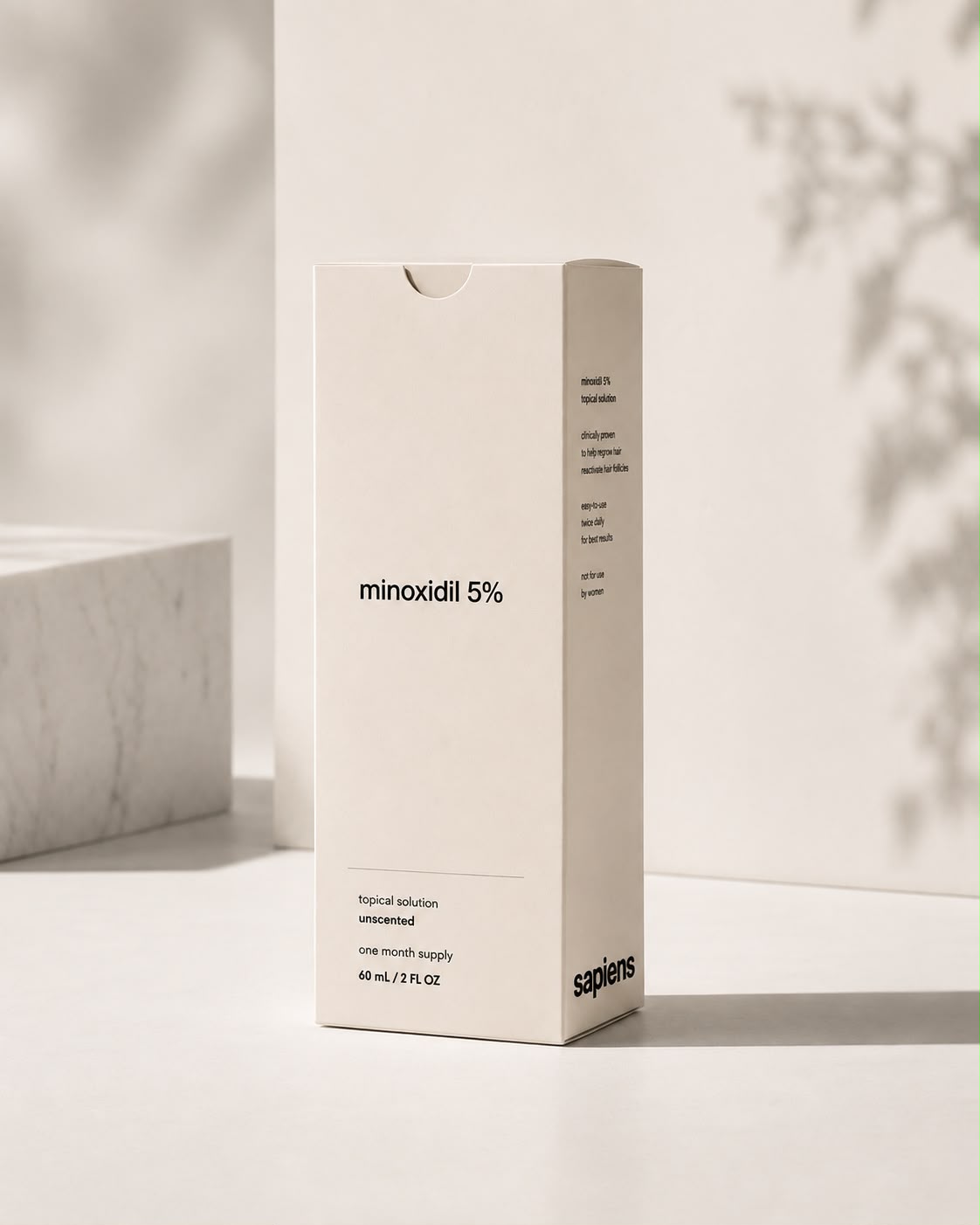
Minoxidil 5% topical solution is the hair-loss treatment most people in India start with: the bottle from the pharmacy, the name in every late-night search about thinning hair. It works, and the evidence behind it is genuinely solid. In a 48-week randomised trial in 393 men, 5% minoxidil produced 45% more regrowth than the 2% version by week 48.1 But "it works" quietly skips past the questions you actually care about: how well, for whom, in which form, and how long before your mirror agrees.
Quick facts
- Minoxidil is approved for androgenetic alopecia (pattern hair loss). It acts directly on the follicle and leaves the hormone (DHT) driving the condition untouched.
- It beats placebo clearly in randomised trials, but cosmetically meaningful regrowth happens in a subset of users. Response varies substantially between people, partly because follicles differ in how well they convert minoxidil into its active form.6,8
- An early "shed" can occur after starting minoxidil. The men's leaflet describes increased shedding for up to two weeks;14 a retrospective study found it temporary within the first 12 weeks for most patients.22 Shedding isn't a validated way to predict whether you'll ultimately respond.
- More concentration doesn't mean more hair: in the one randomised 5%-versus-10% trial, 5% came out ahead on regrowth and the 10% caused marked irritation.17
- For men using 5% solution, the US label says results may take up to four months and advises medical review if there's still no regrowth at that point. Women's 5% foam is a once-daily product with a longer window: results may appear from three months, and some women need at least six.14,18
How minoxidil works Copy link
Minoxidil started life as a blood-pressure tablet in the 1970s. Patients on it grew hair in places they hadn't asked for, and by the late 1980s a topical version had made its way onto pharmacy shelves.8 Half a century later, nobody has fully mapped why it grows hair. Its mechanism is still not completely understood. The parts that are known form a coherent enough picture, though.
Minoxidil itself is inactive. Your follicles carry an enzyme, sulfotransferase, that converts it into the working form, minoxidil sulfate.8 One proposed pathway runs through that active form opening ATP-sensitive potassium channels and widening the small vessels around the follicle. Minoxidil also appears to nudge several follicular signalling pathways and the hair cycle itself, holding follicles in the anagen (growing) phase for longer and shortening the resting phase that follows.5,8 Which of these effects carries the most weight remains unresolved. The practical output is clear enough: more of your follicles stay in active growth, for longer, than they would left alone.
What it never touches is dihydrotestosterone (DHT), the hormone that shrinks follicles in pattern hair loss. That's finasteride's territory, and the mechanisms don't overlap at all, which is exactly why dermatologists often pair the two instead of picking one.
Does minoxidil actually regrow hair? What the trials show Copy link
Get this calibration right before you commit months to anything. Across the placebo-controlled trials, minoxidil is clearly superior to placebo: a systematic review and meta-analysis of the randomised evidence found it beat placebo on hair count consistently.6 At the same time, cosmetically satisfying regrowth happens in a subset of users, and the size of the response varies a great deal from person to person.8 Both things are true at once. The drug is real, and the marketing oversells how universal the result is. In the 48-week trial of 393 men, hair counts kept climbing through the full year, and five percent beat two percent by a wide margin: 45% more regrowth at week 48.1
What happens outside a trial matters just as much. Trials remind people to apply the product and photograph their scalp on schedule. Nobody does that for you at home. An Indian trial that enrolled 80 men and followed them for 16 weeks lost exactly half its participants along the way: 40 of 80 dropped out before the end.7 Consistency is one of the biggest modifiable parts of the result. Even an effective drug never gets a fair test if the routine disappears by month three.
The dread shed: why it gets worse before it gets better Copy link
Somewhere around week two to four, a fair number of people using minoxidil for the first time notice more hair coming out than usual. Your pillow looks worse. The shower drain looks worse. This is also a common point at which people consider quitting, and it's almost always the wrong moment to.
Minoxidil pushes resting (telogen) follicles into the growth phase early. The old hairs those follicles were already going to shed get released faster, in a shorter window, instead of trickling out gradually across months.5 The shed reflects the hair-cycle shift minoxidil can produce, but it isn't a validated way to predict your eventual response.22 Having one doesn't guarantee success, and not having one doesn't mean treatment has failed. The men's leaflet says shedding may increase temporarily for up to two weeks, and tells you to see a doctor if it continues beyond that.14 The clinical literature describes a wider window: a retrospective study of 49 patients found the increase temporary within the first 12 weeks for most, with shedding settling back below pre-treatment levels as treatment continued.22 That same study found larger shedding associated with better 24-week outcomes, which is interesting but nowhere near enough to make shedding a clinical predictor. If it's still going strong well past that, or it starts to feel less like a shed and more like a steady worsening, mention it to a doctor instead of waiting it out.
How long does minoxidil take to work? Copy link
Patience does most of the work, because the hair cycle sets the pace and nothing you apply speeds the cycle itself up. Searches for "minoxidil results after 2 months" spike for a reason: at two months many people see nothing yet, or only the shed, and both are normal. Keep three separate milestones in view instead of one blurry "is it working":
- First visible change (months 2–4). The US label for men's 5% solution puts the earliest results around two months of consistent use. For some men it takes the full four.14 That label carries its own checkpoint: no regrowth by four months means stop and talk to a doctor.14
- Women's foam runs on a different clock. Once-daily application, results possible from three months, and some women need at least six before judging.18
- Formal response check (~6 months). European evidence-based guidance on pattern hair loss suggests judging response properly at about six months.12
- Full result (6–12 months). In the trials, hair counts were still climbing at week 48, so the complete cosmetic picture takes six to twelve months to settle.1,2
Judge it at week eight and you're catching it during its least flattering phase.
How to use minoxidil properly Copy link
Application technique sounds trivial until you realise it's where most real-world results are won or lost. The routine, per the product labelling:13,14
- Dose: 1 ml of solution per application (the dropper has a marking), or half a capful of foam. More product doesn't mean more hair. It means more irritation and an emptier bottle.
- Frequency: twice daily for men's 5% solution, morning and night. Women's 5% foam is once daily.
- Dry scalp: hair and scalp should be dry before you apply. No need to shampoo before each application.
- Placement: part the hair and apply to the scalp in the thinning area, and rub in gently with a fingertip if using solution. The scalp grows the hair; the strands don't need coating.
- Afterwards: wash your hands every time and keep it away from your eyes and from cut, scraped or sunburnt skin. For the night dose, the men's label says to allow two to four hours of drying time before bed.14
- Missed a dose? Skip it. Don't double up.
Now the part the label doesn't tell you. The evening application is the one that fails first: the label wants two to four hours of drying before bed,14 which collides with late dinners, gym schedules and a pillow you'd rather not press a wet scalp into. People who stick with it usually anchor the doses to fixed habits, right after brushing teeth being the classic, and keep a second bottle in their travel kit so a work trip doesn't become a two-week gap. Two India-specific notes: give the morning dose time to dry before a two-wheeler helmet goes on, and keep champi and minoxidil in separate time slots. Apply minoxidil to a dry scalp. If you've oiled your scalp, apply minoxidil after the oil has been washed out and the scalp has dried, so the medicine goes onto the scalp directly instead of over an oil layer. Solution can leave hair slightly stiff or greasy once dry; if that keeps making you skip mornings, that's a formulation problem with a formulation fix, covered below.
Does minoxidil work on a receding hairline or frontal baldness? Copy link
Pick up a box of 5% minoxidil solution in the US and the label says something a lot of people never read closely: it is "not intended for frontal baldness or a receding hairline."14 That line alone has talked plenty of people out of trying it on the one area they're actually worried about. The real story runs more useful than the label suggests, and less absolute than the online shorthand that's grown up around it.
The label reads that way because of trial history, not biology. The 48-week studies behind the original approval measured the vertex, the crown at the back of the top of the head, because that's the area where pattern hair loss is easiest to photograph and measure consistently. Frontal and temporal hair loss simply wasn't what those particular trials were built to test, so the label never claims anything about it either way.
Researchers have since tested the frontotemporal region on its own terms, and the results deserve to be reported precisely. In a 24-week placebo-controlled trial of 70 men, 5% minoxidil foam increased frontotemporal hair count and cumulative hair width from baseline through week 16. At week 24, against placebo, cumulative hair width was significantly better, while the hair-count difference itself didn't reach statistical significance. Participants nevertheless rated their frontotemporal scalp coverage as significantly improved.3 So the frontal region responds, measurably, on some endpoints. The evidence base there is simply thinner and younger than the vertex data.
The same research group then followed a subset of those men for 104 weeks in an open-label extension. Hair width and count initially rose, then drifted back to values comparable with baseline by week 104, in the vertex as well as the frontotemporal region. The authors' conclusion is the defensible one: over two years, treatment stabilised hair density, width and scalp coverage in both regions.4 Read together, the fair summary is this: minoxidil has evidence of activity at the frontal scalp; that evidence is much thinner than at the vertex; and the long-term data support stabilisation more confidently than durable frontal regrowth above baseline.
What this means in practice: if your main concern is a receding hairline or thinning temples, applying minoxidil there isn't wasted effort, and stabilising the line is itself a win. It's still reasonable to expect the crown to respond more reliably, and worth asking a dermatologist whether adding finasteride, which acts on the hairline through a different route entirely, makes more sense for that area than minoxidil on its own.
Minoxidil 2%, 5% and the 10% mistake Copy link
2%: the original
The first approved strength, and still a real drug. It beats placebo in both men and women in the randomised trials.1,2 In men it's since been overtaken: the 48-week head-to-head showed 5% producing 45% more regrowth, and faster.1 Where 2% keeps a place is in women using solution, since higher-strength solution raises the odds of unwanted facial hair in some women.2
5%: the standard
For men, 5% solution twice daily is the benchmark: superior to 2% on every measure that 48-week trial tracked.1 For women, the once-daily 5% foam has changed the picture. A randomised trial found it performed similarly to twice-daily 2% solution with less local irritation,9 and a 404-woman placebo-controlled Phase III trial showed it clearly improved hair count and scalp coverage against vehicle foam.10 The US FDA approved 5% foam for women in 2014 on that evidence. Which strength suits you comes down to the product label, your own tolerance, and your doctor's advice.
10%: stronger isn't better
This is where your intuition breaks. Ten percent isn't FDA-approved for androgenetic alopecia, and in the one randomised 5%-versus-10% trial, a 36-week placebo-controlled study in 90 men, the 5% produced better regrowth with less irritation.17 There's no good evidence that simply pushing the concentration above 5% improves the result. Indian pharmacies do stock 10% and even 12.5% products, which is worth knowing precisely because the shelf implies a ladder the evidence doesn't support. If 5% isn't delivering for you, the answer is a different strategy, and a stronger bottle isn't it.
Solution, foam, spray or tablets: which forms you'll find in India Copy link
The molecule is the same across every format. What changes is the vehicle carrying it, the routine it demands, and how your scalp tolerates it. On an Indian pharmacy shelf you'll meet four broad forms.
Topical solution: the default
The classic dropper bottle, usually alcohol and propylene glycol based, and the form behind most of the trial evidence.1,2 It's the cheapest and most widely stocked, and the carrier is also the usual culprit when scalps itch, flake or sting.7 India has produced its own answer to that: non-alcohol "cetosomal" solutions, built specifically to cut carrier irritation, now sold by several major brands.7
Foam: gentler, faster-drying
Propylene-glycol-free, dries quickly, doesn't drip, and in the women's trials it brought less local irritation than solution.9,10 It's the once-daily format approved for women. In India, foam variants exist from the major minoxidil brands, but the shelf remains dominated by solutions, and foam usually costs more per month.
Sprays, gels and serums: read the label first
A spray isn't a separate drug formulation in the evidence sense: it's usually the same topical solution delivered through a spray-top applicator, convenient for larger areas. The same rules apply, too. It's the millilitres of 5% minoxidil reaching your scalp that matter, and a fine mist landing on hair strands does nothing. "Hair serums" are the category to squint at. Some contain proper 5% minoxidil; plenty of shelf neighbours contain none at all and borrow the aesthetic. Check the composition line for minoxidil and its percentage before paying.
Tablets: oral minoxidil, prescription only
Low-dose oral minoxidil has become a genuine part of dermatology practice, prescribed off-label at a fraction of the old blood-pressure doses. The best comparative evidence to date: a randomised, double-blind trial in 90 men found oral minoxidil 5 mg daily performed similarly to topical 5% twice daily over 24 weeks, without demonstrating superiority.16 A tablet works through your whole body, though: hair can grow beyond the scalp, and blood pressure and fluid retention need a prescriber watching.15 It suits people who genuinely can't get on with the topical routine, and it belongs under a dermatologist's supervision. We'll cover oral minoxidil dosing and safety in depth in its own guide.
Why some people never respond Copy link
Remember that sulfotransferase enzyme from earlier, the one that converts minoxidil into its active form? Its activity varies from person to person. People with lower enzyme activity tend to get less out of the same bottle, applied exactly the same way.8 That's one real, biological reason "it just doesn't work for me" is sometimes true, and not simply a compliance problem in disguise.
Response also tracks with how far the hair loss has travelled. Minoxidil tends to do more for hair loss that's been going on under five years than for hair loss established a decade or more, and it does more where follicles are thinned but still present than where they've miniaturised down to almost nothing.5 Put plainly, that's the same thing dermatologists say constantly and patients often skip past: catching it earlier makes it easier to treat.
When it seems to stop working after a few years Copy link
This one catches people out, and in most cases the medicine hasn't actually stopped doing anything. You should know the long-run shape of the curve. The men's label itself notes that effectiveness hasn't been shown to last longer than 48 weeks of continuous use in studies,14 and long-term follow-up of men on topical minoxidil found that regrowth peaks around the first year and then declines slowly over the years that follow, while still maintaining more hair than the men would have kept without it.11 Pattern hair loss is progressive. It keeps advancing with age and genetics underneath whatever treatment sits on top. So what feels like "it stopped working" is usually the underlying condition moving forward, with minoxidil still slowing the loss relative to doing nothing. If results feel like they're fading, that's a reason to review the plan with a dermatologist, who may suggest adding finasteride, and it isn't automatically a reason to abandon a treatment that may still be earning its keep.
Minoxidil and finasteride: better together? Copy link
Because finasteride and minoxidil act through different mechanisms, using them together can outperform either treatment alone in men with androgenetic alopecia. The clearest single data point: a randomised comparative study of 450 men found improvement at 12 months in 94.1% of those on oral finasteride plus topical 5% minoxidil, against 80.5% on finasteride alone and 59% on minoxidil alone.19 The strength of the combination evidence varies with the formulation and regimen, though. Topical finasteride-minoxidil combinations, including the 0.1% finasteride bottles sold in Indian pharmacies, have a younger and less uniform evidence base than the oral-plus-topical pairing. So whether oral or topical finasteride belongs alongside your minoxidil is a prescribing decision, and one to make with a dermatologist rather than at the shelf.
Buying minoxidil in India: brands, formulations and price Copy link
Topical minoxidil is widely available through Indian pharmacies, in person and online. Dispensing and prescription requirements can vary by product and retailer, though: some online pharmacies list plain 5% solutions as prescription-required, and combination products with finasteride are prescription medicines. Check the label and the pharmacy's requirements for the specific formulation you're buying. Easy availability cuts both ways, too. Minoxidil is licensed for androgenetic alopecia specifically, and plenty of hair loss isn't that. Buying a bottle because your hair is thinning, without confirming why, is how people spend a year on the wrong treatment.
The established names include Tugain (Cipla), Mintop (Dr. Reddy's) and Morr, alongside newer cetosomal formulations built for sensitive scalps.7 A 60 ml bottle of plain 5% topical minoxidil currently spans roughly ₹350 to ₹1,300 at listed prices depending on manufacturer and formulation, with budget generics at the low end and brands like Tugain and Mintop Forte above ₹1,000. Retailer discounts often bring the checkout price lower, and combination products with finasteride typically cost more. Treat these as listed-price ballparks and confirm at checkout. Which brand to actually pick deserves its own comparison, and we'll publish one; the short version is that the active molecule is identical, so tolerability, format and price are what you're really choosing between.
What happens when you stop Copy link
The benefit lasts only as long as you keep applying it. Stop, and the follicles minoxidil was holding in active growth gradually drift back to their previous behaviour. The label puts a number on it: the regrown hair is typically lost again within three to four months of stopping.14 That's not a sudden crash, and it isn't withdrawal or dependence either. Minoxidil doesn't damage follicles or create an addiction in any pharmacological sense. Pattern hair loss is a progressive, ongoing process, and minoxidil was holding a line against it the whole time you used it. Stop holding the line, and the underlying process simply continues from wherever it would have been anyway.
When minoxidil is the wrong tool Copy link
Topical minoxidil is an established treatment for androgenetic alopecia. The US men's 5% solution label specifically covers gradual thinning at the vertex, and doesn't label the product for frontal baldness or a receding hairline.14 Clinical studies have since examined those regions, as discussed above, so evidence of activity outside the vertex isn't the same thing as a labelled indication. It isn't the established treatment for every kind of hair loss. Use it on the wrong one and you'll burn through months for little return. You don't have to take a doctor's word for this either. The US drug facts labels say do not use it if your hair loss is sudden and/or patchy or if you don't know the reason for it,14,18 and the women's label adds hair loss associated with childbirth.18 The manufacturer is drawing the same line a dermatologist would.
Sudden, all-over shedding is usually a different condition: telogen effluvium, the kind that starts two to four months after a fever, delivery, crash diet or major stress. Postpartum hair fall, one of the most searched hair worries in India, sits squarely inside the label's do-not-use list for exactly this reason: it's usually self-limited shedding after childbirth, and minoxidil isn't its treatment. The first-line treatment there is identifying and addressing whatever triggered it, and minoxidil doesn't feature in that first step. A handful of small, uncontrolled studies have tested minoxidil for stubborn telogen effluvium, but the evidence sits nowhere near what backs it for pattern hair loss. Reassurance plus fixing the trigger remains the standard approach. We cover exactly what that looks like, and how to tell diffuse shedding apart from pattern loss in the first place, on our telogen effluvium guide. There's a genuinely useful irony worth knowing here: the "early shed" some people get when they start minoxidil is, mechanically, a small self-limited version of that same telogen-release process. Partly why the two conditions get confused so often.
The men's leaflet is explicit about what minoxidil won't help: hair loss from very low body iron, too much vitamin A, hypothyroidism, chemotherapy, scarring diseases, or grooming methods that pull the hair tightly back, naming cornrowing and ponytails.14 Tight plaits and tightly pulled buns are the everyday Indian version of that last one, and the hair loss they cause is traction alopecia, which needs the tension removed rather than a bottle. Patchy, coin-sized bald spots (alopecia areata) belong to yet another condition, driven by the immune system, and minoxidil isn't the primary treatment there either. If thyroid dysfunction sits behind your shedding, treating the thyroid is what actually reverses it. We go through that in detail in our thyroid and hair loss guide.
Side effects, briefly Copy link
Topical minoxidil is generally well tolerated. The most common issues are scalp irritation, itching, flaking or dryness, and often trace back to the alcohol and propylene glycol carrier in traditional solutions more than to the minoxidil itself, which is why foam and cetosomal formulations tend to sit gentler on sensitive scalps.7,9 Some people, especially women on higher-strength solution, notice unwanted hair growth on the face where the product has spread beyond the scalp. Careful application and washing your hands afterward helps. Only a small fraction is absorbed into the body, so systemic effects stay uncommon at the topical dose, but the label itself warns it may be harmful if used when pregnant or breastfeeding, so avoid it in both.18 Oral minoxidil carries systemic considerations of its own, covered in the forms section above.
When to see a doctor Copy link
- Before starting, if you're not sure your hair loss is actually pattern hair loss. Other causes need different treatment, and minoxidil won't fix a cause it wasn't built for.
- If shedding is sudden, all-over, or came on within a few months of an illness, delivery, crash diet, or new medication.
- For men on 5% solution: if there's no regrowth after 4 months of consistent use. That's the label's own advice, and the earliest sensible checkpoint.14
- For women on 5% foam: the label says stop and ask a doctor if you don't see regrowth in 6 months.18
- Before starting, if you have heart disease. That caution sits on both the men's and women's labels, and it applies to the topical too.14,18
- If there's genuinely no improvement after about six months, review the diagnosis, your adherence, and the treatment plan properly.12 The full cosmetic result can keep building to twelve months, but six months of nothing is worth a conversation.
- If scalp irritation persists past the first few weeks, or you notice unwanted facial or body hair.
- If you're pregnant, breastfeeding, or considering oral minoxidil.
Frequently asked questions Copy link
Does minoxidil really regrow hair?
Yes, with a caveat worth respecting. It clearly beats placebo in randomised trials, and hair counts keep building over the first year of use. Cosmetically satisfying regrowth happens in a subset of users rather than everyone, and it works best on early, milder thinning at the crown. Response varies substantially between people, partly because follicles differ in how well they activate the drug.
Which is better: 2%, 5%, 10% or oral minoxidil?
For men, 5% is the benchmark: it beat 2% by 45% more regrowth in the head-to-head trial, while 10% lost to 5% on regrowth and caused marked irritation. For women, once-daily 5% foam and 2% solution both have solid evidence. Low-dose oral minoxidil performed similarly to topical 5% in a randomised trial and suits people who struggle with the topical routine, but it's a prescription medicine that needs supervision.
Why is my hair shedding more after I started minoxidil?
That early shed is common. It reflects follicles being pushed into a new growth cycle sooner than they otherwise would have gone. The men's leaflet describes increased shedding for up to two weeks,14 and a retrospective study found it temporary within the first 12 weeks for most patients.22 It isn't a validated way to predict your eventual response: experiencing it doesn't guarantee success, and skipping it doesn't mean failure.
Does minoxidil work on a receding hairline or frontal baldness?
There's evidence of benefit, reported precisely: in a 24-week placebo-controlled trial, frontotemporal hair width improved significantly against placebo and patients rated their coverage as better, while the hair-count difference didn't reach significance. Over two years, treatment stabilised the region rather than producing durable regrowth above baseline. The label's "not intended for frontal baldness" line reflects what the original approval trials measured, and the frontal evidence base remains thinner than the vertex one.
Does minoxidil work for beard growth?
The evidence is thin and worth reading precisely. A randomised, placebo-controlled study of 3% minoxidil lotion in 48 men, published as a two-page letter to the editor, found more beard-area hairs against placebo at 16 weeks, while hair diameter showed no significant change.20 A larger 2026 randomised, double-blind trial found significant gains in both beard density and hair diameter, though in 69 transgender men on testosterone therapy, a different population from most men searching this question.21 Beard use remains off-label, so if a fuller beard is the goal, take the question to a dermatologist before repurposing the scalp bottle.
Do I need a prescription for minoxidil in India?
It depends on the product and the pharmacy. Plain topical minoxidil is widely available, though some retailers list it as prescription-required, and combination products with finasteride are prescription medicines. Check the label and your pharmacy's requirements, and confirm the diagnosis before you start either way.
What happens if I stop using minoxidil?
The hair it helped grow is typically lost again within three to four months of stopping, because the underlying pattern hair loss process simply resumes. Minoxidil was holding it back the whole time. It was never curing it. Stopping isn't dependence and it doesn't damage your follicles.
Related on Sapiens
References Copy link
- Olsen EA, Dunlap FE, Funicella T, et al. A randomized clinical trial of 5% topical minoxidil versus 2% topical minoxidil and placebo in the treatment of androgenetic alopecia in men. J Am Acad Dermatol. 2002;47(3):377–385. PMID: 12196747.
- Lucky AW, Piacquadio DJ, Ditre CM, et al. A randomized, placebo-controlled trial of 5% and 2% topical minoxidil solutions in the treatment of female pattern hair loss. J Am Acad Dermatol. 2004;50(4):541–553. PMID: 15034503.
- Hillmann K, Garcia Bartels N, Kottner J, Stroux A, Canfield D, Blume-Peytavi U. A single-centre, randomized, double-blind, placebo-controlled clinical trial to investigate the efficacy and safety of minoxidil topical foam in frontotemporal and vertex androgenetic alopecia in men. Skin Pharmacol Physiol. 2015;28(5):236–244. PMID: 25765348.
- Kanti V, Hillmann K, Kottner J, Stroux A, Canfield D, Blume-Peytavi U. Effect of minoxidil topical foam on frontotemporal and vertex androgenetic alopecia in men: a 104-week open-label clinical trial. J Eur Acad Dermatol Venereol. 2016;30(7):1183–1189. PMID: 26387973.
- Minoxidil. In: StatPearls [Internet]. Treasure Island (FL): StatPearls Publishing. NCBI Bookshelf ID: NBK482378.
- Adil A, Godwin M. The effectiveness of treatments for androgenetic alopecia: a systematic review and meta-analysis. J Am Acad Dermatol. 2017;77(1):136–141. PMID: 28396101.
- Sattur S, Talathi A, Shetty G, Arsiwala S, Pereira R, Dhoot D. Comparative clinical study evaluating the efficacy and safety of topical 5% cetosomal minoxidil and topical 5% alcohol-based minoxidil solutions for the treatment of androgenetic alopecia in Indian men. Cureus. 2023;15(10):e46568. PMID: 37937040. Funded by Glenmark Pharmaceuticals, manufacturer of both products compared.
- Suchonwanit P, Thammarucha S, Leerunyakul K. Minoxidil and its use in hair disorders: a review. Drug Des Devel Ther. 2019;13:2777–2786. PMID: 31496654.
- Blume-Peytavi U, Hillmann K, Dietz E, Canfield D, Garcia Bartels N. A randomized, single-blind trial of 5% minoxidil foam once daily versus 2% minoxidil solution twice daily in the treatment of androgenetic alopecia in women. J Am Acad Dermatol. 2011;65(6):1126–1134. PMID: 21700360.
- Bergfeld W, Washenik K, Callender V, Zhang P, Quiza C, Doshi U, Blume-Peytavi U. A phase III, multicenter, parallel-design clinical trial to compare the efficacy and safety of 5% minoxidil foam versus vehicle in women with female pattern hair loss. J Drugs Dermatol. 2016;15(7):874–881. PMID: 27391639.
- Olsen EA, DeLong ER, Weiner MS. Long-term follow-up of men with male pattern baldness treated with topical minoxidil. J Am Acad Dermatol. 1990;22(4):643–646. PMID: 2180995.
- Blumeyer A, Tosti A, Messenger A, et al. Evidence-based (S3) guideline for the treatment of androgenetic alopecia in women and in men. J Dtsch Dermatol Ges. 2011;9 Suppl 6:S1–57. PMID: 21980982.
- Minoxidil topical solution or foam: drug information. Cleveland Clinic. my.clevelandclinic.org/health/drugs/18238.
- MINOXIDIL FOR MEN, minoxidil topical solution 5%, drug facts label. DailyMed, U.S. National Library of Medicine. dailymed.nlm.nih.gov.
- Role of oral minoxidil in patterned hair loss. Review. PMC ID: PMC9650732.
- Oral minoxidil vs topical minoxidil for male androgenetic alopecia: a randomized clinical trial. JAMA Dermatol. 2024. PMID: 38598226.
- Efficacy and safety of a new 10% topical minoxidil versus 5% topical minoxidil and placebo in the treatment of male androgenetic alopecia: a trichoscopic evaluation. J Dermatolog Treat. 2021;32(2). PMID: 31403367.
- WOMEN'S ROGAINE, 5% minoxidil topical aerosol (once-a-day foam for women), drug facts label. DailyMed, U.S. National Library of Medicine. dailymed.nlm.nih.gov.
- Combined treatment with oral finasteride and topical minoxidil in male androgenetic alopecia: a randomized and comparative study in Chinese patients. Dermatol Ther. 2015. PMID: 26031764.
- Ingprasert S, Tanglertsampan C, Tangphianphan N, Reanmanee C. Efficacy and safety of minoxidil 3% lotion for beard enhancement: a randomized, double-masked, placebo-controlled study. J Dermatol. 2016;43(8):968–969. PMID: 26893270. Published as a letter to the editor.
- Efficacy and safety of topical 3% minoxidil for facial hair enhancement in transmen: a randomized, double-blind, placebo-controlled trial. J Dermatolog Treat. 2026. PMID: 41778417.
- Bi L, et al. Whether the transient hair shedding phase exists after minoxidil treatment and does it predict treatment efficacy? A retrospective study in androgenetic alopecia patients. J Dermatolog Treat. 2025;36(1). PMID: 40122142. Retrospective, n=49.
Medical disclaimer. This article is for general information and does not replace a consultation with a qualified doctor. Minoxidil is licensed for androgenetic alopecia; sudden, patchy or unexplained hair loss needs a diagnosis first, and combination products containing finasteride are prescription medicines. Do not start or stop any treatment on the basis of this page. Written by Dr. Tarun Reddy, MBBS (registration TSMC/FMR/36195). Found an error? Report it here.