Weight & Metabolic · Weight science
Protein for Weight Loss: How Much You Actually Need, and How to Get It on an Indian Plate
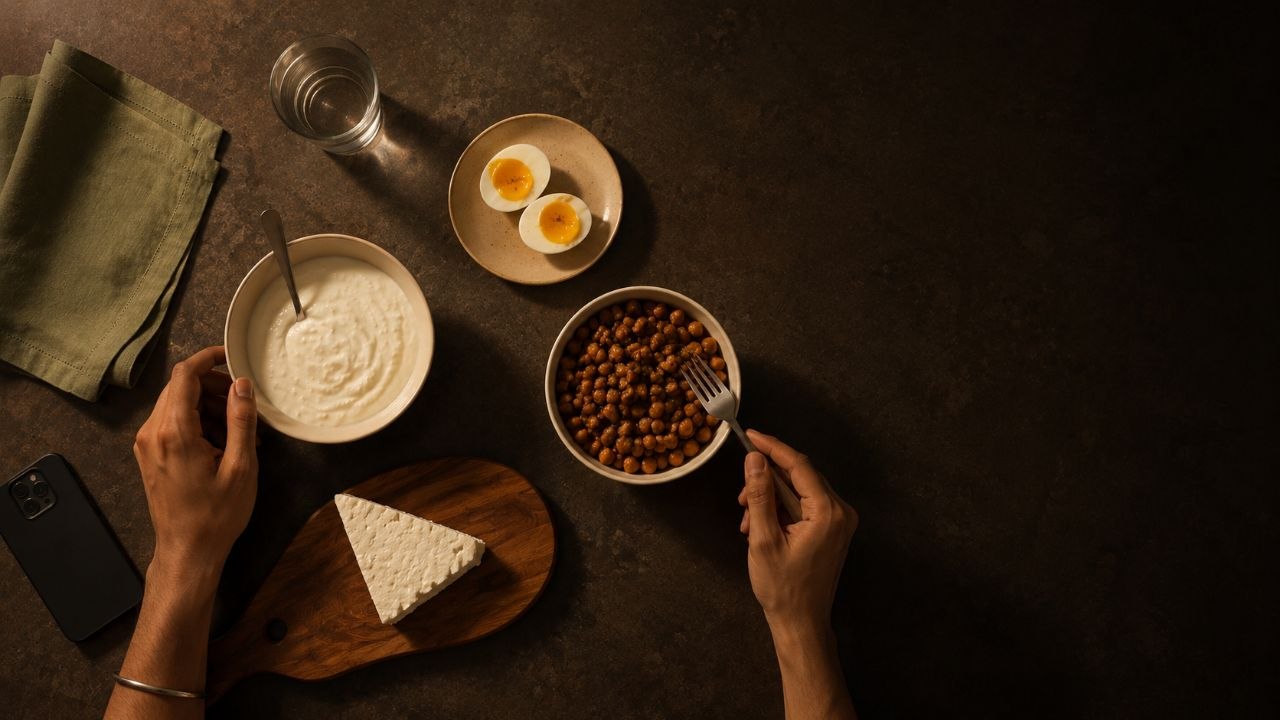
For fat loss with your muscle protected, aim for roughly 1.2 to 1.6 g of protein per kg of body weight a day, which for most adults lands between 80 and 120 g. That is the answer; the rest of this page is how to reach it in an Indian kitchen, and why it matters so much. One reason many calorie-restricted diets become hard to sustain is that the calories fall while the protein barely changes. Hunger rises, energy sags, and some of the weight lost can come from lean tissue instead of fat. Protein does not make a diet work by itself, but getting enough of it makes several parts of weight loss easier, and on an Indian plate it rarely happens by accident. This page gives you the actual numbers, and then does the harder, more Indian part of the job: showing you exactly where that protein comes from, whether your kitchen is vegetarian or not, and what it costs.
In brief
- For fat loss with muscle preserved, aim for roughly 1.2–1.6 g of protein per kg of body weight a day.
- Protein is the most filling macronutrient, costs the most energy to digest, and protects muscle in a deficit.
- Cereals are the largest single source of protein in Indian diets, which is why the target takes deliberate effort here.
- Vegetarians can absolutely hit the target; it usually takes more deliberate planning, because plant sources are less protein-dense.
- Soya, dal and eggs are among the cheapest protein sources; paneer and whey sit at the expensive end of everyday options.
- Powders are a convenience, never a requirement. In adults without kidney disease, trials have not shown consistent evidence of kidney harm from higher protein.
Why does protein decide how a diet goes? Copy link
Because it does three jobs at once, and each one attacks a different way diets fail.
The first job is hunger. Protein is the most satiating of the three macronutrients. In a small controlled feeding study of 19 adults over twelve weeks, raising protein from 15 to 30 per cent of calories increased satiety, and when the participants were then allowed to eat freely, their spontaneous intake fell by about 440 kcal a day.1 Nineteen people is a small trial, so treat 440 as an illustration rather than a promise; larger satiety studies point the same way. If your diets tend to collapse into evening raids on the kitchen, this is a mechanism worth having on your side.
The second job is a small metabolic edge. Digesting food itself burns calories, and protein is by far the most expensive to process. Around 20 to 30 per cent of its calories go into digestion and handling, against 5 to 10 for carbohydrate and nearly nothing for fat.2 In practice this will not transform anything on its own; stacked on top of the hunger effect, it tilts the same meal further in your favour.
The third job is the one that matters most and gets discussed least. In a calorie deficit, your body needs fuel and will take some of it from muscle unless given a reason to spare it. Across a meta-analysis of 24 trials, higher-protein deficits outperformed standard-protein ones at the same calories, and the margins were modest: about 0.8 kg more fat lost and about 0.4 kg less lean mass lost on average.3 Small numbers per trial, and they compound across every diet you ever run. Muscle is the tissue that burns calories at rest, holds your strength, and decides how you look at your goal weight; losing it is how a diet succeeds on the scale and fails everywhere else. For Indians this carries extra weight, because the thin-fat body type starts with less muscle to spare.4
How much protein do you actually need? Copy link
The official Indian recommendation, from ICMR-NIN, is 0.83 g per kg of body weight a day, and it answers a different question than the one you are asking. It is the RDA designed to meet the protein requirements of nearly all healthy adults; it was not designed to optimise lean-mass retention during intentional weight loss.5 The amount that supports fat loss while protecting muscle is higher, and the evidence base settles into a fairly tight band:
| Your situation | Daily protein |
|---|---|
| Healthy-adult RDA (ICMR-NIN baseline) | 0.83 g/kg |
| Active fat loss | 1.2–1.6 g/kg6,15 |
| Fat loss with regular resistance training | Around 1.6 g/kg is a sensible target; some lean, highly trained people may benefit from more7,8 |
In real numbers: a 60 kg person aiming at fat loss wants roughly 72–96 g a day; 70 kg, 84–112 g; 80 kg, 96–128 g. For many adults, 80–120 g a day is a practical working range, and the recent four-society advisory on nutrition during GLP-1 therapy offers the same span as a workable absolute approach.15 Body size, training, degree of excess weight and kidney health all move the answer, so let the g/kg target above lead, and treat any single absolute number as a starting point only. And if you carry substantial excess weight, calculating from actual body weight can overshoot the requirement; adjusted weight, target weight or lean mass may be more appropriate, which is a calculation worth doing with a doctor or dietitian.
Two situations change the arithmetic. If you are on a GLP-1 medicine, appetite falls so far that protein is usually the first casualty, at exactly the moment your body most needs it to limit lean-mass loss. Make protein a priority, eat the protein-rich part of the meal first when appetite is low, and pair it with resistance training, because protein alone does not fully protect muscle during weight loss.15 Our GLP-1 guide has the full picture. And if you have known kidney disease, diabetes, hypertension or an abnormal kidney-function result, set the target with a clinician first; our kidney function test guide explains the numbers involved.
Why does the Indian plate under-deliver? Copy link
Look at a typical thali with fresh eyes. The rice or rotis occupy half the plate. The dal, the only dedicated protein on it, is a small katori, perhaps seven grams’ worth. The sabzi, the curd, the salad and the pickle bring a few grams between them. The whole plate might carry 15 to 18 g of protein, and dinner will look the same. Add a breakfast of toast, poha or biscuits with chai, worth perhaps 5 to 8 g, and the day lands near 35 to 45 g, well under half of what a 75 kg adult dieting for fat loss needs. Notice where the biggest hole is: breakfast, which is exactly where this page will send you first.
The national data shows the same pattern, and it is fresh. In the ICMR-INDIAB dietary analysis of 18,090 adults, published in 2025, protein supplied about 12 per cent of daily energy, below the national guideline of 15, while carbohydrates supplied 62.3 per cent, among the highest shares in the world. In the same study, people in the highest carbohydrate-intake group had higher odds of metabolic disease than those in the lowest: an odds ratio of 1.30 for type 2 diabetes, 1.20 for prediabetes, 1.22 for generalised obesity and 1.15 for abdominal obesity. And in a separate substitution analysis, replacing 5 per cent of energy from carbohydrate with protein from plant, dairy, egg or fish sources was associated with lower odds of newly diagnosed diabetes or prediabetes.9 And in the 2023–24 household consumption survey, cereals remained India’s single largest protein source, contributing roughly 46 per cent of protein in rural diets and 39 per cent in urban ones.16 This, of course, is nobody’s personal failing; it is how the cuisine is built, with protein as a seasoning around a grain. The fix does not require abandoning Indian food. It requires reversing the order you build the plate in: decide the protein anchor first, then fit the roti and rice into what is left. Every practical instruction on this page is that one sentence, applied.
Does protein “quality” matter, or is that supplement-industry talk? Copy link
It matters a moderate, manageable amount, and here is the two-minute version. Proteins are built from amino acids, nine of which your body cannot make. Animal proteins, soya and dairy carry all nine in strong proportions. Most single plant proteins run short of one or two: cereals are low in lysine, pulses lower in methionine. Which sounds like a vegetarian problem until you notice what Indian food has done about it for a few thousand years. Dal with rice, rajma with chawal, chilla made of besan with curd: each pair fills the other’s gap, and eaten across the same day, mixed vegetarian sources add up to complete protein without any charts.5
So quality is a reason vegetarians should lean on variety, dairy and soya, and give the day’s total a small margin. What it is not is a reason to buy anything. A vegetarian eating 100 g from six mixed sources is better supplied than a non-vegetarian eating 60 g from chicken alone.
How can a vegetarian get 100 g of protein a day in India? Copy link
Start with the plain arithmetic: vegetarian sources are, as you know, less protein-dense, so the same target takes more deliberate slots in the day. Here is what the everyday foods actually deliver, in the portions you actually eat, using approximate values from IFCT 2017 and representative product data; brands and portions vary:10
| Food | Everyday portion | Protein (approx.) |
|---|---|---|
| Toor / moong dal, cooked | 1 katori | 7 g |
| Rajma / chana, cooked | 1 katori | 8 g |
| Paneer | 100 g | 18 g |
| Curd | 1 katori (150 g) | 5 g |
| Greek yoghurt / hung curd | 100 g | 10 g |
| Milk (toned) | 1 glass (250 ml) | 8 g |
| Soya chunks | 40 g dry (a small bowl cooked) | 20 g |
| Tofu | 100 g | 9 g |
| Besan chilla | 2, from 60 g besan | 12 g |
| Moong sprouts | 1 katori | 7 g |
| Peanuts / mixed seeds | a small handful (30 g) | 8 g |
| Sattu | 2 tbsp (30 g) in water or buttermilk | 6 g |
| Roti / rice | per roti or katori | 2–4 g |
Now assemble a day from it. Breakfast: besan or moong-dal chilla with a katori of curd, and a glass of milk or a sattu drink if mornings are rushed (about 25 g). Lunch: dal, a generous katori, with rice, sabzi and curd (about 15 g with the grain). Snack: roasted chana or sprouts with a buttermilk (about 8 g). Dinner: a soya-chunk curry or 100 g of paneer with two rotis and sabzi (about 25–28 g). A handful of peanuts somewhere in the day (8 g). That is roughly 80–85 g without a single unfamiliar food on the plate. To reach about 100 g, add another 15 to 20 g from a denser source: more soya, a larger serving of hung curd, extra paneer, or a scoop of whey if convenience matters. The figure below shows one complete 100 g vegetarian version beside a non-veg equivalent.
Three upgrades do most of the work for vegetarians. Swap plain curd for hung curd or Greek yoghurt, doubling the protein in the same bowl. Keep soya chunks in the kitchen; at roughly half protein by dry weight they are one of the most protein-dense common vegetarian staples, and they take up masala like they were designed for it. And give breakfast a protein anchor, because cereal-and-toast mornings are where Indian vegetarian days quietly lose 20 g they never recover.
Does soya raise oestrogen in men, or harm the thyroid? Copy link
Since this page has just asked you to keep soya in the kitchen, you deserve the answers to the two questions that always follow it in India. On hormones: soya contains isoflavones, plant compounds that weakly resemble oestrogen, and the fear writes itself. The trial evidence does not support it. A meta-analysis of 41 clinical studies found that neither soy nor isoflavone intake meaningfully changed testosterone or oestrogen levels in men.12 Soya chunks at dinner will not change your hormones; they will change your protein intake.
On the thyroid: in people with normal thyroid function, a meta-analysis of 18 trials found soy had no significant effect on the thyroid hormones themselves, with only a small rise in TSH of doubtful clinical relevance.13 The one practical rule applies to people on levothyroxine: soya can reduce the tablet’s absorption, so the European Thyroid Association’s 2025 guideline advises taking levothyroxine at least four hours before soy,14 and if your dose has been stable, a routine thyroid test will confirm nothing has drifted.
How do non-vegetarians hit the target? Copy link
Yours is a shorter section, because your sources are denser and the assembly is easier:
| Food | Everyday portion | Protein (approx.) |
|---|---|---|
| Eggs | 1 whole | 6–7 g |
| Chicken (breast or lean cuts) | 100 g raw weight | 22 g |
| Fish (rohu, surmai, pomfret) | 100 g | 18–22 g |
| Prawns | 100 g | 19 g |
| Lean mutton (occasional) | 100 g | 18–20 g |
The pattern: eggs at breakfast, a palm-sized portion of chicken or fish at lunch and dinner, and the day is nearly done before dal and curd add their share. Two things keep it working for fat loss. Cook lean: tandoori, grilled, curry with measured oil, rather than deep-fried or butter-heavy, because a fried protein anchor smuggles in more calories than it saves you in hunger. And keep the vegetarian table above in play anyway; dal, curd and paneer are what carry the days when the non-veg option is unavailable, expensive, or simply not what the family is cooking.
What does protein cost? The efficiency question Copy link
For most Indian households the real constraint on protein is the grocery bill, so let us treat cost as a first-class question. The figure below prices 10 g of protein from common sources at typical retail prices; your city and brand will move the numbers, and they rarely change the order.
The same numbers in words, since they are worth quoting: at typical 2026 retail prices, 10 g of protein costs roughly ₹3 from soya chunks, ₹8 from eggs, ₹8 from toor dal, ₹12 from chicken, ₹18 from milk, ₹22 from paneer and about ₹23 from whey. Your city and brand will move every figure; the order almost never changes, and it is the order that should shape your shopping list.
The same logic applies to calories, which are the other budget you are spending. Per 100 kcal, chicken breast, egg whites, soya chunks and hung curd deliver the most protein; paneer, whole eggs and nuts deliver good protein wrapped in substantial fat, fine in measured portions and easy to overspend. A useful rule for a fat-loss plate: at least one source per meal from the high-protein-per-calorie group, with the richer sources as the supporting cast.
Where does whey fit, and do you need it? Copy link
Nobody needs protein powder to lose weight, and this page would be shorter if more people believed it. What a scoop of whey is, stripped of the marketing, is roughly 24 g of complete dairy protein for around ₹50–60, which prices it near paneer per gram of protein, mixing into milk or water in thirty seconds. That earns it exactly one role: convenience, for the slots where whole food keeps failing you, the rushed breakfast, the post-workout gap, the vegetarian day stuck at 70 g by dinner.
If you do buy one: whey concentrate is the sensible default; isolate contains less lactose and may suit people with lactose sensitivity, at a higher price, without being better for weight loss; plant blends (pea plus rice) work for the dairy-free at a slightly higher price per gram. Check the label for protein per serving above 20 g and sugar below 3 g, buy from a large established brand through its official channel, and skip anything promising “mass gain,” fat burning, or herbs. A powder is groceries, and it should be judged like groceries. One India-specific reason the buying rules matter: a 2024 laboratory analysis of 36 popular protein supplements sold in India found that 25 contained less protein than advertised, while some samples contained detectable aflatoxins, pesticide residues or heavy metals.17 That study was small and was not designed to estimate how widespread poor quality is across the whole Indian market. It is still a good reason to avoid complex “herbal” blends, buy through authorised channels to reduce counterfeit risk, and treat label claims with some scepticism.
Your first week, in five moves Copy link
Do not redesign your diet on a Monday. Add these, in order, and let each settle for a day or two:
- Give breakfast an anchor. Eggs, chilla, hung curd, or a sattu drink. This one move typically adds 15–20 g to the day.
- Double the dal. A proper katori at both meals, not the ceremonial ladle. Costs almost nothing, adds 7 g per meal.
- Upgrade the curd. Hung curd or Greek yoghurt wherever plain curd sat.
- Plan two soya or paneer dinners. The dense sources belong at the meal where hunger peaks.
- Count for three days. Not forever; just long enough to see where your day actually stands. Most people find they were at half their target, and that discovery does more than any lecture.
Then judge the effect the fair way, on a fortnight of evenings: less hunger at night, steadier energy, and, with the deficit and some resistance work in place, a waist that moves. The deficit itself is the other half of this machine, and our calorie deficit guide is where the two halves meet; the fat you want it pulling from is the subject of our pages on belly fat and visceral fat.
What about kidneys, gas and eating too much? Copy link
“Will this much protein damage my kidneys?” In adults without chronic kidney disease, randomised trials have not shown consistent evidence of kidney injury from higher-protein diets, although most trials are relatively short and long-term data are more limited.11 The caveat runs the other way: if you have known kidney disease, diabetes, hypertension, persistent albumin in the urine, an abnormal kidney-function result or another reason to suspect kidney trouble, set the target with a clinician first.
“Doesn’t protein heat the body?” The warmth some people notice after high-protein meals is the digestion cost from the first section doing its work; it is a feature, and it is not harm. No property of dal, eggs or chicken changes with the season.
“Dal and beans give me gas.” Common, and mostly fixable: soak pulses well, cook them fully soft, build the quantity up gradually over two weeks, and add hing and jeera the way your grandmother already did. Sprouting and pressure-cooking help further.
“Can I eat too much protein?” For most adults, evidence of extra fat-loss benefit above the 1.2–1.6 g/kg range is limited; higher intakes are mainly relevant to lean, resistance-trained people in a deficit, and the four-society advisory cautions against sustained intakes at or above 2 g/kg outside that context.15 Protein calories still count, so a fourth scoop of whey is mostly expensive calories. The advisory also marks the other edge: intakes drifting down toward 0.4–0.5 g/kg are the genuinely risky zone, and needs rise rather than fall with age, which matters for the parents and grandparents at your table. In India, though, the common failure is under, not over.
Protein questions, answered Copy link
How much protein do I need per day to lose weight?
Roughly 1.2 to 1.6 g per kg of body weight, which for a 70 kg adult means about 84 to 112 g a day; around 1.6 g/kg is a sensible target if you also do regular resistance training. For many adults that lands in a practical range of 80 to 120 g. People with kidney disease should set targets with a doctor.
Can vegetarians get enough protein for weight loss in India?
Yes, without any unusual foods. A day built on dal at both meals, paneer or soya chunks at dinner, hung curd, a besan or moong-dal chilla breakfast, milk and a handful of peanuts reaches 90 to 100 g. It often takes more deliberate protein opportunities across the day than a diet built around eggs, fish or lean meat, because most plant foods carry less protein per portion.
Is dal enough protein by itself?
No. A katori of cooked dal carries about 7 g, so dal alone would take a dozen katoris to reach a fat-loss target. Dal is the base; paneer, soya, curd, milk, eggs or meat have to supply the density. Pairing dal with rice or roti also completes its amino-acid profile.
Which vegetarian food has the most protein?
Soya chunks, by a wide margin: around half their dry weight is protein, so a 40 g dry portion delivers about 20 g. After soya come paneer (about 18 g per 100 g), hung curd or Greek yoghurt (about 10 g per 100 g), and pulses at 7 to 8 g per cooked katori.
Do I need protein powder to lose weight?
No. Whey is a convenience that delivers about 24 g of complete protein per scoop for the slots where whole food is impractical, such as rushed mornings or after workouts. If your meals already reach your target, a powder adds nothing but cost.
Is a high-protein diet safe for kidneys?
In adults without chronic kidney disease, randomised trials have not shown consistent evidence of kidney injury from higher-protein diets, though long-term data are more limited. Anyone with known kidney disease, diabetes, hypertension, protein in the urine or an abnormal kidney result should set targets with a clinician.
What should I eat for protein at breakfast?
The Indian options are strong: eggs any style, besan or moong-dal chilla, hung curd with fruit, a sattu drink, sprouts, or milk with a scoop of whey on rushed days. Breakfast is often the easiest meal to upgrade, so giving it a protein anchor can make the daily target much easier to reach.
Does protein reduce belly fat specifically?
No food targets belly fat. Protein helps you hold a calorie deficit with less hunger and makes the weight you lose come more from fat than muscle; the belly shrinks as total body fat falls. Where the fat leaves first is set by your body, and the deep abdominal fat tends to fall proportionally faster.
How much protein is there in paneer, eggs and chicken?
Approximate values: paneer carries about 18 g per 100 g, one whole egg 6 to 7 g, and chicken about 22 g per 100 g raw weight. Fish gives 18 to 22 g per 100 g, cooked dal about 7 g per katori, a glass of toned milk 8 g, and soya chunks about 20 g per 40 g dry.
References Copy link
- Weigle DS, Breen PA, Matthys CC, et al. A high-protein diet induces sustained reductions in appetite, ad libitum caloric intake, and body weight despite compensatory changes in diurnal plasma leptin and ghrelin concentrations. Am J Clin Nutr. 2005;82(1):41-48. doi:10.1093/ajcn/82.1.41
- Westerterp KR. Diet induced thermogenesis. Nutr Metab (Lond). 2004;1(1):5. doi:10.1186/1743-7075-1-5
- Wycherley TP, Moran LJ, Clifton PM, Noakes M, Brinkworth GD. Effects of energy-restricted high-protein, low-fat compared with standard-protein, low-fat diets: a meta-analysis of randomized controlled trials. Am J Clin Nutr. 2012;96(6):1281-1298. doi:10.3945/ajcn.112.044321
- Kapoor N, Lotfaliany M, Sattar N, et al. Thin Fat Obesity: The Tropical Phenotype of Obesity. In: Feingold KR, et al., eds. Endotext. South Dartmouth (MA): MDText.com; 2021. NBK568563
- Indian Council of Medical Research – National Institute of Nutrition. Nutrient Requirements for Indians: Recommended Dietary Allowances and Estimated Average Requirements. Hyderabad: ICMR-NIN; 2020.
- Leidy HJ, Clifton PM, Astrup A, et al. The role of protein in weight loss and maintenance. Am J Clin Nutr. 2015;101(6):1320S-1329S. doi:10.3945/ajcn.114.084038
- Phillips SM, Van Loon LJC. Dietary protein for athletes: from requirements to optimum adaptation. J Sports Sci. 2011;29(Suppl 1):S29-S38. doi:10.1080/02640414.2011.619204
- Morton RW, Murphy KT, McKellar SR, et al. A systematic review, meta-analysis and meta-regression of the effect of protein supplementation on resistance training-induced gains in muscle mass and strength in healthy adults. Br J Sports Med. 2018;52(6):376-384. doi:10.1136/bjsports-2017-097608
- Anjana RM, Sudha V, Abirami K, et al. Dietary profiles and associated metabolic risk factors in India from the ICMR-INDIAB survey-21. Nat Med. 2025;31:3813-3824. doi:10.1038/s41591-025-03949-4
- Longvah T, Ananthan R, Bhaskarachary K, Venkaiah K. Indian Food Composition Tables. Hyderabad: ICMR-National Institute of Nutrition; 2017.
- Devries MC, Sithamparapillai A, Brimble KS, Banfield L, Morton RW, Phillips SM. Changes in kidney function do not differ between healthy adults consuming higher- compared with lower- or normal-protein diets: a systematic review and meta-analysis. J Nutr. 2018;148(11):1760-1775. doi:10.1093/jn/nxy197
- Reed KE, Camargo J, Hamilton-Reeves J, Kurzer M, Messina M. Neither soy nor isoflavone intake affects male reproductive hormones: an expanded and updated meta-analysis of clinical studies. Reprod Toxicol. 2021;100:60-67. doi:10.1016/j.reprotox.2020.12.019
- Otun J, Sahebkar A, Östlundh L, Atkin SL, Sathyapalan T. Systematic review and meta-analysis on the effect of soy on thyroid function. Sci Rep. 2019;9(1):3964. doi:10.1038/s41598-019-40647-x
- Centanni M, Duntas L, Feldt-Rasmussen U, et al. ETA guidelines for the use of levothyroxine sodium preparations in monotherapy to optimize the treatment of hypothyroidism. Eur Thyroid J. 2025;14(4):e250123. doi:10.1530/ETJ-25-0123
- Mozaffarian D, Agarwal M, Aggarwal M, et al. Nutritional priorities to support GLP-1 therapy for obesity: a joint Advisory from the American College of Lifestyle Medicine, the American Society for Nutrition, the Obesity Medicine Association, and The Obesity Society. Obesity (Silver Spring). 2025;33(8):1475-1503. doi:10.1002/oby.24336
- National Sample Survey Office, Ministry of Statistics and Programme Implementation. Nutritional Intake in India: Household Consumption Expenditure Survey 2023–24. New Delhi: Government of India; 2025.
- Philips CA, Theruvath AH, Ravindran R, Chopra P. Citizens protein project: A self-funded, transparent, and concerning report on analysis of popular protein supplements sold in the Indian market. Medicine (Baltimore). 2024;103(14):e37724. doi:10.1097/MD.0000000000037724
This article is for information and education and does not replace a consultation with a doctor or dietitian who knows your history. Protein targets given here are for healthy adults; people with kidney disease, liver disease, or who are pregnant should set intake with a clinician. Food values are approximate and portion-dependent; prices are illustrative. Consultations on Sapiens are provided by registered medical practitioners under the Telemedicine Practice Guidelines 2020. To report an error, write to editorial@joinsapiens.in.
Written by Dr. B. Akash Reddy, MBBS · Registered medical practitioner (TSMC/FMR/33901) at Sapiens · Published 30 August 2026 · Editorial standards · Report an error on this page