Labs & Reports · Urine tests
Urine Routine Test: Normal Range, Pus Cells and Price in India
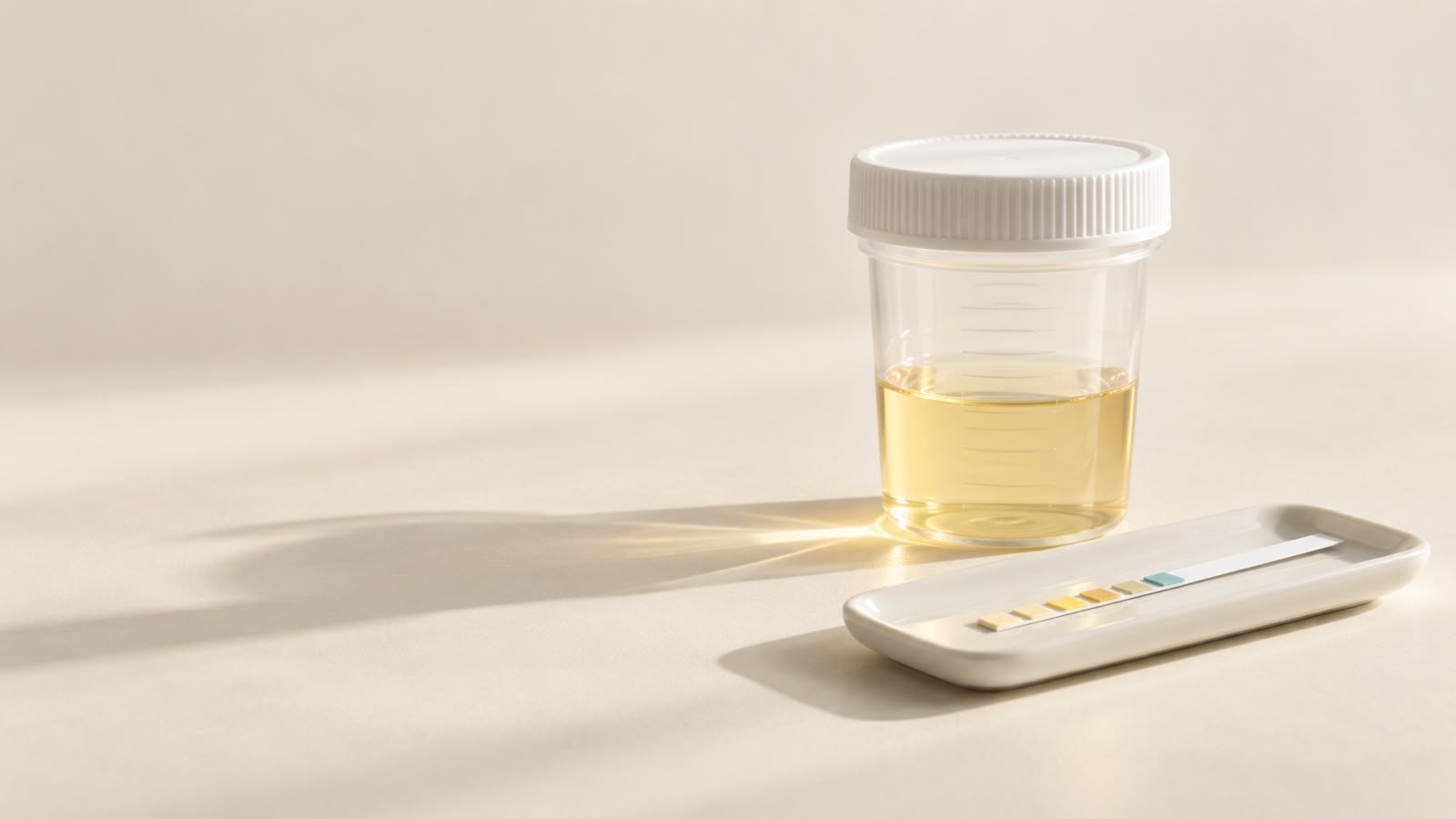
On a normal urine routine test, pH is 4.5 to 8, specific gravity is 1.005 to 1.030, while the strip reads nil for protein, sugar, ketones, blood and nitrite.1, 2 Pus cells stay at 0 to 5 per high-power field.1, 2 The test reads one sample by eye, by chemical strip and under a microscope.3
A urine routine test raises flags and leaves the cause to other tests. Pus cells above 5 can come from a badly caught sample as well as from an infection. A strip that reads nil for protein can still miss an early leak of albumin, the main blood protein, and in a survey of 20,759 adults it flagged fewer than half of them.4
What is a urine routine test? Copy link
A urine routine test checks one urine sample three ways. One cup covers all three. The laboratory records its color and clarity, dips a chemical strip into it, then looks at a drop of the sediment, the solid part that settles, under a microscope.3, 1
The same test goes by several names. Urine R/M stands for routine and microscopy, urine R/E for routine examination, and CUE for complete urine examination.5 Doctors also call it urinalysis. Whichever name is on your form, the sample and the report are the same.
The strip is a thin plastic stick with a row of small pads. Each pad changes color for one thing, among them pH (acidity), specific gravity (how concentrated the urine is), protein, glucose, ketones, blood, bilirubin, urobilinogen, nitrite and leukocyte esterase, an enzyme released by white blood cells.1
Doctors use the result to look for urinary infection, kidney disease, kidney stones and poorly controlled diabetes, and it is also the urine panel inside most health checkup packages.3 So what can one small cup tell you? Quite a lot, provided you know which lines to trust.
Urine routine test normal range Copy link
The urine routine test normal range is a list of expected results, one for each line of your report. Most lines should read nil or negative. The numbered ones are specific gravity, pH, urobilinogen and the cell counts.1
| Line on the report | Normal result | What commonly shifts it |
|---|---|---|
| Color | Pale yellow to deep amber1, 7 | B complex vitamins, rifampin, beets, dehydration |
| Appearance | Clear1, 7 | Infection, crystals, contamination |
| Specific gravity | 1.005 to 1.0302, 1 | How much water you drank; glucose in urine |
| pH | 4.5 to 81, 6 | Diet; a sample that stood too long reads alkaline |
| Protein | Nil or trace2, 1 | Exercise, fever, dehydration, kidney disease |
| Glucose (sugar) | Nil1, 8 | Blood glucose above about 180 mg/dL; SGLT2 inhibitor medicines |
| Ketones | Nil1 | Fasting, carbohydrate-free diets, fever, pregnancy |
| Bilirubin | Nil1 | Liver disease, blocked bile duct |
| Urobilinogen | 0.1 to 1 mg/dL1 | Liver disease, faster breakdown of red cells |
| Blood | Nil1, 3, 9 | Periods, infection, stones; vitamin C can hide it |
| Nitrite | Negative1, 10 | Some bacteria; often negative despite infection |
| Leukocyte esterase | Negative1 | White cells in urine; contamination |
| Pus cells (WBC) | 0 to 5 per HPF1, 2 | Infection, other inflammation, contamination |
| Red cells (RBC) | 0 to 2 per HPF6, 11 | Periods, infection, stones; 3 or more needs a recheck |
| Squamous epithelial cells | Up to 15 to 20 per HPF1, 6 | A sample that picked up skin cells |
| Hyaline casts | 0 to 5 per LPF1, 6 | Concentrated urine |
| Crystals | None or occasional6, 1 | Urine acidity, time before testing |
| Bacteria, yeast | Absent1, 6 | Infection or contamination |
Printed ranges differ a little between laboratories, as they do across lab test results generally. One reference prints specific gravity as 1.005 to 1.030, a second as 1.005 to 1.025, and a third gives the full span a healthy kidney can produce, 1.002 to 1.035.2, 6, 1 Red cells show the same spread, from 0 to 2 per high-power field in one reference to 0 to 5 in another.6, 1
Your own report comes first. Check your result against the range printed beside it, which reflects the method your laboratory used.
How to read a urine routine test report Copy link
Read a urine routine test report in three blocks, in the order they are printed. Physical examination comes first, then chemical examination, then microscopy. Take each block in turn.
The wording is shorthand. Nil, negative and absent all mean the laboratory found none, trace means the pad barely changed color, and the plus signs from + to ++++ mean progressively more. A strip result is a rough grade, which is why kidney guidelines ask for a measured laboratory value once a strip turns positive.12
In the microscopy block, /HPF means per high-power field, the round patch of the slide seen through the strong lens, while /LPF means per low-power field and is used for casts.1 Some laboratories write few or plenty where others print a number.
One abnormal line is a prompt to confirm. Blood on the strip needs a microscope count before it means anything, and albumin has to be raised in two of three samples over three to six months.11, 13 In practice, a repeat on a well-collected morning sample settles many surprises. Keep your symptoms in view as you read, because the same result means different things with and without them.
Pus cells in urine: normal range and what a high count means Copy link
Pus cells in urine are white blood cells, and the normal range is 0 to 5 per high-power field.1, 2 A higher count is called pyuria, meaning white cells in urine. It signals inflammation somewhere in the urinary tract, whether or not infection is present.
Pus cells are better at ruling infection out than at ruling it in. When the count is normal, a urinary infection becomes unlikely in most groups of patients.10 When the count is high, the chance that infection is the cause stays low, because many non-infectious kinds of inflammation raise it too.10 A contaminated sample does the same.1 Plainly, the count cannot tell these apart.
How much does the exact number tell you? Less than you might hope. A 2023 study compared 164 women aged 65 or older, some with a confirmed urinary infection and some without, and the usual cut-off of 10 white cells per microliter caught every infection. Its specificity, the share of uninfected women it correctly cleared, was 36%, so about two in three women without an infection were flagged as well.14 Moving the line to 264 per microliter raised specificity to 88% while still catching 88% of infections.14
More than 90% of the women who carried bacteria without any symptoms had pus cells too.14 Pus cells alone settle little. The study was small and limited to older women, so its cut-off should not be applied to everyone.
So how do you read 8 to 10 pus cells? Symptoms decide the reading. With urinary symptoms such as burning or urgency, the count supports a urinary infection, and a urine culture can identify the organism when one is needed. With no symptoms at all, it may simply reflect the sample, and the sensible next step is a repeat after a careful midstream catch.
Epithelial cells in urine: what few or many means Copy link
Epithelial cells in urine are lining cells shed from the skin and the urinary passage, and a few on a report are normal. The usual kind is squamous, the flat cells from the skin around the opening, and references put the upper limit at 15 to 20 squamous cells per high-power field.1, 6
A high squamous count tells you about the collection more than about your health. Skin cells washed into the cup. Whatever else was on the skin came with them. In an analysis of 19,328 patient records, the urine report predicted bacteria less well when the squamous count was high.15 The same analysis found squamous cells a poor predictor of a contaminated culture, so laboratories treat the count as a caution and no more.15
The report may name other cells. Transitional cells come from the bladder lining and can be normal. Renal tubular cells come from the kidney itself, and a report that names them deserves a doctor's review.1
Protein, sugar and ketones in urine Copy link
Protein, sugar and ketones should all read nil on a urine routine test, though trace protein is accepted as normal.2 Healthy kidneys pass 150 mg of protein or less in a day.1 The protein pad responds mainly to albumin, the main protein in blood.1
A trace or single plus of protein is often temporary. Strenuous exercise, fever, dehydration, emotional stress and long hours on your feet can each push protein into one sample, and very concentrated or alkaline urine can turn the pad positive by itself.1 Try it again on a first-morning sample before you read anything into it.
Sugar appears once blood glucose rises above the kidney's threshold for reclaiming it, commonly quoted at about 180 mg/dL, so a positive pad points back to your fasting and after-meal blood sugar and to an HbA1c check.1 One group of medicines produces the result on purpose. SGLT2 inhibitors, used for diabetes, push glucose out through urine, and the US prescribing information for one of them states that urine glucose tests will read positive on treatment.8 The pad will, of course, stay positive for as long as you take one.
Ketones are what your body makes when it burns fat in place of carbohydrate. Context decides what they mean. They appear after fasting, on carbohydrate-free diets, during a fever and in pregnancy.1 In someone with diabetes, ketones together with nausea, vomiting, abdominal pain or shortness of breath can signal diabetic ketoacidosis.8 Blood sugar does not have to be very high. On an SGLT2 inhibitor it can be below 250 mg/dL when ketoacidosis presents.8 Suspected ketoacidosis needs urgent medical care.
What does blood or RBC in urine mean? Copy link
Red blood cells in urine are normal at 0 to 2 per high-power field in a standard reference, and 3 or more is the point at which urologists look further.6, 11 The American Urological Association calls that finding microscopic hematuria, meaning blood seen only under a microscope, when it is counted on a single properly collected sample.11, 16
The strip and the microscope do not always agree. The blood pad reacts to hemoglobin and to myoglobin, a protein from muscle, so it can turn positive when no red cells are present.1 A positive pad needs checking. At least 20% of positive strips show no red cells on microscopy, and the guideline asks for a microscope count before any further testing.16, 11
The pad can also miss real blood. Vitamin C is one reason. It interferes with the pad's chemistry. In a laboratory audit of 27,856 urine samples, 10.2% contained measurable vitamin C, and the authors warned that blood in those samples could go undetected.9 Note it on your form if you take a vitamin C supplement.
Periods are the everyday explanation. Menstrual blood mixes into the sample, and the advice is to repeat the test once the bleeding has stopped.11 A urinary infection can also put red cells in urine, and the test is repeated after treatment to confirm they have gone.11
Red cells that persist with no such explanation are assessed by risk. Under the 2025 guideline, more than 25 red cells per field or a smoking history above 30 pack-years places a person in the high-risk group.11 Men aged 60 or older are high-risk by age, while women aged 60 or older are intermediate-risk, and the guideline states that age alone should not move a woman into the high-risk group.11
Does bacteria or nitrite in urine mean infection? Copy link
Bacteria or a positive nitrite on a urine routine test point toward infection without confirming it. Diagnosis rests mainly on your symptoms, and the report supports or weakens that picture.10
Nitrite forms when certain bacteria convert the nitrate that urine normally carries. A positive pad is dependable, with specificity of 92 to 100%. A negative pad proves little. Its sensitivity, the share of infections it catches, is 19 to 48%.10 Timing explains part of that. The bacteria need about four hours in the bladder to make enough nitrite, and some species make none.1
A clean strip is more reassuring. A pooled analysis of 72 studies concluded that a strip negative for both nitrite and leukocyte esterase is useful for excluding infection.17
Bacteria seen under the microscope are, as you would expect, less meaningful when the sample was poorly caught.1 Bacteria with no symptoms have their own name, asymptomatic bacteriuria, and the infectious-disease guideline advises against antibiotics for it in healthy women who are not pregnant, in older people and in people with diabetes.18 Pregnancy reverses that advice. Doctors screen for it then, and treat it.18
Can a normal urine routine test miss kidney damage? Copy link
Yes. A normal urine routine test can miss early kidney damage, because the protein pad is too coarse to pick up a small albumin leak. The strip has a blind spot.
Kidney guidelines grade that leak with a ratio of urine albumin to creatinine, shortened to ACR. Below 30 mg/g is category A1, normal to mildly increased, from 30 to 300 mg/g is A2, moderately increased, and above 300 mg/g is A3, severely increased.12 The A2 band is the early warning, and it is the band the strip handles worst.
In a Korean national survey of 20,759 adults, a strip reading of trace or above flagged 43.6% of the people whose ACR was 30 mg/g or more.4 More than half were missed. For an ACR above 300 mg/g, a strip reading of 1+ or more caught 75.4%.4 Large leaks are easier to see. These were Korean adults tested on a single occasion, so the exact percentages may not carry over to India.
This is why the 2024 kidney guideline lists the ACR as its first choice for testing and asks that a positive strip be confirmed by a measured ratio.12 Diabetes standards ask for a urine ACR together with eGFR, a blood estimate of kidney filtering, at least once a year in everyone with type 2 diabetes and in type 1 diabetes of five years or longer.13
The target is common in India. A 2025 pooled analysis of 14 Indian studies covering 35,992 people with type 2 diabetes put diabetic kidney disease at 44%, with a wide margin of error that ran from 31 to 56%.19 A separate pooled review estimated chronic kidney disease in 16% of the Indian general population.20
If you are being treated for diabetes or high blood pressure, ask your doctor whether a urine ACR belongs next to your creatinine and eGFR report. A single raised ACR needs confirming too. Exercise within the previous 24 hours, fever, infection, a period and very high blood sugar can each lift it for a while.13
What do casts and crystals in urine mean? Copy link
Casts are tiny cylinders formed inside the kidney's tubules, and crystals are minerals that have settled out of the urine. A report with hyaline casts or a few crystals is often normal. The type decides the meaning.
Hyaline casts, the clear kind, are accepted up to 5 per low-power field, particularly in concentrated urine.1, 6 Other casts carry more weight. Red cell casts and white cell casts are linked to disease within the kidney, including kidney infection and glomerulonephritis, an inflammation of the kidney's filters, and they need prompt medical review.1
Calcium oxalate is the crystal seen most often, and it can be a normal finding.1 Uric acid crystals form in acid urine. Triple phosphate crystals form in alkaline urine, sometimes alongside infection with certain bacteria.1 Because crystals can be normal, their presence alone does not establish a kidney stone.
Bilirubin and urobilinogen in urine Copy link
Normal urine contains no bilirubin, and urobilinogen stays between 0.1 and 1 mg/dL.1 Bilirubin is a yellow pigment left when the body recycles worn-out red cells, and urobilinogen is what gut bacteria make from it.1 When bilirubin reaches the urine, the usual sources are liver disease or a blocked bile duct, and the next step is a blood liver function panel.1
Raised urobilinogen is seen with liver disease and with conditions that break red cells down faster than usual, thalassemia among them.1 Dark brown urine that stays clear can be a sign of a liver disorder.7 Show it to a doctor.
How to give a urine sample for a routine test Copy link
Give a midstream sample from your first urine of the morning, in the container the laboratory supplies, and hand it over as soon as you can. No fasting is needed.5
First-morning urine is the preferred sample in both laboratory and kidney guidance.1, 12 Midstream means you pass the first part into the toilet, stop, then catch the next part in the cup until it is about half full.21 Between 15 and 30 mL is enough.1
Timing matters as well. Ideally the sample is examined within an hour of collection.1 If testing will be delayed, follow the storage instructions your laboratory gives you. European laboratory guidance sets separate preservation criteria for the chemical strip, for cell counts and for culture, so no single storage rule covers the whole test.22 Urine that has stood too long turns alkaline, and stale specimens are the most common reason for a high pH on a report.1
Avoid giving the sample during your period where you can, since menstrual blood can turn the blood line positive.2, 11 Skip strenuous exercise the day before, because it can put protein into the sample.1, 13 Either can mislead the strip. Tell the laboratory about your medicines and supplements too, because B complex vitamins can turn urine dark yellow or orange, rifampin turns it orange, and beets can turn it red.7
Urine routine test price in India Copy link
The urine routine test price in India has one public benchmark, the rate the Central Government Health Scheme pays laboratories for its members. From 13 October 2025 that rate is ₹100 in a Tier I city at a laboratory holding NABL or NABH accreditation, and ₹85 at one without it.23 In Tier II cities the scheme pays 10% less, and in Tier III cities 20% less.23
The same rate list prices the urine ACR at ₹152 and urine microalbumin at ₹243, both at the accredited Tier I rate.23
Private list prices fall in a similar band. On 30 September 2026, the public booking pages of two large providers listed the test at ₹99 to ₹199 depending on the city, with reports promised in 7 to 24 hours.5 Treat those figures as a snapshot. Confirm the amount when you book.
When to see a doctor about a urine test report Copy link
See a doctor promptly if you can see blood in your urine, or if it is pink, red or smoky brown and food or medicine does not explain the color.7
Contact a doctor right away for burning or urgency that comes with fever, chills, vomiting, or pain in your back or side, since these can be signs of a kidney infection.24 Do the same if you are pregnant and your report shows bacteria or nitrite.18
Book a routine appointment for protein that is still present on a repeat morning sample, or for red cells of 3 or more per field once a period or infection has passed.11 Do the same for any report that mentions red cell casts, white cell casts or renal tubular cells.1 Take the report with you. Bring a list of your medicines as well.
Frequently asked questions Copy link
What is the normal range of pus cells in urine?
The normal range of pus cells in urine is 0 to 5 per high-power field. Pus cells are white blood cells. A higher count shows inflammation in the urinary tract and can also come from a poorly collected sample, so it is read together with your symptoms and often repeated.
Is fasting required for a urine routine test?
No. A urine routine test needs no fasting. A midstream sample from the first urine of the morning is preferred, delivered to the laboratory as soon as possible. If the urine test is booked along with fasting blood tests, follow the fasting instructions given for those.
Can I give a urine sample during my period?
It is better to wait where you can. Menstrual blood mixes with the sample and can turn the blood line positive when the urinary tract is normal. If the test cannot wait, let the laboratory and your doctor know that you were menstruating.
How is a urine routine test different from a urine culture?
A urine routine test screens the sample with a chemical strip and a microscope, and it can only suggest infection. A urine culture grows any bacteria in the sample, names them and tests which antibiotics work against them. A culture is not needed for every simple bladder infection in a healthy adult who is not pregnant. It matters most in pregnancy, in suspected kidney infection and in complicated or recurrent infections.
Does trace protein in urine mean kidney disease?
Usually it does not. Trace protein is often temporary and can follow exercise or fever, or come from a very concentrated sample. It is rechecked on a first-morning sample. Protein that persists, or any protein in someone who has diabetes or raised blood pressure, is followed up with a urine ACR, the ratio of albumin to creatinine.
How long does a urine routine test report take?
Most reports are ready within a day. Public booking pages checked on 30 September 2026 promised results in 7 to 24 hours. The analysis itself is quick, since urine is best examined within an hour of collection, and a delayed sample should be stored as the laboratory instructs.
What is the urine routine test price in India?
The Central Government Health Scheme pays ₹100 for a urine routine test in Tier I cities when the laboratory is accredited and ₹85 when it is not, under rates effective 13 October 2025. Private booking pages checked on 30 September 2026 listed ₹99 to ₹199.
References Copy link
- Queremel Milani DA, Jialal I. Urinalysis. In: StatPearls. Treasure Island (FL): StatPearls Publishing. Last update 1 May 2023. NCBI Bookshelf NBK557685.
- Urinalysis. Cleveland Clinic. Last reviewed 3 July 2024.
- Urinalysis. MedlinePlus Medical Encyclopedia, US National Library of Medicine. Reviewed 1 January 2025.
- Park JI, Baek H, Kim BR, Jung HH. Comparison of urine dipstick and albumin:creatinine ratio for chronic kidney disease screening: A population-based study. PLoS One. 2017;12:e0171106. doi:10.1371/journal.pone.0171106
- Published list prices, reporting times and preparation instructions for the urine routine test, taken from the public booking pages of two Indian diagnostic providers on 30 September 2026. Individual provider pages are held in the Sapiens editorial ledger and are not reproduced here. Prices change; see editorial standards.
- Lerma EV. Urinalysis. Medscape Drugs & Diseases, Laboratory Medicine. Updated 21 June 2022.
- Urine - abnormal color. MedlinePlus Medical Encyclopedia, US National Library of Medicine. Reviewed 1 July 2025.
- FARXIGA (dapagliflozin) tablets, prescribing information. AstraZeneca. DailyMed, US National Library of Medicine. Revised October 2024. Section 5.1, ketoacidosis; section 7, Positive Urine Glucose Test.
- Nikolac Gabaj N, Miler M, Unic A, Milevoj Kopcinovic L, Vrtaric A, Culej J. Ascorbic acid in urine still compromises urinalysis results. Ann Clin Biochem. 2020;57(1):64–68. doi:10.1177/0004563219882051
- Nelson Z, et al. Guidelines for the Prevention, Diagnosis, and Management of Urinary Tract Infections in Pediatrics and Adults: A WikiGuidelines Group Consensus Statement. JAMA Netw Open. 2024;7(11):e2444495. Table 3. doi:10.1001/jamanetworkopen.2024.44495
- Barocas DA, Boorjian SA, et al. Microhematuria: AUA/SUFU Guideline (2025). American Urological Association and Society of Urodynamics, Female Pelvic Medicine & Urogenital Reconstruction. Published 2020, amended 2025. Statements 1, 2, 6 and 7; Table 4, risk stratification.
- Kidney Disease: Improving Global Outcomes (KDIGO) CKD Work Group. KDIGO 2024 Clinical Practice Guideline for the Evaluation and Management of Chronic Kidney Disease. Kidney Int. 2024;105(4S):S117–S314. Table 3, p. S137; Practice Points 1.3.1.1 and 1.3.1.2.
- American Diabetes Association Professional Practice Committee for Diabetes. 11. Chronic Kidney Disease and Risk Management: Standards of Care in Diabetes—2026. Diabetes Care. 2026;49(Suppl 1):S246–S260. Recommendation 11.1a. doi:10.2337/dc26-S011
- Bilsen MP, Aantjes MJ, van Andel E, et al. Current Pyuria Cutoffs Promote Inappropriate Urinary Tract Infection Diagnosis in Older Women. Clin Infect Dis. 2023;76(12):2070–2076. doi:10.1093/cid/ciad099
- Mohr NM, Harland KK, Crabb V, et al. Urinary Squamous Epithelial Cells Do Not Accurately Predict Urine Culture Contamination, but May Predict Urinalysis Performance in Predicting Bacteriuria. Acad Emerg Med. 2016;23(3):323–330. doi:10.1111/acem.12894
- Arnold MJ. Microscopic Hematuria in Adults: Updated Recommendations from the American Urological Association. Am Fam Physician. 2021;104(6):655–657.
- Devillé WLJM, Yzermans JC, van Duijn NP, Bezemer PD, van der Windt DAWM, Bouter LM. The urine dipstick test useful to rule out infections. A meta-analysis of the accuracy. BMC Urol. 2004;4:4. doi:10.1186/1471-2490-4-4
- Nicolle LE, Gupta K, Bradley SF, et al. Clinical Practice Guideline for the Management of Asymptomatic Bacteriuria: 2019 Update by the Infectious Diseases Society of America. Clin Infect Dis. 2019;68(10):e83–e110. doi:10.1093/cid/ciy1121
- Hoda F, Arshad M, Zayed S, Khan MA, Habib MA, Najmi AK. Prevalence of diabetic kidney disease in Indian type 2 diabetes mellitus patients: A meta-analysis. Diabetes Metab Syndr. 2025;19(6):103267. doi:10.1016/j.dsx.2025.103267
- Shrestha N, Gautam S, Mishra SR, Virani SS, Dhungana RR. Burden of chronic kidney disease in the general population and high-risk groups in South Asia: A systematic review and meta-analysis. PLoS One. 2021;16(10):e0258494. doi:10.1371/journal.pone.0258494
- Clean catch urine sample. MedlinePlus Medical Encyclopedia, US National Library of Medicine. Reviewed 23 July 2024.
- Kouri TT, Hofmann W, Falbo R, et al. The EFLM European Urinalysis Guideline 2023. Clin Chem Lab Med. 2024;62(9):1653–1786. Section 3.3.1, criteria for preservation of chemical measurements, particle counting and bacterial culture. doi:10.1515/cclm-2024-0070
- Directorate General of CGHS, Ministry of Health and Family Welfare, Government of India. Office Memorandum F.No.5-16/CGHS(HQ)/HEC/2024(PartI), dated 3 October 2025. Revised CGHS rates effective 13 October 2025, X (Tier I) cities, codes LB001, LB002 and LB246.
- Urinary tract infection - adults. MedlinePlus Medical Encyclopedia, US National Library of Medicine. Reviewed 23 July 2024.
This article is general health information for readers in India and is not a diagnosis or a prescription. Every laboratory prints its own reference ranges, and the range on your own report comes first. A result outside it is a question for a doctor who can examine you. Do not start, stop or change a prescribed medicine on the strength of this page. The ₹100 and ₹85 figures are Central Government Health Scheme rates for Tier I cities effective 13 October 2025, the ₹99 to ₹199 range is a snapshot of public list prices on 30 September 2026, and both change. Sapiens is operated by Pangaea Sciences Private Limited, Hyderabad. Editorial standards: joinsapiens.in/editorial-standards. Report an error on this page.