Labs & Reports · Fever & infection
Widal Test: Normal Range, 1:80, 1:160 and What It Misses
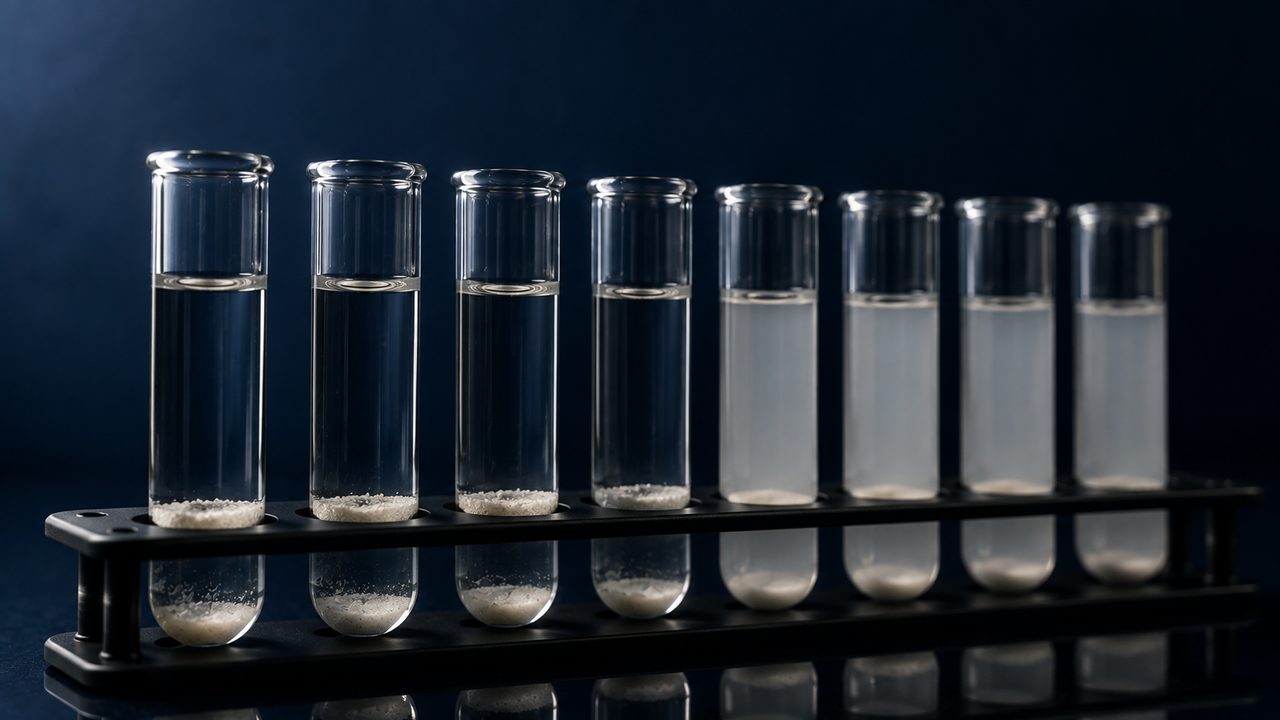
The Widal test is a blood test that measures antibodies your immune system has made against the O and H antigens of Salmonella Typhi, the bacterium behind typhoid, and against the H antigens of the two paratyphoid strains. It does not detect the bacteria. It detects the immune memory of them, and in India that memory is common: a past infection, one of the older whole-cell typhoid vaccines, or a related bacterium the antibodies cross-react with. In one survey, 42.6 per cent of 2,164 healthy people in Garhwal with no fever and no symptoms had a reactive Widal.1 So a positive Widal is a clue, and often a weak one. India's 2025 national antimicrobial guideline tells doctors to avoid the Widal for diagnosing typhoid.2 What follows explains what your titres say, where the cut-offs come from, and what to ask for instead.
In brief
- The Widal test reports antibody titres such as 1:80 or 1:160. O antibodies appear on days 6 to 8 of illness, H antibodies on days 10 to 12.3
- Many Indian laboratories treat a titre of 1:160 or higher for both O and H as significant, but a healthy baseline of O 1:40 and H 1:80 has been measured in India.1,4
- The Widal can be negative in up to 30 per cent of people whose typhoid was proven by culture.3
- Blood culture confirms typhoid and picks up about 55 to 60 per cent of true cases, more in the first week and less after antibiotics.5,6
What does the Widal test measure? Copy link
The Widal test measures how far your blood can be diluted and still clump killed Salmonella antigens. A lab mixes your serum with a suspension of the O antigen, from the bacterial cell wall, and the H antigen, from its flagella. Then it repeats the mix at doubling dilutions: 1 in 20, 1 in 40, 1 in 80, 1 in 160, 1 in 320. The last dilution that still shows visible clumping is your titre. So 1:160 means your serum kept reacting at 160-fold dilution and stopped at 320. Your report will usually show four lines: TO and TH for S. Typhi, AH and BH for S. Paratyphi A and B.
What it does not measure matters as much. It cannot see live bacteria, it cannot tell a fresh antibody from one made years ago, and it cannot tell an antibody raised by typhoid from one raised by a related organism. Every confusion about the Widal, and there are many, traces back to one of those three gaps, which is why the rest of this page keeps returning to the day of your fever, the age of your antibodies and the other infections that share the season.
What is the normal range for a Widal test in India? Copy link
There is no single normal range for the Widal test, because the range depends on how much background antibody the healthy population around you carries. Laboratories in India commonly report titres below 1:80 as non-reactive and flag 1:160 or above for both O and H as significant. The Indian Academy of Pediatrics task force set the same 1:160 mark for both antibodies, on a tube test done after five to seven days of fever.4 The Garhwal survey found the most common reactive titre in healthy adults was O 1:40 and H 1:80. On that basis the department set its own cut-offs one step higher, at O 1:80 and H 1:160.1 A blood-bank survey in Ahmednagar, Maharashtra, found a different pattern: 81.6 per cent of 103 donors reactive, both O and H most often at 1:40, and cut-offs of 1:80 for each.7 Two Indian towns, two sets of cut-offs. That is the point. A city with more typhoid will have a higher baseline, which is why the World Health Organization asks each region to measure its own before calling any titre abnormal, and why there is no single Indian Widal normal range to look up.3
In practice, the "normal" printed on your report is your lab's convention rather than a biological constant. A 1:80 that one lab calls reactive, another will call baseline. Men and women share the same range; there is no separate Widal normal range by sex, whatever the report template implies. And when a report or a lab website talks about a "typhoid normal range", it means this same Widal cut-off under another name.
What do 1:80 and 1:160 mean on a Widal report? Copy link
A Widal titre of 1:80 can fall within the background level of a healthy Indian population, and a titre of 1:160 is the level many laboratories start to call significant, but only when it sits beside a matching fever. How each number reads depends on the local baseline, the test method and the lab. With that caveat, read your four lines this way.
| Titre | Without fever | With fever of 5 days or more |
|---|---|---|
| 1:40 or lower | Within background levels in the surveys above | Does not rule out typhoid, particularly early in illness; culture if clinically suspected |
| 1:80 | Often within background; the most frequent H titre in the Garhwal survey | Borderline; repeat in 7 to 14 days or send a blood culture |
| 1:160 (O and H) | Past exposure, old vaccine, or cross-reaction | Supports typhoid; still not proof |
| 1:320 or higher | Unusual; ask why | Stronger support, especially if it has risen from a lower first sample |
| Four-fold rise between two samples | Much stronger evidence of recent infection than any single titre (1:80 climbing to 1:320 over 7 to 14 days); historically treated as diagnostic, but India's 2025 guideline still prefers culture to confirm3,2 | |
The O and H lines age differently, and that difference is more informative than either number. O antibodies rise first, from about day 6, and fade over months; H antibodies rise from about day 10 and can persist for years.3 A high TH with a low TO early in an illness does not establish current typhoid; it can reflect background antibody, previous exposure or older vaccination. An isolated H titre is particularly difficult to date, because H antibodies can persist. A rising O titre across appropriately timed paired samples is more consistent with recent infection than an isolated H elevation, but it still does not replace culture under current Indian guidance.2 Check which line leads on your own report.
Why does India's own antibiotic guideline say avoid the Widal? Copy link
The 2025 National Treatment Guidelines for Antimicrobial Use come jointly from the National Centre for Disease Control and the Indian Council of Medical Research. Under enteric fever they state that blood culture remains the gold standard and that the Widal test should be avoided for diagnosis.2 That is a stronger position than a caveat about cut-offs. It rests on measured failures. The test misses real typhoid: WHO puts the false-negative rate at up to 30 per cent of culture-proven cases, partly because antibiotics taken early blunt the antibody rise.3 It flags people who do not have typhoid, because S. Typhi shares O and H antigens with other Salmonella and with other gut bacteria. Malaria, scrub typhus, other bloodstream infections and cirrhosis can all push titres up too.3 WHO's 2026 position paper puts it in one line: these assays have poor and highly variable accuracy, because antibodies cross-react with other pathogens, persist after past infection or exposure, and have no standardized threshold.5 And in endemic settings where background titres can be common, a single titre has no fixed meaning without a local baseline that few labs have measured and fewer still print on the report.
Why is it still ordered so often? Because it is cheap, it is on every fever panel, and it gives a number the same afternoon. A blood culture takes two to four days and needs 8 to 10 ml of blood drawn before the first antibiotic dose. When antibiotics have already been taken for several days, the culture is less likely to be positive, and the Widal can look like the only test able to say anything. Knowing that tells you what a Widal ordered on day three of a fever can and cannot carry.
The scale of the problem explains the guideline's position. The Surveillance for Enteric Fever in India study, published in 2023, measured culture-confirmed typhoid at 576 to 1,173 cases per 100,000 child-years in urban cohorts, against 35 in rural Pune. In adults at hospital sites the figure ran from 108 to 970 per 100,000 person-years.8 Modelling from those inputs estimated 4.9 million typhoid cases in India in 2023, and about 600,000 of the 730,000 hospitalisations were attributed to fluoroquinolone-resistant infection.9 Every unnecessary antibiotic course prompted by a baseline titre adds to that resistance.
Why do healthy people in India test Widal positive? Copy link
Healthy people in India test Widal positive because background antibodies can reflect previous exposure, older vaccination and cross-reactivity with related bacteria. A positive baseline does not prove a past typhoid infection. In the Garhwal series, 42.6 per cent of symptom-free adults were reactive, with anti-O most often at 1:40 and anti-H at 1:80.1 That is a single-centre survey from one hill region, so the exact percentages will differ where you live, and similar surveys from other Indian cities have reported baselines a dilution higher or lower. The direction holds everywhere it has been measured: a low titre in a well person is the expected state.
Vaccination matters less than people assume. The old injectable whole-cell TAB vaccine, no longer in routine use, raised both O and H titres. The typhoid conjugate vaccine in use in India today is built on the Vi capsular antigen, which the Widal does not test for, so on principle it should not move your O or H lines.3 Direct studies of Widal titres after conjugate vaccination are sparse. Treat it as a mechanism-level expectation, not a measured guarantee.
What else can push a Widal titre up? Copy link
Malaria, dengue, scrub typhus, non-typhoidal Salmonella food poisoning, other bacterial infections in the blood, and chronic liver disease can each produce a positive Widal without typhoid. The antibodies raised in those illnesses cross-react with the O and H antigens on the test slide.3 Dengue matters most during the monsoon, when the two infections share a season and a fever panel.
Ask yourself which of these is in play before you read a lone 1:160 as typhoid. A confirmed alternative diagnosis such as malaria or dengue should not be overridden by a nonspecific Widal result.
When does the Widal miss typhoid? Copy link
The Widal misses typhoid most often in the first week, before O antibodies have appeared, and after antibiotics have been started. WHO's timing is specific: O antibodies on days 6 to 8, H antibodies on days 10 to 12.3 A sample drawn on day three or four of fever, which is when most people reach a lab, is testing for something that has not been made yet. The bacteria, meanwhile, have been in the blood since before the fever began, multiplying inside the cells of the liver, spleen and bone marrow and spilling back into the circulation in a low, steady stream that a culture bottle can catch. That is the mismatch the figure below draws, and it is why a negative Widal early in a fever tells you almost nothing.
Antibiotics compound it. If the first doses went in before the antibody response got going, the titre may never climb to a reportable level, which is the mechanism behind WHO's 30 per cent negative rate in culture-proven cases.3 Some people, particularly the very young and the immunosuppressed, mount a weak response regardless. The method matters as well. The rapid slide Widal reads only up to about 1:320 and produces more false results than the tube method, which is why the IAP task force asked for slide Widal to be discouraged.4,10 If your report does not say "tube", it was probably a slide. Ask.
What actually confirms typhoid? Copy link
A blood culture that grows Salmonella Typhi or Paratyphi confirms typhoid; nothing else does. It also yields the antibiotic sensitivity pattern, which is the part that changes treatment in a country where more than 60 per cent of isolates resist fluoroquinolones.9 The catch is sensitivity. WHO's 2026 typhoid position paper puts the sensitivity of a single blood culture at roughly 55 to 60 per cent, shaped by the volume of blood taken and by antibiotics already swallowed.5 The two systematic reviews behind that figure found 61 per cent (95 per cent confidence interval 52 to 70) against combined blood and bone marrow culture, and 59 per cent overall in a meta-analysis of sample volume, against 96 per cent for bone marrow.11,6 Yield depends on volume and timing. Sensitivity rose from about 51 per cent with 2 ml of blood to 65 per cent with 10 ml, and was 34 per cent lower in people who had already taken antibiotics and 31 per cent lower after the first week.6 So a negative culture does not exclude typhoid either; it simply fails in a different, more predictable way than the Widal.
Between the two sit the rapid antibody kits. A 2017 Cochrane review pooled 37 studies. TUBEX averaged 78 per cent sensitivity and 87 per cent specificity; Typhidot 84 and 79; the Test-It lateral-flow test 69 and 90. The confidence intervals were wide and the certainty of evidence low.12 WHO's 2026 position paper reaches the plain conclusion: these tests are not accurate enough to replace a properly collected blood culture.5 In a room of 700 people without typhoid, Typhidot would label about 147 of them positive. That is better than a single Widal titre and still not a confirmation. Bone marrow culture is the reference standard but is rarely done outside a prolonged, undiagnosed fever. PCR exists and is not routine.
Reading your own report against your fever Copy link
Take a report on the fourth day of a fever: TO 1:80, TH 1:160, AH and BH non-reactive, after three days of antibiotics taken before any test. What does that tell you?
Less than it seems.
You are on day four, so O antibodies would barely have started; the TO 1:80 could be baseline. The TH 1:160 is more likely an old memory than the current illness, because H lags O and outlasts it. The antibiotics you already took will have made both the culture and any repeat Widal harder to read.
So ask your doctor practical questions. Is a blood culture still worth sending, given the antibiotics? Should the Widal be repeated in a week to look for a rise? What else on the fever panel points somewhere, such as a low white cell count, a falling platelet count or a positive dengue antigen? Those questions move the conversation from "is it typhoid or not" to "what would bring us closer to knowing".
If a Widal is the only test on offer, the pattern to hope for is a paired sample. One now, one 7 to 14 days later, and a four-fold rise in the O titre between them.3 WHO and the IAP task force historically treated that rise as diagnostic; the 2025 national guideline still asks for culture to confirm, so treat the pair as strong evidence that still wants a culture behind it.4,2 A single titre on day four is a snapshot of a process that has not started. A pair shows the direction. Ask for the pair.
Do you need to fast for a Widal test? Copy link
No, you do not need to fast for a Widal test. It measures antibodies, which food does not change, and it can be drawn at any hour. If other tests ordered at the same visit require fasting, follow those instructions; our full body checkup guide lists which panels do. The Widal itself is unaffected. The timing that does matter is how many days into the fever you are: day five or later gives the antibodies a chance to be there.4 Results usually come the same day for a slide test and within 24 hours for a tube test.
What sits next to the Widal on a fever panel? Copy link
A typical Indian fever panel pairs the Widal with a complete blood count, a malaria smear or antigen, a dengue NS1 or IgM, and often liver enzymes. The supporting tests frequently say more than the Widal line does. Typhoid tends to leave the white cell count normal or low; leukopenia appears in only 20 to 25 per cent. It often removes eosinophils from the differential and drops the platelet count modestly toward the end of the first week, while a sharp platelet fall points more toward dengue.10 Our guide to the CBC test and what each value means covers how to read those lines. Liver enzymes rise mildly in typhoid, seldom beyond two to three times the upper limit, which is one of the patterns explained in our LFT decoder. One line to read with care while you are unwell: ferritin, which can rise as an acute-phase reactant during inflammation, making it harder to interpret as a marker of iron stores. Every test on that panel is decoded in the Labs & Reports journal. A fever that has lasted more than a week without an explanation needs a doctor's examination and targeted tests chosen from your history and the season.
After the fever: relapse, carriage, and the hair that falls in month two Copy link
Two things can follow a treated typhoid infection that a Widal will never warn you about. Relapse occurs in roughly 5 to 20 per cent of apparently cured cases, usually two to three weeks after the antibiotics stop, and milder than the first illness. A returning fever in that window deserves a fresh culture rather than a repeat Widal, because the titres will still be high from round one.3,10 And roughly 2 to 5 per cent of people go on to carry S. Typhi, usually in the gallbladder, shedding it intermittently for long periods, which is why anyone who handles food professionally is asked for negative stool cultures before going back to work.5
Hair shedding can also follow typhoid. Around two to three months after a high sustained fever, some people notice increased hair fall. That is telogen effluvium, a shedding phase triggered by the illness, and it resolves on its own over several months. Our guide to telogen effluvium and hair fall after typhoid explains the timing and what helps.
Frequently asked questions Copy link
Does a positive Widal test mean I have typhoid?
Not on its own. A positive Widal shows antibodies against typhoid antigens, which can come from past infection, old vaccination or cross-reaction with other infections. It supports typhoid only alongside a compatible fever; a blood culture is the preferred confirmation, and a four-fold rise on a repeat sample is the strongest the Widal itself can offer.
Is a Widal titre of 1:80 typhoid?
Usually not. A titre of 1:80 can fall within the background level measured in healthy Indian adults, and by itself it rarely indicates active typhoid; how it reads depends on the local baseline, the test method and the laboratory. It becomes meaningful if a repeat test 7 to 14 days later shows it rising to 1:320 or beyond, and even then culture is the preferred way to confirm.
Can the Widal be negative and I still have typhoid?
Yes. The test can be negative in up to 30 per cent of culture-proven typhoid, especially in the first week of fever or after antibiotics. A negative Widal early in a fever does not rule typhoid out.
When should the Widal test be repeated?
Seven to fourteen days after the first sample. A four-fold rise in the O titre between the two, for example 1:80 to 1:320, is much stronger evidence of recent infection than a single titre and was historically treated as diagnostic. India's current national guideline still advises against using the Widal to diagnose enteric fever, so a blood culture remains the preferred confirmation.
Is the Widal test normal range different for men and women?
No. The same cut-offs apply to men and women. The range differs by region and by laboratory; sex plays no part.
Does the typhoid vaccine make the Widal test positive?
The conjugate vaccine used in India today targets the Vi antigen, which the Widal does not measure, so it is not expected to raise O or H titres. Older whole-cell vaccines did raise them, and direct studies after conjugate vaccination are limited.
The three numbers to keep Copy link
A Widal titre of 1:160 for both O and H is where many Indian laboratories draw the line. Yet 42.6 per cent of healthy adults in one Indian survey were reactive, with the baseline at O 1:40 and H 1:80. The test is negative in up to 30 per cent of culture-proven typhoid, which is the main reason India's 2025 antimicrobial guideline asks doctors to avoid it for diagnosis. Blood culture, the test that can confirm typhoid, finds about 55 to 60 per cent of true cases, more in the first week and less after antibiotics. One action matters more than the rest: ask for that culture before the first antibiotic dose. And if a Widal is all you have, ask for a second one a week later.
References Copy link
- Pal S, Prakash R, Juyal D, Sharma N, Rana A, Negi S. The Baseline Widal Titre Among the Healthy Individuals of the Hilly Areas in the Garhwal Region of Uttarakhand, India. J Clin Diagn Res. 2013;7(3):437-440. PMID: 23634391. pubmed.ncbi.nlm.nih.gov/23634391
- National Centre for Disease Control, Indian Council of Medical Research. National Treatment Guidelines for Antimicrobial Use in Infectious Disease Syndromes. Government of India; 2025. Section 3.2, Enteric fever, p. 28. ncdc.mohfw.gov.in
- World Health Organization. Background document: The diagnosis, treatment and prevention of typhoid fever. WHO/V&B/03.07. Geneva: WHO; 2003.
- Kundu R, Ganguly N, Ghosh TK, Yewale VN, Shah RC, Shah NK; IAP Task Force. IAP Task Force Report: diagnosis of enteric fever in children. Indian Pediatr. 2006;43(10):875-883. PMID: 17079830. pubmed.ncbi.nlm.nih.gov/17079830
- World Health Organization. WHO position paper on typhoid vaccines, August 2026. Wkly Epidemiol Rec. 2026;101(32):166-180. who.int
- Antillon M, Saad NJ, Baker S, Pollard AJ, Pitzer VE. The Relationship Between Blood Sample Volume and Diagnostic Sensitivity of Blood Culture for Typhoid and Paratyphoid Fever: A Systematic Review and Meta-Analysis. J Infect Dis. 2018;218(Suppl 4):S255-S267. doi:10.1093/infdis/jiy471
- Gunjal SP, Gunjal PN, Patil NK, Vanaparthi N, Nalawade AV, Banerjee S, Keshav KS. Determination of Baseline Widal Titres Amongst Apparently Healthy Blood Donors in Ahmednagar, Maharashtra, India. J Clin Diagn Res. 2013;7(12):2709-2711. doi:10.7860/JCDR/2013/6252.3738
- John J, Bavdekar A, Rongsen-Chandola T, et al. Burden of Typhoid and Paratyphoid Fever in India. N Engl J Med. 2023;388(16):1491-1500. doi:10.1056/NEJMoa2209449
- Mogasale VV, John J, Sahai N, et al. Burden of typhoid fever and antimicrobial resistance in India (2023): a modelling study. Lancet Reg Health Southeast Asia. 2026. doi:10.1016/j.lansea.2025.100714
- Shah AK. Diagnosis of Enteric Fever. Pediatr Inf Dis. 2021;3(4):165-169. pidjournal.com
- Mogasale V, Ramani E, Mogasale VV, Park J. What proportion of Salmonella Typhi cases are detected by blood culture? A systematic literature review. Ann Clin Microbiol Antimicrob. 2016;15:32. doi:10.1186/s12941-016-0147-z
- Wijedoru L, Mallett S, Parry CM. Rapid diagnostic tests for typhoid and paratyphoid (enteric) fever. Cochrane Database Syst Rev. 2017;5:CD008892. doi:10.1002/14651858.CD008892.pub2
This article is educational and does not replace a consultation. Reference ranges and cut-offs vary between laboratories and regions; read your report with your doctor, and seek care promptly for a fever lasting more than three days, severe abdominal pain, confusion, or bleeding. Report an error on this page.
Written by Dr. Tarun Reddy, MBBS · Registered medical practitioner (TSMC/FMR/36195) at Sapiens · Published 4 September 2026 · Editorial standards · Report an error on this page