Hair & Scalp · Pattern hair loss
Receding hairline: causes, stages, and what actually regrows it
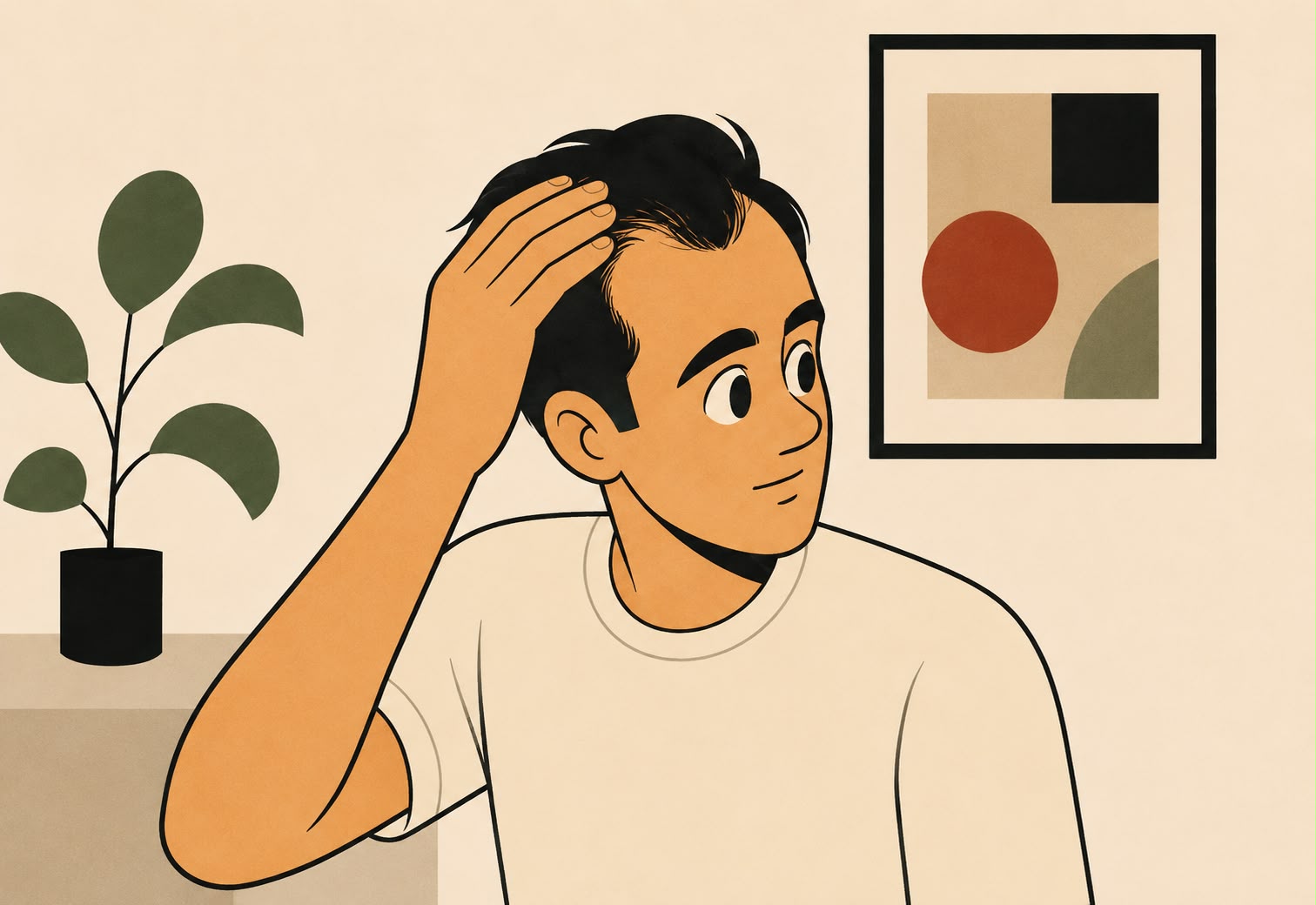
In a Bangalore population study that graded 1,005 men between 30 and 49, the single commonest grade of pattern hair loss was Norwood 2, the one where only the corners have gone. More men sat there than at any other stage.1 So if your temples have moved, you are in the most crowded room in the building. The questions that matter are narrower than "am I going bald": has the line actually moved, is it still moving, what is moving it, and what can be brought back. Those four get answered below, in that order.
A receding hairline is progressive loss and miniaturisation of hair along the frontal and temporal edge of the scalp, most commonly from male pattern hair loss. A mature adult hairline can also sit higher than the teenage hairline; the distinction that matters is whether the line and the hair calibre keep changing over time.
Has your hairline actually moved, or has it just finished growing up? Copy link
Almost every boy has a low, rounded hairline that sits close to the eyebrows. Somewhere between the late teens and the late twenties it rises and the corners open, and the result is the flatter, slightly angled adult hairline you see on most men. Rassman and colleagues, who measured hairlines in over a thousand children and adults, describe this as ordinary maturation, a developmental change and not hair loss.2 The change is usually modest and may then remain stable for years. What distinguishes maturation from progressive pattern loss is not the exact height of the line, but whether recession and follicular miniaturisation continue.
A receding hairline is a different event that starts in the same place. Follicles at the temples that respond to DHT begin producing finer, shorter hairs with each cycle, the corners deepen into an M, and the movement does not settle. Same corners, different process. One of the most useful practical ways to tell them apart is to document what happens over time.
So here is the photo check. Take a photograph of your hairline today: same bathroom, same light, hair pushed straight back, phone held by someone else at eye level. Note the date. Take an identical one in six months. Put them side by side. If the line has clearly moved under comparable photography, that strongly supports ongoing recession, and usually the hairs at the new corner look wispier than those an inch behind. If it looks unchanged, that is reassuring, though it does not prove the process has permanently stopped: pattern loss can move slowly enough that six months shows little, and lighting, angle, styling and hair length all add noise. If you are unsure, repeat at twelve months. That comparison tells you more than any mirror, because memory for hair density is unreliable and photographs are not. Our separate mature hairline versus receding hairline guide goes through the shapes in detail; the six-month photo check is what to hold on to.
Two shortcuts, if you cannot wait six months. Find the oldest phone selfie you have and compare it with today. And look at your parting under a bright light: in a mature hairline the hairs at the corner are as thick as the hairs an inch behind them; in a receding one they are visibly thinner. Thickness is the tell. Position alone is not.
What a receding hairline looks like: the signs that count Copy link
Five things, roughly in the order they usually appear.
- The corners go first. Recession starts above the outer edge of each eyebrow, at the frontotemporal corners, and works inward. The front-centre usually holds longest, which is what creates the M. A V-shaped hairline, where the centre point is strong and the sides sweep back, is often the same process seen earlier, and a widow's peak that has always been there is simply a hairline shape, not a sign of anything.
- Finer hair at the new edge. Run a fingertip along the corner. Pattern recession leaves a rim of short, fine, pale hairs along the retreating line. That miniaturised rim is a characteristic sign of DHT-driven loss.
- More scalp under bright light. The forehead looks taller in photographs taken in sunlight, at the barber's, or in a car mirror, before it looks taller at home.
- Both sides, usually. Pattern loss is generally bilateral, although the two corners do not always move at exactly the same rate, so a little unevenness is ordinary. Marked or isolated one-sided recession raises the possibility of traction, from the side you part on or tie from, or of another scalp disorder, and deserves a doctor's look sooner.
- Company at the crown. Many men with temple recession also have a thin spot developing at the back, which they cannot see. Ask someone to photograph your crown too. Two zones thinning together makes pattern loss much more likely.
What a receding hairline does not usually do: itch, flake, hurt, or shed in handfuls. If any of those are happening, keep reading, because the cause may be something else.
Receding hairline stages, and why "stage" matters less than direction Copy link
Dermatologists grade pattern loss on the Hamilton–Norwood scale, from 1 (no loss) to 7 (a band around the sides and back), and Indian clinics usually say "grade" with Roman numerals.3 A receding hairline on its own lives at the bottom of that scale.
| Grade | What the hairline is doing | What that means for treatment |
|---|---|---|
| 1 | Minimal or no temporal recession. The Bangalore study counted grade I within its 58%, which is one reason its total reads high.1 | Nothing to treat. Photograph and revisit. |
| 2 | Mild, symmetrical recession at the corners. This can be a stable mature adult hairline or early progression, depending on what happens over time. The commonest grade in Indian men aged 30 to 49.1 | If it is moving, the best window for medicine; follicles are barely weakened. Watching is reasonable if the six-month photo check says it is stable. |
| 3 | Deep corners, a clear M or U. Norwood's own threshold for definite pattern baldness, and the point at which most men first book an appointment.3 | Medicine holds the line well and can partly thicken the corners. Regrowth of the exact old line is uncommon. |
| 3 vertex / 4 | Recession plus a separate thinning spot at the crown. | Now a whole-scalp plan, not a hairline plan. The male pattern baldness guide covers grades 3 to 7 stage by stage. |
Two cautions on the number. When dermatologists graded the same photographs, their agreement was rated unsatisfactory, so your grade is a landmark, and a rough one.4 And the "A" variants, where the whole front retreats in a straight line without a crown spot, look worse for the same amount of hair lost, which changes how a surgeon plans but not how medicine works. What actually predicts your outcome is direction of travel and how early you are on the road. Those two things do not depend on whether you are "really" a 2 or a 3. One note on the Bangalore figures used on this page: they are the study's headline numbers, because its age-band breakdown contains internal inconsistencies, and it is a population-based sample drawn from the public, not a clinic queue.1
What is pulling the hairline back? Copy link
In most men, and in a smaller share of women, a receding hairline is the front edge of androgenetic alopecia: follicles at the corners that inherited a sensitivity to dihydrotestosterone (DHT), a hormone made from testosterone inside the follicle itself. Each hair cycle in a sensitive follicle is a little shorter than the last, each new hair a little finer, until the corner is covered only by down. The sensitivity is inherited from both sides of the family, and your blood testosterone level is not the issue; men with ordinary and even low testosterone recede if their follicles are built that way.5 The mechanism, the genetics and the mother's-side question are covered in depth in the male pattern baldness guide, so this page does not repeat them.
What it will do is name four important alternatives worth recognising, because each one needs a different plan and two of them are more common in India than in the trial populations.
- Traction. Years of steady pull on the front hairline from a tight bun, a tight plait, a turban or patka tied over a topknot, or hair extensions. The loss sits exactly where the pull is, is often one-sided or band-like, and can scar if it goes on long enough. More on this in the next section.
- Diffuse shedding (telogen effluvium). Some months after a fever, dengue, delivery, surgery, a crash diet or a bad stretch of stress, a large share of follicles shed at once. The hairline can look thinner, but so does the whole head, and hair comes out in the comb and the drain in quantities you notice. The telogen effluvium guide covers the timeline and how it recovers.
- Frontal fibrosing alopecia (FFA). A scarring condition, mostly in women after 45, where the front and side hairline recedes as a smooth band and the eyebrows thin at the same time. In a multicentre series of 355 patients, eyebrow loss was often the first sign.6 This one is urgent, because lost follicles do not return.
- Thyroid disease and iron deficiency. Both thin the hair evenly across the whole head, but either can sit on top of early pattern loss and make a mild recession look sudden and severe. The thyroid and hair loss guide explains what to test.
The everyday suspects, helmets, caps, oiling, hard water, daily washing, have no effect on the follicle's DHT response, and the reasons those beliefs persist are set out on the pattern baldness page. Smoking has been associated with androgenetic alopecia and with greater severity in observational studies, although that does not establish that smoking causes progression.7
The Indian causes that are not DHT at all Copy link
Ask yourself what your hairline has been holding up for the last ten years.
A schoolgirl's plait is pulled tight enough to last until evening, every day, for a decade. A nurse's or air hostess's bun sits on the same tension for a twelve-hour shift. A Sikh boy's joora and patka, and later the dastar, are tied over a knot that rests on the frontal scalp and stays there for a full day. Each of these transfers a constant small force to the follicles along the front edge, and follicles do not like constant force. The result, traction alopecia, is a thinning band along the hairline and above the ears that mirrors wherever the pull was, and it is one of the few forms of frontal loss that is genuinely mechanical.
The turban form is well described. A 2007 report in an American family-medicine journal and an earlier Indian series both document frontal traction loss in Sikh men from decades of tightly tied hair, and note the difficulty that arises when the practice cannot simply be stopped.8 A case report of two adolescent brothers described a band-like scarring loss at the frontal hairline after wearing turbans since early childhood.9 Those are case reports and small series, so they establish that it happens; how often is unknown.
Traction is worth ruling in or out before anything else, for one reason: caught early, it can reverse once the pull is removed. Loosen the knot, change where the plait starts, alternate the style, and the fine hairs at the edge often recover over months. Left for years, the follicles scar and nothing regrows. Signs that point to traction: the loss follows the line of the pull instead of the corners, it is markedly worse on the side you part or tie, small pimples or a tender scalp appear along the band, and the "fringe sign", a thin rim of retained fine hairs at the very front with loss behind it. A man whose corners are receding and who also ties a topknot may have both going on at once. In that case the traction is the part you can fix this week.
Receding at 18, 20 or 25: what it means and what to do Copy link
At 18, the first question is whether the hairline is maturing or whether follicular miniaturisation is already present, and the likeliest explanation is that your hairline is doing what hairlines do at 18: rising from the boyhood position to the adult one. Rassman's description of normal maturation puts this change squarely in the late teens and twenties.2 If the whole front is rising evenly and the corner hairs are as thick as the ones behind them, that is maturation, and no treatment is indicated.
Three things tip it toward early pattern loss instead. The corners are going back much further than the centre. The hairs at the corners are visibly finer and paler. Or a thin spot is opening at the back of the head in the same months. If two of those are true at 20, the process has started early, and early onset is the group in which starting treatment changes the most, because there is the most hair still to keep.
One practical limit. Finasteride is a prescription medicine, and the consumer minoxidil label carries a do-not-use instruction for anyone under 18.10 For someone under 18, treatment decisions belong with a dermatologist, the young person and their parent or guardian, rather than being started from an adult over-the-counter algorithm. If you are under 18 and the corners are moving, the useful steps are the six-month photographs, ruling out traction, and a dermatology visit if the line is still moving at the second photo. That is not a brush-off. It is the same sequence an adult should follow, without the medicines yet.
Is a blood test worth doing for a receding hairline? Copy link
For the diagnosis, no. A receding hairline in a man with the typical pattern is diagnosed by looking, sometimes with a handheld scope that shows the mix of thick and thin hairs at the corner, and Indian and European guidance agree that laboratory work-up is not routinely required.5
There are two situations where a test earns its cost. If the loss is diffuse, sudden, or you are a woman, then a thyroid panel and a ferritin level are the first layer, because those two conditions produce a shedding that gets mistaken for early recession. A ferritin result needs reading with care in India, where borderline values are common; our ferritin test guide covers what the number means for hair.
The second situation has nothing to do with hair. Men whose pattern loss starts before 30 appear to carry more metabolic risk. At PGIMER Chandigarh, 100 men under 30 with grade 3 or worse pattern loss were assessed: 44 had insulin resistance, 26 met criteria for metabolic syndrome, and 34 had an altered hormonal profile. There was no control group, so the study describes this population without proving a difference from men with full hair, and the men had been referred to a hospital clinic, which selects for more severe cases.11 A 2022 meta-analysis of 19 studies did find higher pooled odds of metabolic syndrome in people with pattern loss, with early onset among the factors that raised the risk.12 Association, not cause. But if your corners went at 23 and you also carry weight at the waist or have a parent with diabetes, it is sensible to make sure your routine screening is current: blood pressure, an HbA1c, and a lipid profile, all of which sit inside a standard full body checkup. Your hairline is not the problem those tests are looking for. It is a reason to look.
Can a receding hairline grow back? The frontal evidence, specifically Copy link
Partly, from follicles that are still producing hair. The frontal hairline and temples generally respond less dramatically than the vertex in the available treatment evidence. Here is what the trials measured at the front, because most of the numbers quoted for pattern loss come from the crown.
Finasteride at the hairline. The large finasteride trials enrolled men with crown loss. One trial did not: 326 men with active thinning in the frontal and mid-scalp area took finasteride 1 mg or placebo for a year, followed by an open second year. Hair counts in a one-square-centimetre frontal target area rose significantly on finasteride, and blinded photographs and patient ratings improved with them; the gain held or grew through year two. The study was funded by the manufacturer and the frontal hair-count difference is reported in the abstract as significant, without a specific number, so this page does not put a figure on it.13 A later photographic analysis of the crown trials found improvement over placebo in every region at two years, and the front and temples gained least of all.14 Read those two together: the front responds, and it responds least.
Indian data exists, and it is small. At AIIMS New Delhi, 80 men were randomised to finasteride 1 mg or placebo for a year. Only 39 completed, which is a serious limitation. Among those who did, hair counts rose by a mean of 20.6 on finasteride against a fall of 9.6 on placebo, and 69.6% of treated men were rated improved on photographs against 6.3% on placebo. A quarter of the treated men reported sexual side effects, a rate far above the large trials, which the authors themselves flag and which a trial of this size cannot settle either way.15
Minoxidil at the hairline. The label on 5% minoxidil sold over the counter in the United States says, in those words, that it is "not intended for frontal baldness or receding hairline", because the registration trials enrolled men with crown loss and measured the crown.10 The 48-week trial that established the 5% strength counted hairs at the vertex in 393 men.16 That is not the same as saying it does nothing at the front; the European guideline recommends it for pattern loss without carving out the hairline, and dermatologists use it there routinely.17 It is saying that the controlled evidence for the corners is thinner than the marketing, and that if you use it at the hairline you should expect to hold ground more than to rebuild it. How to apply it, the early shed, and the timeline are in the minoxidil 5% guide.
What "regrow" actually counts as. The trials count hairs in a small circle. A good response at the front is a denser corner: more hairs, thicker hairs, a line that reads as fuller in a photograph. It is rarely a line that moves forward by a centimetre. A 2016 modelling commentary argues that regrowth in treated men comes from follicles that were still producing visible hair having their cycle lengthened, and not from long-miniaturised follicles being converted back into thick ones.18 Commentary, so weight it accordingly, but it fits the trial pattern and it gives you a home test: part the hair at the corner under a torch. Visible miniaturised hairs generally mean the follicles are still producing hair and may have more potential to respond. A long-standing, completely bare corner is much less likely to regrow on medicine, and is the ground where a transplant is usually discussed.
How to stop a receding hairline: what works, in order of evidence Copy link
Start with the timeline, because it is where most people give up. Nothing visible happens for three months. Six months is the earliest fair verdict, and for some men on finasteride the change is not evident until twelve.5 Whatever you choose below, decide at the start whether you are prepared to do it for years, because every medicine on this list is a maintenance treatment: the benefit is generally held only while treatment continues, and after stopping, pattern loss typically resumes.
Finasteride 1 mg (prescription)
The best-established oral treatment for male pattern hair loss, and the one with a dedicated frontal trial behind it.13 In the crown trials, 48% of treated men were rated improved on blinded photographs at one year and 66% at two, against 7% on placebo.19 It lowers scalp DHT; it does not touch the cause of traction or shedding, which is why the diagnosis matters first. Sexual side effects are reported in a small minority in the large trials and resolved on stopping in most; the AIIMS trial reported a much higher rate in a much smaller sample. In 2025, the European Medicines Agency confirmed suicidal ideation as an adverse effect of oral finasteride tablets; its frequency cannot currently be estimated from available data. Patients taking finasteride 1 mg who develop depressed mood, depression or suicidal thoughts are advised to stop treatment and seek medical advice.20 Women who are or may become pregnant should not handle broken tablets. All of this belongs in a conversation with a doctor before a pharmacy counter.
Topical minoxidil 5%
Twice daily, to a dry scalp, for as long as you want the effect. Expect a shed inside the first two months, as resting hairs fall to make room for new growth; that is where most men quit. At the hairline its evidence is weaker than at the crown, as set out above, and it partners finasteride better than it replaces it, because the two act on different steps.17 It is widely available in India in topical solution, foam and spray formulations.
Both together
Guidelines allow combination, and a Chinese open-label trial in 450 men rated 94% improved on both against 80.5% on finasteride and 59% on minoxidil alone; open-label clinician ratings run high in every arm, so read the ordering and treat the exact figures loosely.21 For men with active pattern recession, combining finasteride and topical minoxidil is a common evidence-based approach.
Microneedling as an add-on
In a Mumbai trial, 100 men with mild to moderate pattern loss were randomised to weekly 1.5 mm microneedling plus 5% minoxidil, or minoxidil alone, for 12 weeks. Hair counts rose by a mean of 91.4 in the combined group against 22.2 with minoxidil alone.22 Twelve weeks, one centre, evaluator-blinded, and the counts were taken at the vertex, so for the corners it is promising and unproven. Done at home with a cheap roller and no hygiene, it is also a way to get folliculitis.
PRP, laser caps, dutasteride
Platelet-rich plasma injections and low-level laser devices are offered widely in Indian clinics, on smaller and shorter trials than the two core medicines, and neither replaces the DHT step. Dutasteride blocks both forms of the enzyme finasteride mainly blocks one of, is used off-label in India for men who respond poorly to finasteride, and carries the same class of side effects with a much longer half-life.23 A systematic review and meta-analysis of pattern-loss treatments found finasteride, minoxidil and low-level laser all better than placebo, with the finasteride and minoxidil evidence the most consistent.24
A hair transplant
Takes follicles from the band at the back that DHT leaves alone and plants them in the corners, where they keep growing. It is the only way to rebuild a hairline that has gone smooth, and it is the wrong move for a hairline that is still moving fast, because the native hair behind the grafts keeps receding unless it is treated. Surgeons generally want men on medicine before and after. Cost, technique and how to judge an Indian clinic are a guide of their own.
What does not work on the corners
"DHT-blocking" shampoos, onion oil, biotin in a man who is not deficient, and the scalp-massage videos. Ketoconazole shampoo is a reasonable wash if the scalp is flaky and does nothing to the pattern itself. None of these has controlled hairline data. The practical risk is losing time while miniaturisation continues.
How to regrow a receding hairline naturally: what that can and cannot mean Copy link
It can mean fixing the causes that are not DHT. Loosen the plait, retie the joora over a broader base, take the extensions out, correct a low ferritin or an underactive thyroid, wait out a post-fever shed. Each of those is a natural reversal in the plain sense, and each works.
It cannot mean reversing DHT-driven recession with diet, oil or massage; that needs a treatment with evidence behind it for pattern hair loss. No plant product has been shown to do to scalp DHT what finasteride does, and none has five-year controlled data.23 The scalp-massage figure that circulates comes from an online survey in which participants rated their own results, with no control group, and a self-rated survey cannot separate the massage from the hope.25 Eating well, sleeping, and stopping smoking are good for the hair you have and for the rest of you. They will not move the corners forward. If you want to try oils or supplements, the fair way is alongside the medicines that have evidence, with the six-month photographs, so that you can see for yourself what changed.
Receding hairline in women: why it usually means something other than pattern loss Copy link
Female pattern hair loss usually presents with central thinning and a widening parting; the classic grading scale for women, described by Ludwig in 1977, is built around a preserved frontal fringe.26 But frontal and temporal recession can occur as part of the female pattern too. In a Mumbai series of 90 women, 30% had some frontal recession, and when the same women were graded on the BASP system the commonest basic pattern, at 46.7%, was the M type, meaning recession at both temples.28 A widening parting plus temple recession can therefore still be pattern loss. What shifts the picture toward something else is isolated band-like recession, eyebrow loss, inflammation, or a clear line of pull, and those three alternatives are worth knowing by name.
Traction, first, for all the reasons in the section above; a long-standing tight plait or bun is an important and often overlooked cause of thinning temples in Indian women. Postpartum shedding, second, which can strip the frontal fringe dramatically three to four months after delivery and then regrows. And frontal fibrosing alopecia, third, which is the one to rule out early: a smooth, pale band of recession along the front and sides, often with itch or tenderness along the edge, in a woman usually past 45, with thinning eyebrows. In the 355-patient series, eyebrow loss was frequently the first sign, and antiandrogen tablets stabilised or improved most of the patients who received them.6 Recession plus eyebrow thinning warrants prompt dermatology assessment rather than prolonged watchful waiting.
A woman with a receding frontal line who has none of those three, and who has a widening parting as well, is most likely looking at female pattern hair loss with temple involvement; the female pattern hair loss guide covers BASP grading, the PCOS question and the treatment trial numbers for women. Finasteride must not be used in pregnancy because of the risk to a male fetus, and its use in women of child-bearing potential needs specialist assessment and reliable contraception. Minoxidil has its own 48-week controlled data in 381 women, which the female guide sets out.27
Haircuts while you decide Copy link
None of this needs to be visible while you sort it out. The principle is contrast: what reads as "receding" from across a room is a sharp change between full hair on the sides and a bare corner. Cut the sides short and the corner disappears into the general shortness. A crew cut or short textured crop with a little length on top, brushed forward, softens an M-shaped line better than anything grown long. A buzz cut settles it completely. Slicked-back styles, long fringes combed over the corners, and anything wet-look advertise the line. Tell the barber what you are doing.
When to see a doctor Copy link
If the six-month photo check shows the line still moving and you want to keep what you have. If the corners went before 25. If the loss is one-sided, band-like, itchy, tender or looks scarred. If you are a woman with frontal recession and any eyebrow thinning. If you have started a medicine and want to know at six months whether it is working. Bring the photographs. Ask which grade the doctor would put you at and how confident they are, whether they see fine hairs at the corner under the scope, and what they would expect at six and twelve months. A doctor can confirm what is driving your hairline back and what is worth doing for your stage; that is the whole of what the visit is for.
Questions people ask Copy link
Is a receding hairline normal?
A hairline that rises evenly once in the late teens or twenties and then holds is normal maturation. It is not hair loss. Corners that keep moving back, with finer hairs at the new corner, are the early stage of pattern hair loss, which is common, and which keeps going.
At what age does a receding hairline start?
Pattern recession can begin any time after puberty, and onset in the late teens and early twenties is not rare, particularly where it runs in the family. Population data on onset age in Indian men is thin; the largest Indian study enrolled men from 30 upwards and found corner-only recession the commonest grade in that band, which says how common it is by 30, not when it began.
How do I know if my hairline is receding or maturing?
Photograph it under the same light today and in six months. A line that has clearly moved under comparable photography strongly supports ongoing recession; a line that looks unchanged is reassuring but does not prove the process has stopped, since pattern loss can progress slowly and photographs vary with lighting and styling. Check thickness too: at a mature corner the hairs are as thick as those behind them; at a receding corner they are visibly finer.
Can a receding hairline grow back naturally, without medicine?
If the cause is traction, a post-illness shed, low iron or thyroid disease, yes, once the cause is corrected. DHT-driven recession does not reverse with diet, oils or massage; slowing or partly reversing it requires an evidence-based treatment directed at pattern hair loss, most commonly finasteride, minoxidil or both in men, and only for as long as it is used.
Does finasteride work on the hairline?
A one-year trial in 326 men with frontal thinning found significantly higher frontal hair counts on finasteride than placebo, with the gain held through a second year. A photographic analysis of the crown trials found improvement in every region, with the front gaining least. It works at the front, and less than at the crown.
Does minoxidil work for a receding hairline?
The over-the-counter label states it is not intended for frontal baldness or a receding hairline, because the registration trials measured the crown. Dermatologists still use it at the front, usually alongside finasteride, and guidelines do not exclude the hairline. Expect it to help you hold ground more than rebuild it.
Why is my hairline receding on one side only?
Pattern loss is usually bilateral, though the two sides do not always progress at exactly the same rate, so slight unevenness is common. Marked or isolated one-sided recession raises the possibility of traction, from the side you part, tie or cover, or of another scalp disorder. Have a doctor look at it.
Does a receding hairline mean high testosterone?
No. Recession depends on how sensitive your follicles are to DHT, which is inherited, and men with ordinary or low testosterone recede if their follicles are built that way. Guidelines do not recommend hormone testing for a typical receding hairline in a man.
Can wearing a helmet, cap or turban cause a receding hairline?
Helmets and caps do not. A turban, patka or any style that keeps the front hair under constant tension can cause traction loss along the hairline, which is mechanical, and which can regrow if the pull is reduced early.
Is a widow's peak a receding hairline?
No. A widow's peak is a V-shaped point at the centre of the hairline that many people have from childhood. It can look more prominent as the corners recede on either side of it, but the peak itself is only a shape.
What blood tests should I get for a receding hairline?
None are needed to diagnose typical pattern recession in a man. If the loss is diffuse, sudden or you are a woman, a thyroid panel and ferritin are the first layer. If your recession started before 30, it is reasonable to make sure routine metabolic screening, blood pressure, HbA1c and a lipid profile, is up to date, because early-onset pattern loss is associated with metabolic syndrome.
References Copy link
- Krupa Shankar DS, Chakravarthi M, Shilpakar R. Male androgenetic alopecia: population-based study in 1,005 subjects. Int J Trichology. 2009;1(2):131-133. PMC2938575
- Rassman WR, Pak JP, Kim J. Phenotype of normal hairline maturation. Facial Plast Surg Clin North Am. 2013;21(3):317-324. PMID 24017973
- Norwood OT. Male pattern baldness: classification and incidence. South Med J. 1975;68(11):1359-1365. PMID 1188424
- Guarrera M, Cardo P, Arrigo P, Rebora A. Reliability of Hamilton-Norwood classification. Int J Trichology. 2009;1(2):120-122. PMC2938573
- Kaliyadan F, Nambiar A, Vijayaraghavan S. Androgenetic alopecia: an update. Indian J Dermatol Venereol Leprol. 2013;79(5):613-625. ijdvl.com
- Vañó-Galván S, Molina-Ruiz AM, Serrano-Falcón C, et al. Frontal fibrosing alopecia: a multicenter review of 355 patients. J Am Acad Dermatol. 2014;70(4):670-678. PMID 24508293
- Kavadya Y, Mysore V. Role of smoking in androgenetic alopecia: a systematic review. Int J Trichology. 2022;14(2):41-48. PMC9069908
- James J, Saladi RN, Fox JL. Traction alopecia in Sikh male patients. J Am Board Fam Med. 2007;20(5):497-498. PMID 17823469
- Karimian-Teherani D, El Shabrawi-Caelen L, Tanew A. Traction alopecia in two adolescent Sikh brothers: an underrecognized problem unmasked by migration. Pediatr Dermatol. 2011;28(3):336-338. PMID 21371118
- DailyMed. Men's Rogaine (minoxidil) 5% topical solution and foam, Drug Facts label: "not intended for frontal baldness or receding hairline"; do not use if under 18. US National Library of Medicine. dailymed.nlm.nih.gov
- Vinay K, Bhattachajee R, Bishnoi A, et al. Clinical and metabolic characteristics of males with early-onset androgenetic alopecia. Indian J Dermatol Venereol Leprol. 2023;89(4):530-535. PMID 36688892
- Qiu Y, Zhou X, Fu S, Luo S, Li Y. Systematic review and meta-analysis of the association between metabolic syndrome and androgenetic alopecia. Acta Derm Venereol. 2022;102:adv00645. doi:10.2340/actadv.v101.1012
- Leyden J, Dunlap F, Miller B, et al. Finasteride in the treatment of men with frontal male pattern hair loss. J Am Acad Dermatol. 1999;40(6 Pt 1):930-937. PMID 10365924
- Olsen EA, Whiting DA, Savin R, et al. Global photographic assessment of men aged 18 to 60 years with male pattern hair loss receiving finasteride 1 mg or placebo. J Am Acad Dermatol. 2012;67(3):379-386. jaad.org
- Prasad HR, Khanna N, Pandhi RK. A randomized double blind study of the effect of finasteride on hair growth in male patients of androgenetic alopecia. Indian J Dermatol. 2005;50(3):139-145. journals.lww.com
- Olsen EA, Dunlap FE, Funicella T, et al. A randomized clinical trial of 5% topical minoxidil versus 2% topical minoxidil and placebo in the treatment of androgenetic alopecia in men. J Am Acad Dermatol. 2002;47(3):377-385. PMID 12196747
- Kanti V, Messenger A, Dobos G, et al. Evidence-based (S3) guideline for the treatment of androgenetic alopecia in women and in men: short version. J Eur Acad Dermatol Venereol. 2018;32(1):11-22. doi:10.1111/jdv.14624
- Sinclair R. Androgenetic alopecia. Modelling progression and regrowth. Exp Dermatol. 2016;25(6):424-425. PMID 27061176
- Kaufman KD, Olsen EA, Whiting D, et al; Finasteride Male Pattern Hair Loss Study Group. Finasteride in the treatment of men with androgenetic alopecia. J Am Acad Dermatol. 1998;39(4 Pt 1):578-589. PMID 9777765
- European Medicines Agency. Measures to minimise risk of suicidal thoughts with finasteride and dutasteride medicines. EMA/202053/2025, CMDh endorsement 19 June 2025. ema.europa.eu
- Hu R, Xu F, Sheng Y, et al. Combined treatment with oral finasteride and topical minoxidil in male androgenetic alopecia: a randomized and comparative study in Chinese patients. Dermatol Ther. 2015;28(5):303-308. doi:10.1111/dth.12246
- Dhurat R, Sukesh M, Avhad G, Dandale A, Pal A, Pund P. A randomized evaluator blinded study of effect of microneedling in androgenetic alopecia: a pilot study. Int J Trichology. 2013;5(1):6-11. PMID 23960389
- Ntshingila S, Oputu O, Arowolo AT, Khumalo NP. Androgenetic alopecia: an update. JAAD Int. 2023;13:150-158. doi:10.1016/j.jdin.2023.07.005
- Adil A, Godwin M. The effectiveness of treatments for androgenetic alopecia: a systematic review and meta-analysis. J Am Acad Dermatol. 2017;77(1):136-141. doi:10.1016/j.jaad.2017.02.054
- English RS Jr, Barazesh JM. Self-assessments of standardized scalp massages for androgenic alopecia: survey results. Dermatol Ther (Heidelb). 2019;9(1):167-178. PMID 30671883
- Ludwig E. Classification of the types of androgenetic alopecia (common baldness) occurring in the female sex. Br J Dermatol. 1977;97(3):247-254. PMID 921894
- Lucky AW, Piacquadio DJ, Ditre CM, et al. A randomized, placebo-controlled trial of 5% and 2% topical minoxidil solutions in the treatment of female pattern hair loss. J Am Acad Dermatol. 2004;50(4):541-553. jaad.org
- Singh S, Makhecha MB. A cross-sectional, observational study of the clinico-epidemiological profile of female pattern hair loss in Western India and its association with metabolic syndrome. Indian Dermatol Online J. 2023;14(2):226-231. PMID 37089856
This article is general health information for readers in India and is not a diagnosis or a prescription. Finasteride is a prescription medicine. A registered medical practitioner can confirm what is driving your hair loss and what is appropriate for your stage. Report an error on this page.