Sapiens · GLP-1
Wegovy in India: Price After the Cuts, Real Results, and What Happens If You Stop
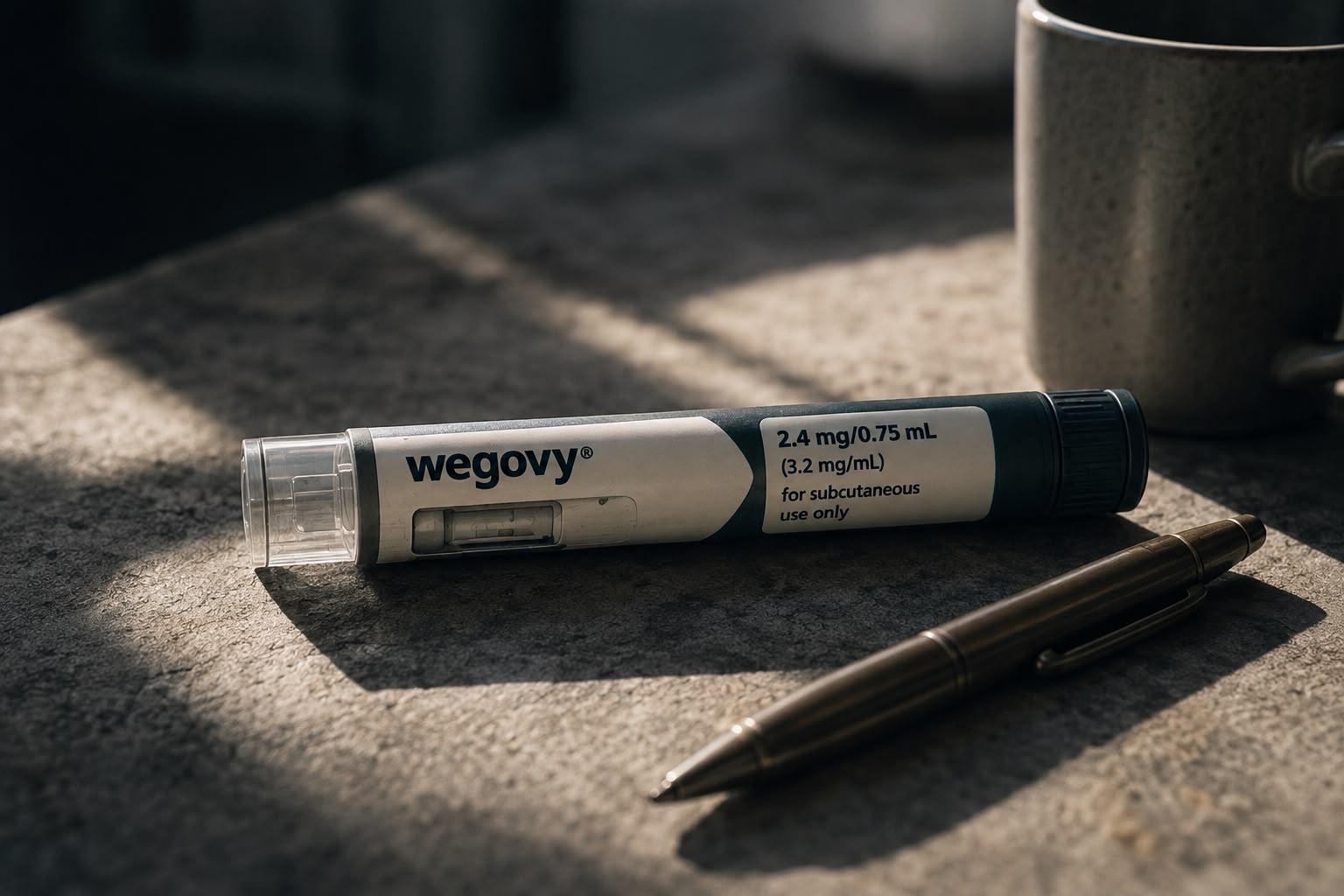
In its biggest trial, people on the full dose of Wegovy lost an average of 14.9% of their body weight over 68 weeks, about 15 kg for someone starting at 100 kg.1 A year after the injections stopped, the same people had regained roughly two-thirds of it.2 Both numbers are true, and you deserve both before you spend a rupee.
The second number is not a warning against the drug. It is a description of what the drug is: a treatment that suppresses appetite regulation while it is present, in a condition that does not resolve because you treated it for a year. Everything else on this page makes more sense once that is settled, from the price ladder to the side effects to the generic comparison.
Quick facts
- Wegovy is semaglutide licensed for weight management, titrated to 2.4 mg weekly across five dose strengths.3
- In STEP 1, its biggest trial, average loss was 14.9% of body weight at 68 weeks, against 2.4% on placebo.1
- After the March 2026 cut the starting dose is ₹5,660 a month; the full dose sits near ₹16,400 at pharmacy quotes, putting a first year at about ₹1.67 lakh in medication at those prices.3,4,5
- Licensed generic semaglutide starts near ₹1,290 a month for the same molecule.
- A year after stopping, participants had regained about two-thirds of the weight, and the metabolic gains faded with it.2
- Prescription-only. The core contraindications travel with the molecule; monitoring is individualised to the indication and the patient.
What Wegovy is, and how it differs from Ozempic Copy link
Wegovy is a once-weekly injection of semaglutide, made by Novo Nordisk and licensed specifically for weight management. It comes as a pre-filled pen you inject under the skin of the abdomen, thigh or upper arm, any day of the week, with or without food. The needle is short and fine, and most people find the anticipation worse than the injection.
Semaglutide imitates GLP-1, a gut hormone your body releases after eating. That is its mechanism of action: it binds the same receptors the hormone does, in the gut and in the appetite centres of the brain. At weight-management doses it does three things you notice: food leaves the stomach more slowly, so fullness arrives earlier and lasts; the hunger signalling in the brain quietens, so food occupies less of your thinking; and blood sugar regulation improves. People describe the effect less as willpower and more as silence: the running negotiation with food gets quieter.
The Wegovy sold in India is the once-weekly injection. An oral Wegovy tablet now exists in some overseas markets, but it is a different presentation and not the product on Indian shelves. Semaglutide tablets do exist here, as Rybelsus and as Indian generics, taken daily on an empty stomach and absorbed far less efficiently; generic tablets land near ₹3,000 a month. If tablets are what you are looking for, that is a separate prescribing decision, and our generic semaglutide guide covers the oral brands.
Ozempic is the same molecule under a different licence. In India it is approved for type 2 diabetes and sold in 0.25 mg, 0.5 mg and 1 mg strengths; Wegovy is approved for weight management and climbs to 2.4 mg.3 That matters for how you read the headline numbers: the 14.9% comes from the 2.4 mg dose, which Ozempic does not reach here. Comparing their prices compares two different treatments. For the full picture on the diabetes side, see our guide to Ozempic in India.
What results to expect, and what the average hides Copy link
The core evidence is STEP 1: 1,961 adults with obesity, or overweight plus a weight-related condition, none with diabetes, followed for 68 weeks.1 Average loss on 2.4 mg was 14.9% of body weight against 2.4% on placebo; 86% lost at least 5%, and about one in three lost 20% or more.
Three caveats belong beside those numbers. Everyone in the trial also received diet counselling and an activity target, so the drug was tested on top of lifestyle change. In the STEP arm built around intensive behavioural therapy, average loss reached 16.0%.6 The trial population was largely Western, and Indian data at this scale does not yet exist, though the underlying biology gives no strong reason to expect a different result. And averages hide spread: some people lose 25%, while about 14% do not reach 5%. A poor response is a review trigger, covering dose, adherence, tolerability, and whether continuing makes clinical and financial sense. If you have type 2 diabetes, expect less: 9.6% in the diabetes trial, a gap that holds across the GLP-1 class.7
The weight that goes is not all fat. In the STEP 1 body-composition sub-study, total fat mass fell 19.3% and visceral fat 27.4%, while lean body mass fell 9.7%; because fat fell faster, lean mass rose about three percentage points as a proportion of the body.8 Read both halves of that. Composition improved, and a real quantity of lean tissue still left. It is why any doctor worth the fee raises protein intake and resistance training in the same conversation as the prescription. That matters more on a vegetarian diet, where protein often runs low before treatment starts.
What Wegovy costs in India after the 2026 cuts Copy link
Semaglutide’s Indian patent expired on 20 March 2026, more than a dozen Indian companies launched generic versions, and Novo Nordisk answered at the end of the month with its second price cut in five months: up to 48% on Wegovy, averaging 27% across doses.3
| Weekly dose | Per shot | Per month | Where the figure comes from |
|---|---|---|---|
| 0.25 mg (start) | ₹1,415 | ₹5,660 | Reuters and Business Standard, March 20263,4 |
| 0.5 mg | ₹2,025 | ≈₹8,100 | Reuters, March 20263 |
| 1 mg | ₹2,275 | ≈₹9,100 | Reuters, March 20263 |
| 1.7 mg | — | ≈₹13,000 | Pharmacy quotes; not itemised in March reporting |
| 2.4 mg (full) | — | ≈₹16,400 | Price set at the November 2025 cut5 |
Be careful with the bottom two rows. The March 2026 revision was reported dose by dose only for the lower strengths, so the 1.7 mg and 2.4 mg figures are pharmacy quotes carried forward from the earlier cut, not confirmed current MRP.5 Verify the printed price before you commit to a plan built on it.
That is the arithmetic that matters more than the sticker. You climb the ladder over four to five months, stepping up roughly monthly as tolerated, then stay at the top. At current quoted prices, a first year at the standard schedule adds up to about ₹1.67 lakh in medication alone, before consultations, baseline and follow-up blood work, and the protein and training support that protects your muscle. Eight of those twelve months sit on the unconfirmed top rung, so the total moves with the 2.4 mg price. Budget for the programme. A cheaper pen abandoned in month three because nobody managed the nausea costs more than a supported course you finish.
Wegovy or a generic: what the brand price buys Copy link
Since March 2026 the same molecule has been available from licensed Indian manufacturers at a fraction of the price: vial-based versions from about ₹1,290 a month, branded-generic pens from roughly ₹1,800. Several cleared CDSCO approval on comparative Phase III trials run in Indian patients. Our brand-by-brand map of generic semaglutide covers who makes what and at what price.
So what does the difference buy? The device and the record. Wegovy’s pre-filled pen meters the dose for you, which is simpler than drawing up from a vial, and Novo has manufactured this peptide for over a decade with a deep safety file behind it. Whether that is worth three or four times the price is a value judgement, not a medical fact. Several generics now ship in pens too, which narrows the gap to the record alone.
Two things are medical facts. The indication, formulation, concentration and prescribed dose matter more than the badge: use any semaglutide product according to its approved formulation and your prescriber’s dosing plan, and never extrapolate doses between pens, vials or products. Switching mid-treatment is likewise a prescriber’s call, because drawing errors from vials are the main practical safety concern the generics wave has introduced.
Wegovy or Mounjaro Copy link
This is the comparison most Indian readers are actually weighing. Mounjaro is tirzepatide, a different molecule acting on two gut-hormone receptors instead of one, and it became India’s top-selling medicine by value within months of launch. The two have now been compared directly: over 72 weeks, tirzepatide produced 20.2% average weight loss against semaglutide’s 13.7%, with waist circumference down 18.4 cm against 13.0 cm.9 Note that semaglutide underperformed its own STEP 1 figure in that trial, which is a useful reminder that trial averages move with the population studied.
That does not settle it for you. Semaglutide holds one card tirzepatide has not yet played: in SELECT, it cut major adverse cardiovascular events by 20% in 17,604 people with established heart disease and excess weight.10 If your history includes heart disease, that evidence may outweigh a few percentage points of weight loss. Availability, price, side-effect tolerance and your own history move the rest. The head-to-head comparison lays out the trade-off in full.
What the side effects actually feel like Copy link
Gut effects dominate, they are front-loaded, and they are the reason the dose ladder exists. In STEP 1, nausea affected 44.2% of participants, diarrhoea 31.5%, vomiting 24.8% and constipation 23.4%.1 Most of it clustered in the weeks after each dose increase and settled as the body adapted. About 7.0% stopped because of adverse events, against 3.1% on placebo.
That 7% deserves context, because the number depends on how long you watch, and on whom. In SELECT, which followed 17,604 people with established heart disease for over three years, adverse events led to permanent discontinuation in 16.6% against 8.2% on placebo.10 The two trials cannot be compared directly, since their populations and follow-up differ, but the direction is useful: over the years a maintenance treatment actually runs, cumulative discontinuation can sit materially higher than any first-year figure suggests.
In practice: eat smaller meals, stop at “no longer hungry” instead of full, go easy on oily food, and tell your doctor early. Pausing or slowing the dose climb often settles troublesome gut symptoms. Constipation answers to water, fibre and movement; keep isabgol at home before you need it.
Your doctor screens for three rarer things. Gallbladder problems showed up in 2.6% of the semaglutide group against 1.2% on placebo, with rapid weight loss itself contributing.1 Pancreatitis is rare, and severe persistent upper-abdominal pain means stop and be seen. And if you have diabetes, particularly known retinopathy or the prospect of a rapid fall in glucose, make eye disease part of the baseline discussion and the follow-up. Semaglutide caused thyroid C-cell tumours in rodents; whether it causes medullary thyroid carcinoma in humans remains unknown, which is why a personal or family history of medullary thyroid carcinoma or MEN 2 is a hard exclusion.
One newer warning deserves its own line. European regulators have added NAION, a very rare optic-nerve condition, to semaglutide’s label, with a frequency of up to 1 in 10,000 users; sudden loss of vision or rapidly worsening eyesight needs urgent assessment, and confirmed NAION means stopping the drug.11
One mundane, daily thing: the pen is supplied refrigerated, and permitted room-temperature windows vary by product. Follow the carton for your pen, and plan for power cuts and travel the way you would for insulin.
What happens when you stop Copy link
Sit with this section longer than the price table.
Wegovy does not reset weight regulation; it suppresses it while present. The STEP 1 extension followed participants for a full year after the last injection: on average they regained about two-thirds of what they had lost, and the improvements in blood pressure, lipids and blood sugar largely faded with the weight.2 Appetite does not return politely. Many people describe hunger coming back louder than they remembered it.
This is not a personal failing and it is not peculiar to Wegovy. It is how a chronic, biology-driven condition behaves when treatment stops, in the same way blood pressure climbs after a BP tablet is withdrawn. Indian obesity guidance now frames obesity formally as a chronic disease needing staged, long-term management.12 The practical implication is blunt: price Wegovy as an ongoing treatment, not a course. Some people step down to a maintenance dose, or come off with intensive diet and training support and hold most of the loss. It happens. It is not the average outcome. If ₹12,000 a month is sustainable for six months and no longer, that is not a shorter version of the plan. It is a different plan, and the regain data deserves a seat at the table while you and your doctor make it.
Who it is for, and who should not take it Copy link
Two systems are in play here, and they answer different questions. Wegovy’s weight-management indication uses the familiar thresholds: a BMI of 30, or 27 with at least one weight-related condition such as type 2 diabetes, hypertension, sleep apnoea, PCOS or fatty liver. Separately, India’s 2025 obesity framework starts risk staging at a lower BMI and reads abdominal adiposity, functional limitation and comorbid disease together, because Indians carry cardiometabolic risk at lower BMIs.12 Stage 1 is managed primarily with lifestyle treatment, though the framework allows medication in selected Stage 1 patients at high risk of progressing; Stage 2 supports earlier pharmacotherapy. A doctor may reasonably decline inside any of those brackets, or look first for what mimics or worsens weight gain, such as certain medications or untreated sleep apnoea. Thyroid disease is one reversible contributor worth checking when symptoms or history suggest it.
Two lists travel with the molecule, and their core overlaps across every semaglutide product, though exact labelling varies by formulation and indication. A short set of hard stops, led by medullary thyroid carcinoma or MEN 2 in the family and use for weight loss in pregnancy; then a longer set that needs individual judgement, from previous pancreatitis to gallbladder and kidney disease. The full eligibility and exclusion list sits on our medical weight-loss guide, which is where we keep it current. One Wegovy-specific note: it should be stopped at least two months before a planned pregnancy, because the drug clears slowly.
And one exclusion that is not on any label: if the plan has no protein target, no strength work and no follow-up rhythm, you are buying weight loss with muscle loss folded in. At any price, that is a poor purchase.
Getting it in India, safely Copy link
Wegovy is prescription-only, and the route looks the same in person or by telemedicine: a proper history, usually baseline blood work, a prescribing decision by a registered medical practitioner, then a pharmacy with cold-chain delivery. Baseline testing depends on the indication and on your history. HbA1c places you on the diabetes spectrum and thyroid testing catches a common mimic; kidney function matters before a medicine that can leave you dehydrated in a bad week, with liver enzymes and lipids added when your history makes them relevant. One structured panel covers the lot. The follow-up rhythm through titration is where nausea gets managed, doses get adjusted, and muscle gets protected.
A pharmacist cannot lawfully supply this without a prescription, and some counters in India will hand it over anyway. What that convenience costs is specific to a titrated drug: nobody has set your ladder, nobody adjusts it when week three is rough, and nobody is watching the doses where side effects peak. Buying unprescribed also puts you in the channel counterfeit stock moves through, and it is the channel the DCGI’s circular of 18 May 2026 on unauthorised promotion and distribution of GLP-1 drugs directed state regulators to police.13
Frequently asked questions Copy link
How much weight will I lose on Wegovy?
In the STEP 1 trial the average was 14.9% of body weight over 68 weeks at the full 2.4 mg dose, alongside diet and activity support, or roughly 15 kg for someone starting at 100 kg. Results spread widely: about a third of participants lost 20% or more, while about 14% did not reach 5%; a poor response should prompt a review of dose, adherence, tolerability and whether continuing makes sense. People with type 2 diabetes tend to lose less, closer to 9–10%.
What is Wegovy’s price in India in 2026?
After the March 2026 cut, the 0.25 mg starting dose is ₹1,415 a weekly shot, or ₹5,660 a month; 0.5 mg is ₹2,025 a shot and 1 mg ₹2,275 a shot. The full 2.4 mg dose sits near ₹16,400 a month at pharmacy quotes. Because you climb the ladder and then stay near the top, a first year at current quoted prices adds up to about ₹1.67 lakh in medication alone, most of it at the top-dose quote, which should be confirmed at purchase. Prices have moved twice in a year, so check the printed MRP.
Is Wegovy the same as Ozempic?
Same molecule, different products. Ozempic is semaglutide licensed in India for type 2 diabetes and sold in 0.25 mg, 0.5 mg and 1 mg strengths. Wegovy is semaglutide licensed for weight management and titrated to 2.4 mg. The 14.9% weight-loss figure comes from Wegovy’s 2.4 mg dose, not from Ozempic’s lower ceiling, so comparing their prices compares two different treatments.
Is Wegovy better than Mounjaro?
In the only head-to-head trial, tirzepatide (Mounjaro) produced greater average weight loss than semaglutide: 20.2% against 13.7% over 72 weeks. Semaglutide carries something tirzepatide has not yet shown, a trial in which it cut major cardiac events by 20% in people with existing heart disease. Which matters more depends on your history, and it is a decision to make with a prescribing doctor.
Should I buy Wegovy or a generic semaglutide?
Both are the same molecule, and licensed Indian generics start near ₹1,290 a month against Wegovy’s ₹5,660 entry. What the brand price buys is the pre-filled pen and a longer manufacturing record; several generics also come as pens. The indication, formulation and prescribed dose matter more than the badge; use any product according to its approved formulation and your prescriber’s plan, and let the prescriber decide any switch.
What are the side effects of Wegovy?
Gut effects dominate and cluster around dose increases. In STEP 1, nausea affected 44.2% of participants, diarrhoea 31.5%, vomiting 24.8% and constipation 23.4%; most were mild to moderate and settled. About 7.0% stopped because of side effects, against 3.1% on placebo. Rarer concerns include gallbladder problems, pancreatitis, and worsening of existing diabetic retinopathy.
Will the weight come back if I stop Wegovy?
On average, yes. In the STEP 1 extension, participants regained about two-thirds of the weight they had lost within a year of the last injection, and the blood pressure, lipid and blood sugar improvements largely faded with it. This is how a chronic condition behaves when treatment stops. Some people hold most of their loss on a maintenance dose or with intensive support, so plan the exit with your doctor before starting.
Can I buy Wegovy without a prescription in India?
No. Wegovy is a prescription-only medicine: a pharmacist cannot lawfully sell it without a valid prescription, or swap in a different brand at the counter. Some counters will hand it over anyway. That convenience is exactly the channel counterfeit stock moves through, and it means nobody has screened you, set your titration or planned your follow-up.
Who should not take Wegovy?
The core molecule-related contraindications and precautions overlap across semaglutide products, though exact labelling varies by formulation and indication. Hard stops include medullary thyroid carcinoma or MEN 2 in the family, a previous serious allergic reaction, and use for weight loss in pregnancy; Wegovy should be stopped at least two months before a planned pregnancy, because it clears slowly. Previous pancreatitis, severe gastroparesis, diabetic retinopathy, gallbladder disease and kidney disease call for individual judgement. Our medical weight-loss guide carries the full list.
References Copy link
- Wilding JPH, Batterham RL, Calanna S, et al. Once-Weekly Semaglutide in Adults with Overweight or Obesity (STEP 1). New England Journal of Medicine. 2021;384(11):989–1002 — 1,961 adults with BMI ≥30, or ≥27 with a weight-related condition, and without diabetes, randomised 2:1 to semaglutide 2.4 mg or placebo for 68 weeks, everyone receiving lifestyle counselling; mean weight change −14.9% against −2.4%, with 86.4% losing at least 5% and about a third losing 20% or more. Adverse events: nausea 44.2%, diarrhoea 31.5%, vomiting 24.8%, constipation 23.4%; discontinuation for adverse events 7.0% against 3.1%; gallbladder disorders 2.6% against 1.2%. PMID 33567185
- Wilding JPH, Batterham RL, Davies M, et al. Weight regain and cardiometabolic effects after withdrawal of semaglutide: the STEP 1 trial extension. Diabetes, Obesity and Metabolism. 2022;24(8):1553–1564 — participants followed for one year after the 68-week treatment period ended; mean regain of about two-thirds of the weight lost, with cardiometabolic improvements reverting toward baseline. Exploratory analysis in a subset of trial sites, so the finding is directional, not confirmatory. PMID 35441470
- Novo Nordisk cuts prices of Ozempic, Wegovy in India again to fend off generics competition. Reuters, 31 March 2026 — the second cut, up to 36% on Ozempic and 48% on Wegovy; Wegovy’s 0.25 mg weekly shot falls to ₹1,415 from ₹2,712, the 0.5 mg dose by 41.5% to ₹2,025, and the 1 mg shot to ₹2,275; average reduction across doses 27% for Wegovy. Confirms Wegovy sells in five dose strengths and Ozempic in three.
- As generics wave builds up, Novo Nordisk slashes Ozempic, Wegovy prices. Business Standard, 1 April 2026 — states the monthly figure directly: after the reduction the 0.25 mg dose of both Ozempic and Wegovy is priced at ₹5,660 per month, down from ₹8,800 and ₹10,848 respectively. Novo confirmed it was not making a matching cut on oral semaglutide.
- Exclusive: Novo Nordisk cuts Wegovy price by up to 33% in India, document shows. Reuters, 11 November 2025 — the first cut, which set the 2.4 mg dose at ₹16,400 a month from ₹24,389 and the 0.25 mg pack at ₹10,850. The 2.4 mg figure is the most recent published price for the top of the ladder; the March 2026 revision was reported dose by dose only for the lower strengths, so treat the top two rungs as pharmacy quotes.
- Wadden TA, Bailey TS, Billings LK, et al. Effect of Subcutaneous Semaglutide vs Placebo as an Adjunct to Intensive Behavioral Therapy on Body Weight in Adults With Overweight or Obesity (STEP 3). JAMA. 2021;325(14):1403–1413 — 16.0% mean weight loss when semaglutide was added to intensive behavioural therapy and an initial low-calorie diet, the STEP arm that most closely resembles a supported programme. PMID 33755728
- Davies M, Fírañová L, Mathieu C, et al. Semaglutide 2.4 mg once a week in adults with overweight or obesity and type 2 diabetes (STEP 2). The Lancet. 2021;397(10278):971–984 — mean weight loss of 9.6% at 68 weeks in participants with type 2 diabetes, materially less than the 14.9% seen in STEP 1 without diabetes. PMID 33667417
- Wilding JPH, Batterham RL, Davies M, et al. Impact of semaglutide on body composition in adults with overweight or obesity: exploratory analysis of the STEP 1 study. DXA sub-study, n=140 (95 semaglutide, 45 placebo) — total fat mass fell 19.3% and regional visceral fat 27.4%, while total lean body mass fell 9.7%; because fat fell faster, lean mass rose about 3 percentage points as a proportion of body mass. Nine sites, participants with BMI ≤40 only, so the figures indicate direction; the precise split is soft. PMC8089287
- Aronne LJ, Horn DB, le Roux CW, et al. Tirzepatide as Compared with Semaglutide for the Treatment of Obesity (SURMOUNT-5). New England Journal of Medicine. 2025 — the first head-to-head trial, 751 adults with obesity and without diabetes, open-label, 72 weeks at maximum tolerated dose; weight change −20.2% with tirzepatide against −13.7% with semaglutide, a difference of 6.5 percentage points, and waist circumference −18.4 cm against −13.0 cm. Gastrointestinal adverse events causing discontinuation were more frequent on semaglutide (5.6% against 2.7%). Open-label design, and the semaglutide figure here runs below STEP 1’s. NEJM
- Lincoff AM, Brown-Frandsen K, Colhoun HM, et al. Semaglutide and Cardiovascular Outcomes in Obesity without Diabetes (SELECT). New England Journal of Medicine. 2023;389(24):2221–2232 — 17,604 adults with established cardiovascular disease and overweight or obesity, without diabetes, followed over three years; a 20% reduction in major adverse cardiovascular events. Adverse events led to permanent discontinuation in 16.6% on semaglutide against 8.2% on placebo, a far higher figure than STEP 1’s over a much longer exposure. PMID 37952131
- European Medicines Agency. PRAC concludes eye condition NAION is a very rare side effect of semaglutide medicines Ozempic, Rybelsus and Wegovy. EMA news, 6 June 2025 — non-arteritic anterior ischaemic optic neuropathy classified as a very rare side effect, potentially affecting up to 1 in 10,000 users, with EU product information updated in September 2025 and a matching WHO alert; sudden vision loss on treatment needs urgent review, and confirmed NAION means stopping semaglutide.
- Misra A, Vikram NK, Ghosh A, Ranjan P, Gulati S, et al.; India Obesity Commission Members. Revised definition of obesity in Asian Indians living in India. Diabetes & Metabolic Syndrome: Clinical Research & Reviews. 2025;19(1):102989 — the two-stage Indian framework, staging obesity from a BMI above 23 with abdominal adiposity as a co-primary signal. Stage 2, where excess weight travels with a functional limit or a weight-related condition, supports earlier pharmacotherapy; the framework also allows medication in selected Stage 1 patients at high risk of progression. PMID 39814628
- Drugs Controller General of India. Strengthening Enforcement against Unauthorised Promotion and Distribution of GLP-1 Based Drugs. CDSCO circular, 18 May 2026 — directs state regulators to act against unauthorised sale and promotion of GLP-1 medicines across retail pharmacies, online platforms, wholesalers and wellness clinics, extending the surveillance drive the health ministry announced in March 2026.
This article is educational and does not replace personalised medical advice. Wegovy is a prescription medicine: do not start, stop or change doses without a doctor. Prices and availability move; verify the printed MRP at purchase. Report an error on this page.