Sapiens · GLP-1
Generic Semaglutide in India: All Major Brands, Prices, and How to Buy Safely
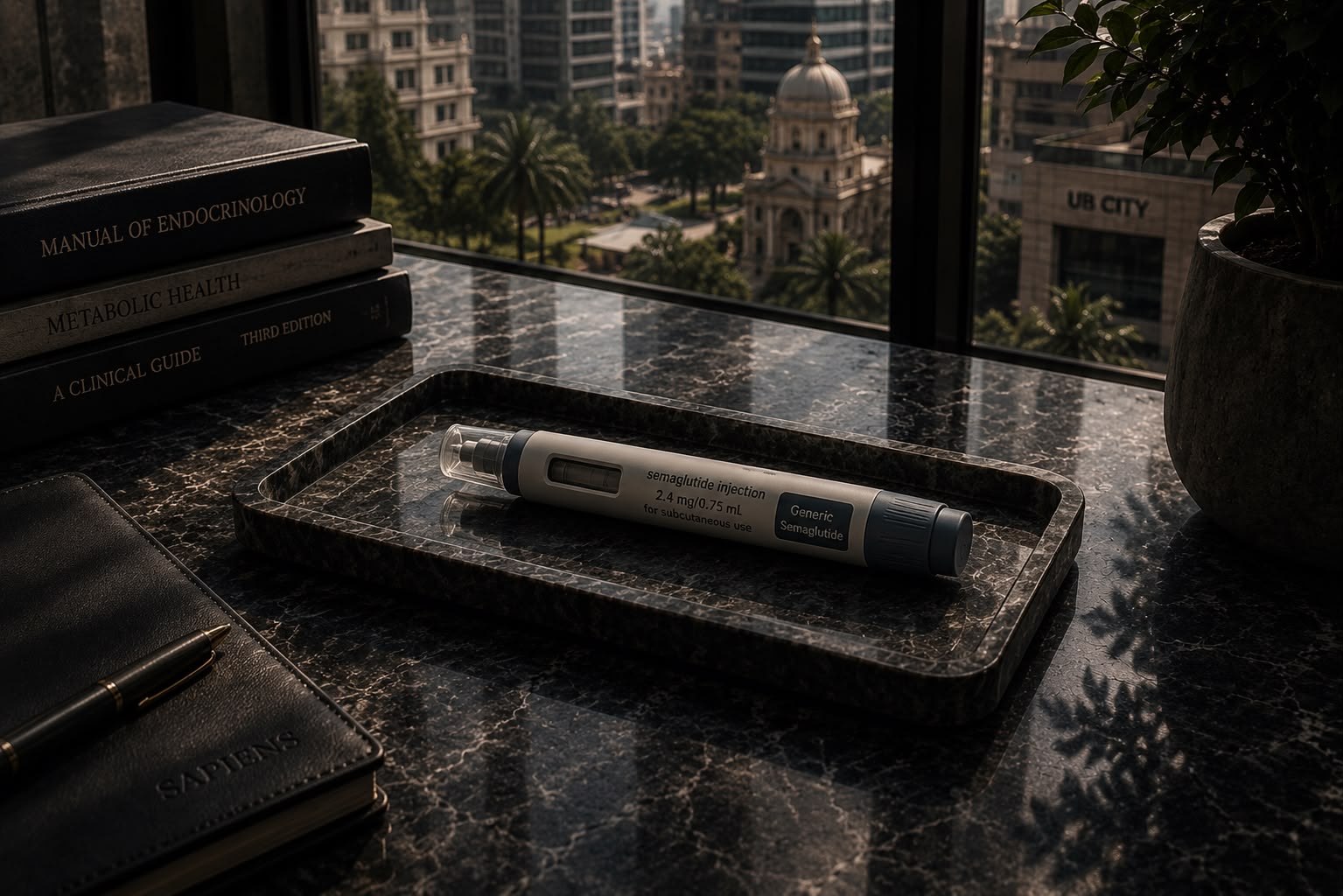
Generic semaglutide is real, licensed, and now widely available on Indian pharmacy shelves: the patent expired on 20 March 2026, more than a dozen Indian companies have launched versions, and dozens more brands were expected as the market opened. The cheapest licensed vial now costs ₹1,290 a month against the ₹5,660 that branded Ozempic charges at its own starting dose.1,2
The copies moved fast: within the first fortnight, Bloomberg data had generics at roughly 30% of the semaglutide market by value, and by April they were selling ₹44 crore a month.3,4 That speed has consequences worth understanding before you buy. There are eleven brand families at very different price points, three formats that demand different skills, a licensing map the counter does not always respect, and a documented counterfeit record. This page is the map.
Quick facts
- Semaglutide went off patent in India on 20 March 2026; licensed generics launched within a day and now span vials, pens and tablets.2
- Licensed generic prices run ₹1,290–8,000 a month by maker and format; oral generic semaglutide starts at ₹99 a tablet.
- Branded prices fell too: Novo cut twice, and Ozempic and Wegovy now start at ₹5,660 a month.1
- Bloomberg data showed generics at roughly 30% of India’s semaglutide market by value within weeks; by April they were selling ₹44 crore a month, led by Torrent.3,4
- Tirzepatide (Mounjaro) is a different molecule with no generic in India.
- Every product on this page is prescription-only. The core semaglutide contraindications and safety precautions still apply; monitoring is individualised to the indication, formulation and patient.
What changed on 20 March Copy link
For a year before the expiry, semaglutide in India meant three Novo Nordisk products at premium prices, and a waiting market of generic manufacturers with approvals already in hand. Dr Reddy’s was the first Indian company to receive DCGI clearance, on the strength of a 312-participant head-to-head trial against the innovator; Natco fired the first shot at the counter, launching the day the patent lapsed.5,6 When the patent lapsed on a Friday, the first launches came that weekend, undercutting the originals by up to 80%.2
The counter-move arrived eleven days later. Novo Nordisk, which had already trimmed Wegovy in November, cut both its injectables again on 31 March. The starting doses of Ozempic and Wegovy fell to ₹1,415 a weekly shot, ₹5,660 a month, and the average reductions ran 23.8% and 27% across their dose ranges.1 Sun Pharma answered from the other direction with a weekly price as low as ₹750.2 By the end of March, Bloomberg data showed Novo still holding about 70% of the semaglutide market by value, the generics splitting the rest, and Torrent alone at 8%; even Mounjaro’s Indian sales dipped as the cheap semaglutide wave rose.3 April hardened the picture: generic semaglutide sold ₹44 crore in the month, and Torrent, the only maker shipping both an injectable and a tablet, held 38% of it.4 The argument about whether Indians would trust a generic GLP-1 is over. The market settled it.
The shelf, maker by maker Copy link
Eleven brand families from ten manufacturers cover what a counter will actually stock. Formats matter as much as names here, so the table carries both.7,8,9,10
| Brand | Maker | Format | Monthly cost | Licensed for |
|---|---|---|---|---|
| Semanat | Natco | Multi-dose vial + syringes | ₹1,290–1,750 | Type 2 diabetes |
| Semafull | Natco | Pre-filled pen (from April) | ₹4,000–4,500 | Type 2 diabetes |
| Sundae | Eris | Multi-dose vial | from ₹1,290 | Type 2 diabetes |
| Sundae (pen) | Eris | Pre-filled pen, three strengths (from April) | ₹4,000–4,500 | Type 2 diabetes |
| GLIPIQ | Glenmark | Multi-dose vial + pre-filled pen | from ₹325 a week (≈₹1,300–1,760 a month) | Type 2 diabetes |
| Semasize / Obesema / Hepaglide | Alkem | Pre-filled pen | from ₹1,800 | Diabetes and weight |
| Semaglyn / Mashema / Alterme | Zydus (with Lupin) | Reusable multi-dose pen | about ₹2,200 | Diabetes and obesity |
| Sematrinity | Sun Pharma | Multi-dose pen, two strengths | ₹3,000–5,200 | Type 2 diabetes |
| Noveltreat | Sun Pharma | Pre-filled pen, five strengths | ₹3,600–8,000 | Weight management |
| Obeda | Dr Reddy’s | Disposable pen, 2 and 4 mg | about ₹4,200 | Type 2 diabetes |
| Sembolic / Samakind / Semabest | Torrent / Mankind / MSN | Injectable pens (Torrent also sells oral) | confirm current MRP at the counter | Check the label; licences vary |
| Obeda tablets / Semalix | Dr Reddy’s / Torrent | Oral, daily | from ₹99 a tablet, near ₹3,000 a month | Type 2 diabetes |
Notice what the licensing column says. Several of the cheapest products carry a type 2 diabetes licence only, while the weight-management licence sits on specific brands such as Noveltreat and Alkem’s range. Prescribing outside the licence is a documented clinical decision your doctor can make; it is different from a counter treating every semaglutide box as interchangeable, which no licence supports.
One molecule, four prices Copy link
Strip the brand names away and the market sorts into four tiers, which is the version worth carrying in your head.
The vial tier starts near ₹1,290 a month, and asks you to draw up each dose. The generic pen tier runs roughly ₹1,800–4,500 and works like the branded device. The branded tier now spans ₹5,660 at the entry dose to the mid-teens of thousands at Wegovy’s full dose. And the oral tier, at ₹99 a tablet, lands near ₹3,000 a month taken daily.7 Over a year of maintenance, the spread is roughly ₹16,000 against ₹2 lakh, for the same molecule. That gap is why affordability is a clinical variable, and why the sustainable option often beats the prestigious one. The wider arithmetic, consult and labs included, is worked through inside the Ozempic in India guide and our medical weight-loss guide.
Is a generic the same drug? Copy link
The right frame is regulatory, and it is reassuring without being naive. Every licensed generic on this page had to satisfy the CDSCO’s requirements for its semaglutide formulation, covering quality standards and, where the pathway requires them, bioavailability and bioequivalence studies — and several makers went further, into Indian clinical data. Dr Reddy’s cleared its approval with a 312-participant head-to-head Phase III against the innovator, showing non-inferior efficacy and similar safety; Glenmark’s approval followed a multicentre, randomised, active-controlled Phase III in Indian patients with type 2 diabetes.5,10 The molecule is the molecule: the same peptide whose landmark trial produced a mean 14.9% weight loss at the 2.4 mg dose.13 That evidence belongs to the molecule, though; it does not mean every new Indian brand has independently repeated a 68-week STEP-1-style obesity outcomes trial.
What a young product cannot have is years of its own real-world record: the branded pens carry that history, the specific box in your fridge does not. That is a reason for ordinary vigilance, and for buying from makers of standing. It is not a reason to pay six times the price for the same peptide, and the prescribing doctors of India appear to agree, at scale.4
| Licensed generic | Branded (Ozempic / Wegovy) | |
|---|---|---|
| Molecule | Semaglutide — the identical peptide | Semaglutide |
| Evidence | CDSCO quality bar; several makers ran comparative Indian Phase III trials5,10 | The STEP and SUSTAIN trial programmes, plus years of global pharmacovigilance |
| Monthly cost | ₹1,290–8,000 | ₹5,660–16,400 |
| Formats | Vials, disposable and reusable pens, tablets | Pre-filled pens; Rybelsus tablets |
| Track record | Months in the Indian market | Years, worldwide |
| Rules | Prescription-only, both. The core molecule-related contraindications and precautions remain applicable; monitoring depends on indication and patient. | |
Vial or pen: the skill question Copy link
The price floor belongs to multi-dose vials, and vials come with homework. Each weekly dose is measured out at home with an insulin syringe, by you. Lakhs of Indian households already do this daily for insulin, and that is exactly the population the vial makers priced for. If that describes your household, the floor price is genuinely available to you. If the thought of drawing 0.05 ml accurately makes you nervous, it should, and the pen tier exists for exactly that nervousness. What the extra ₹500–3,000 a month buys is a device that meters the dose for you.
Two format warnings earn their space. Vial strengths and draw volumes do not mirror the pen doses you may know from Ozempic, so the strength on the label deserves a careful look every single time. And a reusable pen with cartridges, the Zydus design, is a third pattern again, with its own loading steps. Whichever format you choose, have the pharmacist walk you through the first dose, and ask for the draw volume in writing on the prescription if you are on vials.
Switching from Ozempic or Wegovy Copy link
Because the molecule is identical, switching between equivalent injectable semaglutide products can often be done at your current weekly dose, with no new titration ladder — provided your prescriber matches the formulation, concentration, indication and device. Oral and injectable semaglutide are not milligram-for-milligram interchangeable, so a tablet-to-injection move is a fresh prescribing decision, not a swap. The discipline sits elsewhere. The switch should be your prescriber’s written decision: under Rule 65(11A) of the Drugs and Cosmetics Rules, a pharmacist dispensing a Schedule H prescription cannot supply a different preparation in place of the one written on it. Brand changes belong to the prescriber, and dose-format mismatches are where substitution goes wrong in practice.
Once switched, stay on one brand rather than drifting with whatever the counter stocks that month. Supply in this market is young, so stock-outs happen; when they do, the answer is a call to your prescriber, and the interim answer is never a different molecule. If you are weighing a molecule change instead, tirzepatide against semaglutide is a different decision entirely, and the head-to-head comparison covers it.
Buying safely: the counterfeit record Copy link
This section stopped being theoretical this year. April 2026 brought the Gurugram case: over 260 suspect GLP-1 pens pulled from a car near Delhi by Haryana’s drug administration, two arrests, and ingredients traced to Alibaba listings. The stock had never seen a refrigerator, and the lettering did not match the genuine carton.14 February had already produced a warning from Britain’s MHRA about a falsified KwikPen batch at one online pharmacy, exposed when the dose knobs failed.15 And in July the forgers reached this article’s own molecule: the CDSCO directed state regulators to tighten supply-chain surveillance after an Interpol alert, routed through the CBI, flagged falsified semaglutide batches traced out of an Austrian investigation.16 A market this hot draws forgers, and a forged peptide is a double failure: it will not work, and its sterility is unknown.
Your protections are unglamorous and effective. Buy against a valid prescription from a licensed pharmacy, physical or online; treat any seller who does not ask for one as disqualified. Match the brand, strength and batch number on the carton to the bill, and check the expiry and the printed MRP. Confirm the injectable has been stored within the manufacturer’s permitted temperature range, and if a brand is unfamiliar, check that it appears in the CDSCO’s published approval lists before paying. Injectable semaglutide is generally supplied refrigerated, though permitted room-temperature windows vary by product and device, so follow the carton and the package insert for your exact brand; oral semaglutide tablets are stored at room temperature, protected from moisture. Most people who have bought insulin here know these motions already. The full counter checklist lives inside the Ozempic in India guide, question by question, and covers every box on this shelf.
Who should take it, and who should not Copy link
A cheaper price changes the affordability of semaglutide. It changes nothing about the medicine, and two different lists travel with the molecule. The hard stops: a personal or family history of medullary thyroid carcinoma or MEN 2 syndrome, a previous serious allergic reaction to semaglutide, and weight-loss treatment in pregnancy. Semaglutide used for weight management should be stopped during pregnancy and at least two months before a planned pregnancy, because the drug clears slowly; breastfeeding advice depends on the formulation and is a conversation with your prescriber. Then the list that needs individual judgement: a history of pancreatitis, severe gastroparesis or other significant gut disease, diabetic retinopathy, gallbladder disease, and kidney disease where a bad week of vomiting could tip function. So does the workup. Under India’s revised obesity framework, drug treatment enters the picture at Stage 2, where a BMI above 23 travels with abdominal obesity plus a functional limit or a weight-related condition. At Stage 1, lifestyle change comes first.17
Baseline testing depends on why you are starting and what your history holds. It is good obesity care, and it is where treating a patient differs from dispensing a box. HbA1c places you on the diabetes spectrum, and kidney function matters before a drug whose worst days involve vomiting; a lipid profile, liver enzymes and a thyroid check join when your history makes them relevant. One structured panel covers the lot. Where the weight gain itself has no explanation, the thyroid chapter deserves a read before any injection. And when you want the assessment done properly end to end, that is what Sapiens is opening with: eligibility, baseline labs, titration and monitoring as one supervised programme.
What has no generic Copy link
The generic revolution is a semaglutide story only, and its limits are just as instructive: even mid price war, tirzepatide holds about 63% of India’s GLP-1 market by value, and Mounjaro has been reported as the country’s top-selling medicine brand since October 2025.4,11 Tirzepatide, the molecule in Mounjaro and its Cipla co-brand Yurpeak, remains under Indian patent cover expected to hold to roughly 2036. No licensed generic exists, and anything sold as one is a red flag by definition. If a counter offers you “generic Mounjaro”, walk out. The same logic applies to Wegovy itself. Its price has fallen and its molecule is what the generics copy, but a box claiming to be Wegovy at a generic price is either a licensed generic under its own name or a problem.
Frequently asked questions Copy link
Is generic semaglutide available in India now?
Yes. The Indian patent on semaglutide expired on 20 March 2026, licensed generics launched the same weekend, and more than a dozen Indian companies have since entered with vials, pens and tablets. The cheapest licensed vial format starts near ₹1,290 a month, and generic sales had reached ₹44 crore a month by April.
Which companies make generic semaglutide, and under what brand names?
The major launches so far: Natco (Semanat vial, Semafull pen), Eris (Sundae vial), Alkem (Semasize, Obesema and Hepaglide pens), and Zydus with Lupin (Semaglyn, Mashema and Alterme reusable pens). Sun Pharma sells Sematrinity for diabetes and Noveltreat for weight, Dr Reddy’s sells the Obeda pen and tablets, Glenmark sells GLIPIQ in vial and pen, and Torrent (Sembolic, Semalix), Mankind (Samakind) and MSN (Semabest) round out the shelf. Extensior, Poviztra and Yurpeak are partner brands of the original products, and are priced accordingly.
How much does generic semaglutide cost in India?
Licensed generic vials start near ₹1,290 a month, with Glenmark quoting its vial at ₹325 a week, and generic pens run roughly ₹1,800–4,500 by maker and dose. Sun’s weight-management range reaches ₹8,000 at the top dose, and oral generic semaglutide starts at ₹99 a tablet, near ₹3,000 a month. Branded Ozempic and Wegovy now start at ₹5,660 a month after two price cuts. Prices in this market have mostly moved downward and change often.
Is generic semaglutide as effective as Ozempic?
It is the same molecule at the same doses, and every licensed generic had to clear the CDSCO’s quality bar, with bioequivalence evidence where the pathway demands it; several makers, including Dr Reddy’s and Glenmark, additionally ran comparative Phase III trials in Indian patients. The expected effect is comparable. What differs is format, device and price, and the branded products’ longer real-world track record.
Can I switch from Ozempic or Wegovy to a generic?
Often, yes: between equivalent injectable products, the same molecule usually means continuing at your current dose rather than restarting titration — but your prescriber must match the formulation, concentration, indication and device, and oral and injectable semaglutide are not milligram-for-milligram interchangeable. The switch is the prescriber’s written decision; under the Drugs and Cosmetics Rules, a pharmacist cannot substitute a different preparation for the one prescribed. After switching, stay on one brand, and check vial strengths carefully, as they do not mirror the pen doses.
Should I choose a vial or a pen?
Vials are the cheapest format and require you to draw up each weekly dose with an insulin syringe, a skill many Indian households already have. Pens cost ₹500–3,000 more a month and meter the dose for you. Choose the vial only if the draw-up genuinely does not intimidate you, and have the pharmacist demonstrate the first dose either way.
Is there a generic version of Mounjaro or Wegovy?
There is no generic tirzepatide in India; Mounjaro’s molecule stays under patent cover expected to hold to roughly 2036. Wegovy’s molecule, semaglutide, is what all these generics copy, so the generics compete with Wegovy without carrying its name. Anything sold as “generic Mounjaro” is not a licensed product.
Do I still need a prescription and blood tests?
A prescription, always: every product on this page is Schedule H, and a pharmacist can neither sell it without one nor substitute a different brand for the one written. Baseline tests depend on why you are taking semaglutide and on your history — HbA1c and kidney function are commonly useful, with liver enzymes, lipids, thyroid testing and other investigations added when clinically relevant. A structured baseline is good obesity care, and it is what separates a treatment from a transaction.
What happens if I stop taking it?
In semaglutide’s withdrawal evidence, the year after stopping handed back about two-thirds of the average loss. So plan stopping with your doctor: a maintenance dose, or a stepped reduction, with diet, protein and strength work carrying more of the load.18
References Copy link
- Novo Nordisk cuts prices of Ozempic, Wegovy in India again to fend off generics. Reuters, 31 March 2026 — eleven days after patent expiry, both drugs’ 0.25 mg starting doses fell to ₹1,415 a weekly shot (₹5,660 a month), with average reductions of 23.8% across Ozempic’s three doses and 27% across Wegovy’s five, reaching 36% and 48% at the entry doses. Company-announced prices; pharmacy quotes vary around them.
- India is launching cheap weight-loss drugs, but Novo Nordisk is betting its brands will stay on top. CNBC, 23 March 2026 — at least five drugmakers launched over the first weekend at up to 80% below the original price; Sun Pharma’s entry ran as low as ₹750 a weekly injection; Dr Reddy’s launched near ₹4,200 a month with export plans for Canada, Turkey and Brazil.
- Generic semaglutide climbs to 33% share in India, eroding branded players’ pricing power. EMARKETER, citing Bloomberg, early April 2026 — read the layers correctly: the 33% is semaglutide’s share of India’s whole GLP-1 market in March (up from 25% in February), taken from tirzepatide. Within semaglutide, Novo retained about 70% by value and Torrent had reached 8%, and Mounjaro’s Indian sales dipped from about $14.6 million in February to $12.3 million in March. Second-hand market reporting, used only for these Bloomberg-attributed March figures.
- Torrent emerges early leader in India’s generic semaglutide race with 38% market share. Medical Dialogues, 9 May 2026, reporting the Pharmarack PharmaTrac MAT April 2026 dataset — generic semaglutide sold about ₹44 crore in April, with Torrent near 38% of the generic segment; India’s GLP-1 agonist market tripled year on year to ₹1,736 crore, with tirzepatide at 63% of value and semaglutide near 30%.
- Dr Reddy’s Laboratories announces launch of India’s first DCGI-approved Semaglutide injection ‘Obeda’ for Type 2 Diabetes. Company press release filed under SEBI Regulation 30, via SEC Form 6-K, 21 March 2026 — the primary record of the first-approval claim and of the 312-participant head-to-head Phase III showing non-inferior efficacy and similar safety to the innovator.
- ₹325–4,200/month: Dr Reddy’s, Sun Pharma, Glenmark kick off generic semaglutide price war. ThePrint, 22 March 2026 — independently corroborates Dr Reddy’s as the first to receive DCGI approval, records Natco launching on the Friday before formal expiry, and details Zydus’s semi-exclusive licensing partnerships with Lupin and Torrent.
- Indian drugmakers flood market with cheaper versions of Novo’s Ozempic, Wegovy. Reuters factbox — launch-by-launch detail: Sun’s Noveltreat in five strengths at ₹900–2,000 a week and Sematrinity at ₹750–1,300; Dr Reddy’s Obeda pen in 2 and 4 mg near ₹4,200 a month; Zydus’s reusable multi-dose pen device. Dr Reddy’s later added oral semaglutide from ₹99 a tablet, following Torrent’s Semalix.
- Sun Pharma launches semaglutide injection under brand names Noveltreat and Sematrinity in India. Business Standard, 21 March 2026 — the company’s launch statement: Noveltreat for chronic weight management in five strengths from 0.25 to 2.4 mg at ₹900–2,000 a week; Sematrinity for type 2 diabetes in two strengths at ₹750–1,300 a week; pre-filled pen devices manufactured in Europe.
- Eris Lifesciences launches generic semaglutide under the brand ‘SUNDAE’. Company launch release, 20 March 2026 — multi-dose vials from ₹1,290 a month for the 2 mg/1.5 ml and 4 mg/3 ml variants, entry-dose costs quoted from ₹220 a shot, and a pen version from April at ₹4,000, ₹4,200 and ₹4,500 a month by strength.
- Glenmark Pharmaceuticals launches GLIPIQ® (semaglutide) in India. Company press release, March 2026 — weekly treatment from ₹325 in vial and pre-filled pen formats, approved by the CDSCO after a multicentre, randomised, comparative, active-controlled, open-label Phase III study in Indian patients with type 2 diabetes.
- Recalls by Dr Reddy’s, Torrent put spotlight on quality standards in India’s semaglutide market. Medical Dialogues, July 2026 — voluntary recalls of selected Obeda, Semalix and Usema batches by Dr Reddy’s, Torrent and USV; Dr Reddy’s halted new manufacturing after an impurity surfaced during production scale-up, with Indian supply disruption expected until at least late October. The piece also records Mounjaro as India’s top-selling medicine brand since October 2025.
- Dr Reddy’s says API issue delays commercial supplies of its generic semaglutide. Pharma Manufacturing, August 2026 — the impurity was detected in API pre-validation batches during scale-up; existing inventories are unaffected, and the company guided to resuming commercial supply around late October or early November 2026.
- Wilding JPH, Batterham RL, Calanna S, et al.; STEP 1 Study Group. Once-weekly semaglutide in adults with overweight or obesity. New England Journal of Medicine. 2021;384:989–1002 — the molecule’s efficacy anchor: mean weight change −14.9% at 68 weeks on semaglutide 2.4 mg against placebo. Every licensed generic on this page trades on this evidence base. DOI 10.1056/NEJMoa2032183
- India seizes suspected fake Mounjaro pens, says raw materials sourced from Alibaba. Reuters, 20 April 2026 — Haryana’s Food and Drug Control Administration recovered more than 260 suspected counterfeit Mounjaro KwikPens near Delhi and arrested two accused; raw materials had been ordered from Alibaba vendors, the pens were stored outside cold-chain conditions, and label details differed from the genuine product. Eli Lilly is supporting the investigation.
- Falsified Mounjaro KwikPen 15 mg pre-filled pens. MHRA, Drug Safety Update, 24 February 2026 — a falsified batch (D873576) supplied through one UK online pharmacy, identified when dose knobs failed in use; likely containing tirzepatide but below the quality and safety standards of legitimate pens. Regulator source.
- CDSCO tightens semaglutide oversight after counterfeit alert. Market reporting, July 2026 — the CDSCO directed state drug regulators to intensify supply-chain surveillance under the Drugs and Cosmetics Act after an Interpol alert, shared through the CBI, identified counterfeit semaglutide batches traced from an Austrian investigation. Secondary reporting of the regulatory directive.
- Misra A, Vikram NK, Ghosh A, Ranjan P, Gulati S, et al. Revised definition of obesity in Asian Indians living in India. Diabetes & Metabolic Syndrome: Clinical Research & Reviews. 2025;19(1):102989 — stage-based framework: obesity begins at BMI above 23; Stage 1, increased adiposity without organ or functional effects, is managed primarily with lifestyle; Stage 2, adding abdominal adiposity by waist (above 90 cm for men, 80 cm for women) or waist-to-height ratio plus functional limitation or a comorbidity, warrants intensive management including early pharmacotherapy. PMID 39814628
- Wilding JPH, Batterham RL, Davies M, et al. Weight regain and cardiometabolic effects after withdrawal of semaglutide: the STEP 1 trial extension. Diabetes, Obesity and Metabolism. 2022;24(8):1553–1564 — one year after stopping, participants had regained roughly two-thirds of lost weight, with cardiometabolic improvements reverting toward baseline. Exploratory analyses in a subset of trial sites, so hypothesis-generating rather than confirmatory. PMID 35441470
This article is educational and does not replace personalised medical advice. Semaglutide in all its branded and generic forms is a Schedule H prescription medicine in India, to be started and adjusted only under a registered medical practitioner. Prices are dated market references reviewed on 8 August 2026 and change frequently; trial figures are averages from the cited studies. Report an error on this page.