Sapiens · GLP-1
Mounjaro vs Wegovy: Which Works Better, and What Each Costs in India
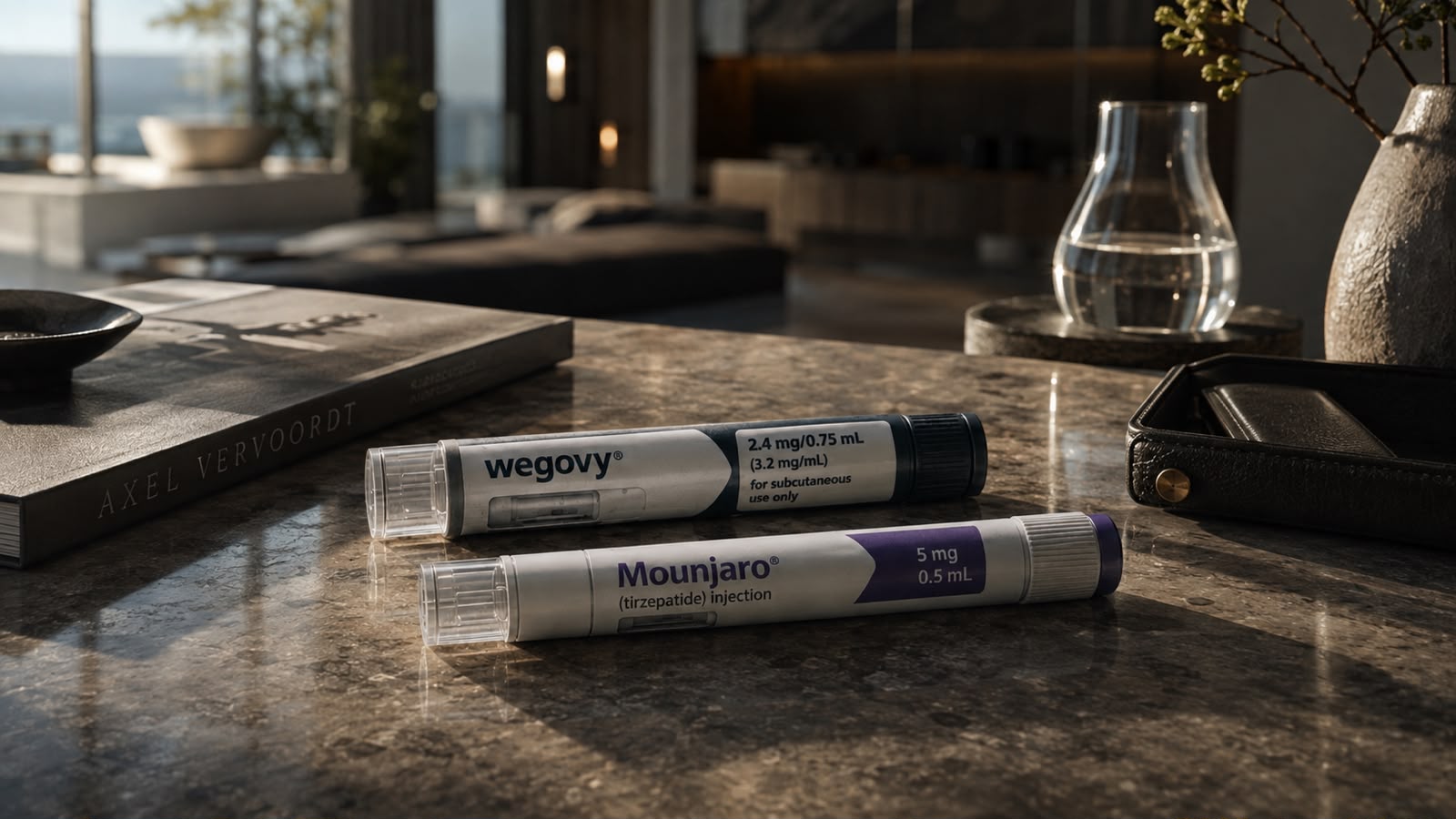
Mounjaro produces more weight loss than Wegovy, and the margin is now directly measured: in the only head-to-head trial, tirzepatide averaged a 20.2% reduction in body weight over 72 weeks against 13.7% for semaglutide at its full Wegovy dose.1
Wegovy answers back on two fronts. Its molecule carries placebo-controlled proof of fewer heart attacks and strokes, which tirzepatide does not yet have. And its Indian patent expired in March 2026, so the same semaglutide now sells from ₹1,290 a month while Mounjaro holds at ₹13,125–25,781 with no generic in sight. Which fact should decide it depends on your body, your bloodwork and your budget, and this page walks through all three.
Quick facts
- Wegovy is semaglutide. Mounjaro is tirzepatide. They are different molecules, and Ozempic is the same molecule as Wegovy at lower doses.
- In SURMOUNT-5, the direct trial, tirzepatide beat semaglutide on average weight loss: 20.2% against 13.7% at 72 weeks.1
- Semaglutide 2.4 mg has placebo-controlled evidence of fewer major cardiovascular events. Tirzepatide’s equivalent trial reads out around 2027.4
- After two price cuts, Wegovy starts at ₹5,660 a month in India. Mounjaro runs ₹13,125–25,781. Generic semaglutide starts at ₹1,290.
- No generic tirzepatide currently exists in India.
- Both are prescription-only weekly injections that require medical assessment, dose titration and appropriate baseline monitoring.
Two molecules, five brand names Copy link
Start by clearing the naming fog, because most of the confusion in this comparison is branding. Semaglutide is one molecule, sold in India as Wegovy for weight management, as Ozempic for type 2 diabetes at lower doses, and as Rybelsus in daily tablet form. Tirzepatide is a different molecule, sold as Mounjaro and licensed in India for both diabetes and weight. So the phrase “Ozempic vs Wegovy” compares a molecule with itself; the comparison with actual stakes is semaglutide against tirzepatide, and that is the one this page runs, inside our wider medical weight-loss guide.
The pharmacology differs in one important way. Semaglutide imitates a single gut hormone, GLP-1, which quiets appetite, slows the stomach and steadies blood sugar. Tirzepatide imitates two: GLP-1 plus a second incretin called GIP, which appears to amplify the effect on appetite and on how fat tissue handles energy. One receptor against two is the cleanest available explanation for the gap you are about to see in the trial data, though nobody would claim the mechanism is fully mapped.
Both partner widely in India. Novo Nordisk sells second brands of its semaglutide injections through Emcure, and Cipla co-markets tirzepatide as Yurpeak. Same drug, same maker, different box — none of these partner brands is a generic.
The head-to-head: what SURMOUNT-5 found Copy link
Until 2025, comparing these drugs meant comparing separate trials with different participants, a method that suggests but never settles. SURMOUNT-5 settled it. The trial randomised 751 adults with obesity but not diabetes to the maximum tolerated dose of tirzepatide (10 or 15 mg) or semaglutide (1.7 or 2.4 mg) weekly for 72 weeks. Everyone received the same behavioural support.1 Open-label, funded by Eli Lilly, published in the New England Journal of Medicine, and consistent almost to the decimal with what each drug had shown separately.2,3
Weight fell by a mean of 20.2% on tirzepatide against 13.7% on semaglutide. Waist circumference dropped 18.4 cm against 13.0 cm. And at the ambitious end, 32% of the tirzepatide group lost at least a quarter of their body weight; on semaglutide, 16% did. Every one of those differences was statistically significant, and the gap held across subgroups.1
Two findings deserve more attention than they get. Women lost considerably more than men on both drugs: 23.8% against 17.8% on tirzepatide, 18.0% against 11.0% on semaglutide. The investigators noted this reverses the old dieting pattern, where men reliably lost more.1 And the tolerability result ran against intuition. Despite tirzepatide being the stronger drug, gastrointestinal side effects forced more discontinuations on semaglutide, 5.6% against 2.7%.1 Potency and tolerability turned out not to be a simple trade.
A second head-to-head exists at diabetes doses. SURPASS-2 compared tirzepatide with semaglutide 1 mg, the Ozempic maintenance dose, in type 2 diabetes, and tirzepatide won on both blood sugar and weight there too.6 So the pattern repeats at two different dose levels, in two different populations. On average effectiveness, this question is answered.
What the headline number hides Copy link
Averages conceal as much as they reveal, and three things live under that 6.5-point gap.
First, individual spread is wide on both drugs. Plenty of people respond better to semaglutide than the average suggests, and a smaller group responds poorly to tirzepatide; the reasons remain genuinely unclear. You will not know your own response curve until roughly three months in, which is one reason the choice stays revisable. And if unexplained weight gain is part of your story, it is worth ruling the thyroid in or out before attributing everything to lifestyle.
Second, enough is a real number. The SURMOUNT-5 lead investigator made this point himself: for people with class 1 obesity, a BMI of 30 to 35, semaglutide’s average loss is often sufficient to reach a healthy weight. The extra power of tirzepatide matters most at higher starting weights.1 India defines the starting line differently, and its definition answers a question most comparisons skip: whether this drug class applies to you at all. The revised 2025 Indian framework starts obesity at a BMI above 23 and then stages it. Stage 1 is raised adiposity without effects on organ function or daily life, managed first with lifestyle change. Stage 2 requires, on top of the BMI, abdominal obesity (a waist above 90 cm for men or 80 cm for women, or a raised waist-to-height ratio) together with functional limitation or a weight-related condition. That is the stage where intensive treatment, including early pharmacotherapy, enters the guideline.13 If your pattern reads Stage 2, this comparison is clinically live for you; at Stage 1, the guideline’s first prescription is usually not an injection at all. If you are unsure where you fall, a baseline workup answers it; a structured full-body panel covers the relevant markers in one draw.
Third, the scale does not report what kind of weight left. Rapid loss on any drug takes lean muscle as well as fat unless you defend it, and muscle is what holds your metabolic rate and your strength through maintenance. If you are on either drug, it is worth asking your doctor for a protein target and pairing it with resistance work twice a week. The drug handles the appetite side, and the pairing protects the muscle. A smaller loss that is mostly fat beats a bigger one that took muscle with it, on either molecule.
Protein on an Indian plate Copy link
The muscle point deserves its own section, because the standard advice collides with the standard Indian meal. During drug-driven weight loss, protein needs rise toward 1.2–1.6 g per kilo of body weight a day, while a day built on dal, roti and rice commonly lands well short of it. An appetite the drug has switched off turns every large meal into a negotiation. The fix is ordering and density, which means protein first, before the roti reaches the plate. A katori of cooked dal carries roughly 7–8 g, 100 g of paneer about 18, a bowl of curd around 9, an egg 6–7. Soya chunks, at roughly 52 g per 100 g dry, remain the densest thing in a vegetarian kitchen, and whey works where it is acceptable.
If you are starting either drug, a gram target from your doctor or a dietitian is worth more than any supplement, and a follow-up body-composition check tells you whether the plan is holding muscle. On a smaller appetite, every bite has to argue for its place.
Heart evidence: where Wegovy still leads Copy link
Weight is what these drugs are bought for. Outcomes are what they are prescribed for, and here the two molecules stand on different ground.
Semaglutide 2.4 mg, the Wegovy dose, has SELECT: 17,604 people with cardiovascular disease and excess weight but no diabetes, randomised against placebo for over three years. Major adverse cardiovascular events fell by 20%.4 That is the trial that turned a weight-loss drug into a cardiology drug, and no other obesity medication has its equivalent yet.
Tirzepatide’s cardiovascular outcome trial, SURPASS-CVOT, reported in December 2025, and it was designed differently: against dulaglutide, an active drug with proven heart benefit of its own, in people with diabetes. Tirzepatide was non-inferior for major cardiovascular events, and a later post-hoc analysis found a broader cardiorenal composite 16% lower on tirzepatide, a hypothesis-generating result rather than a definitive one.5,7 The placebo-controlled obesity trial that would match SELECT, called SURMOUNT-MMO, runs in about 15,000 people and reads out around 2027.1
Read plainly: nothing suggests tirzepatide harms the heart, and the indirect signals point the right way. But if your history includes a heart attack, a stent or a stroke, semaglutide is the molecule with direct proof in people like you, and that can outweigh a percentage-point difference on the scale. This is precisely the kind of call your prescriber should make with your lipid numbers and history on the table.
What a month costs in India, dose by dose Copy link
Price is where 2026 redrew the map. Semaglutide’s Indian patent expired on 20 March; Novo Nordisk cut Wegovy’s price twice, once in November 2025 and again on 31 March 2026, and a wave of Indian generics landed underneath it.8,9 Tirzepatide sat the price war out. Eli Lilly has not cut Mounjaro, and with its patent protection reported to run to around 2036, no generic pressure is coming to make it.10 One consequence: until late 2025, Mounjaro was the cheaper of these two drugs. Two Wegovy cuts and the generic wave reversed that, and the reversal is recent enough that general awareness has not fully caught up.
| Rung | Wegovy (semaglutide) | Mounjaro (tirzepatide) |
|---|---|---|
| Starting dose | 0.25 mg — ₹5,660 | 2.5 mg — ₹13,125 |
| Early titration | 0.5 mg and 1 mg — unpublished; pharmacy-quoted between the entry and full-dose prices | 5 mg — ₹16,406 |
| Mid ladder | 1.7 mg — roughly ₹12,000–14,400 at pharmacies | 7.5 mg and 10 mg — ₹20,625 |
| Full / maintenance dose | 2.4 mg — roughly ₹12,800–16,400 | 12.5 mg and 15 mg — ₹25,781 |
| Generic version | from ₹1,290 (vial) to about ₹4,200 (pen) | none exists |
Methodology, stated plainly. Mounjaro’s figures are Eli Lilly’s KwikPen MRPs, unchanged since the September 2025 tax revision trimmed them slightly.10 Wegovy’s starting price of ₹1,415 a week (₹5,660 a month) is Novo’s stated figure from the 31 March cut, which averaged 27% across its five doses and reached 48% at the entry dose. The company did not publish every revised rung. So the mid and full doses above carry the range pharmacies actually quote, and the top of the 2.4 mg range is the pre-March ceiling.9 Treat all of it as dated: GLP-1 prices in India have moved five times in twelve months.
Run the arithmetic over a year and the gap stops being abstract. Maintenance on Mounjaro at 10 mg costs about ₹2.5 lakh annually. Wegovy at 2.4 mg costs roughly ₹1.5–2 lakh. The same semaglutide as a licensed Indian generic can run under ₹50,000. Since weight regain is common after stopping, the price you can carry for years matters more than the price you can manage for a launch month. The point is clinical, and the Ozempic in India guide covers it in full, including how generic substitution works at the counter.
Availability in India: brands, generics, patents Copy link
Both drugs are Schedule H: prescription-only, no exceptions. Wegovy arrived in June 2025 in five pen strengths and also sells as Poviztra through Emcure. Mounjaro arrived in March 2025 in vials, added the six-strength KwikPen in August, sells as Yurpeak through Cipla, and by October 2025 had become India’s top-selling drug by value. Sit with that fact a moment, in a country of 100 million people with diabetes.10
The structural difference is the generic shelf. Semaglutide now exists in India as vials from Natco and Eris, pens from Alkem, Sun, Zydus and Dr Reddy’s, and oral tablets from ₹99 a tablet, near ₹3,000 a month taken daily. That is an entire market underneath Wegovy. Tirzepatide has none of this and will not for years. So the price gap between these two molecules is set to define this market well into the next decade. Every practical question that follows from that — which generic brands exist, what bioequivalence approval actually requires, what to check at the pharmacy counter — is covered in the generic semaglutide guide.
Storage, stock-outs and fakes, in Indian conditions Copy link
Whichever box you carry home, it wants a refrigerator. Both drugs hold at 2–8°C until use, and both labels allow a limited period outside the fridge whose length differs by product and format. The leaflet in your carton is therefore the authority for the pen in your hand.15 Most people who have ordered medicines online through an Indian summer know the ritual already: insulated packaging, and gel packs that have kept their chill. If a delivery arrives warm, do not assume it is safe to refrigerate and use: check the product’s temperature limits and call the dispensing pharmacy first.
Stock-outs are now a routine feature of this market, and they connect straight back to the switching rule above. A missing brand is a reason to call your prescriber, and it is no reason to accept a different molecule across the counter. Counterfeits in this class are documented, in India and beyond, and recently. In April 2026, Haryana’s drug regulators seized more than 260 suspected counterfeit Mounjaro pens from a vehicle on the outskirts of Delhi and arrested two people. The raw materials had been ordered from vendors on Alibaba; the pens had not been kept cold, and the label fonts did not match the genuine article.14 Two months earlier, the UK regulator flagged a falsified batch of Mounjaro KwikPens sold through an online pharmacy, discovered when dose knobs came off in use.14 Buying from a licensed pharmacy, prescription in hand, and checking the batch number, expiry and printed MRP on the carton removes most of the risk. The full counter checklist in the Ozempic in India guide applies to every product on this page.
Side effects, compared properly Copy link
The two molecules share a side-effect family, of course, because they share a mechanism: nausea, constipation, diarrhoea and reflux, clustering around dose increases and easing as the body adapts. In SURMOUNT-5 the rates were strikingly similar — about 44% of each group reported nausea — and, as above, semaglutide caused more treatment-stopping gut trouble despite being the gentler drug on paper.1 Hair shedding from rapid weight loss touched roughly 6% of both groups, a temporary effluvium, and it regrows.1
The serious-but-rare list is also shared: pancreatitis, gallbladder trouble, and the dehydration that follows unrelenting vomiting, where a kidney-function baseline earns its keep. Both carry the class-wide contraindication for anyone with a personal or family history of medullary thyroid carcinoma or MEN 2 syndrome. Screening and slow titration are the protections, identical on either drug. Dose-by-dose specifics, warning signs and the two eye risks are laid out in the Ozempic side-effects guide. Much of it transfers across the class, though some of the evidence is semaglutide-specific, the eye signals in particular, so read it as a semaglutide guide with class-wide lessons.
Safety rarely decides this choice, because neither drug has shown a clear overall tolerability advantage in the direct obesity trial. They share the gastrointestinal profile and the serious warnings, but drug-specific risks and your own medical history still matter. Choose on effectiveness, outcomes evidence, price and fit, and expect the same management rhythm either way: screening first, slow titration, review at every dose change.
Which one fits which person Copy link
There is no universal winner here; there is a right fit, and it usually declares itself once you name what you are optimising for.
| If this matters most | The direction that follows |
|---|---|
| Maximum average weight loss | Tirzepatide. The head-to-head margin is 6.5 points and consistent. |
| Cost you can sustain for years | Semaglutide, branded or generic. The gap is five-to-tenfold at the floor. |
| A history of heart attack, stent or stroke | Semaglutide 2.4 mg carries the placebo-controlled outcomes proof today. |
| BMI in the low 30s | Either. Semaglutide’s average is often enough to reach target from here. |
| BMI well above 35, or a long distance to travel | Tirzepatide’s extra power earns its premium most clearly here. |
| Type 2 diabetes alongside the weight | Genuinely clinical. Both treat it; tirzepatide won SURPASS-2 on sugar control, semaglutide brings kidney and heart data. Your HbA1c and history decide. |
| Needles are the obstacle | Semaglutide is the only one with a tablet form, branded and generic. |
| Uncertain | Assessment first. The workup that qualifies you also often picks the drug. |
Notice what is absent from that table: brand loyalty. Prescribers switch people between these molecules routinely, which brings up the next question.
And when you are ready to look at this properly, the useful first step is molecule-neutral: a doctor-led assessment built on baseline labs and your history, which is how Sapiens is opening.
Switching between them Copy link
Switching is common, done for cost, availability, response or tolerability, and it has one iron rule: the doses do not map onto each other. There is no published equivalence chart between semaglutide milligrams and tirzepatide milligrams; they are different molecules with different potencies and different titration ladders. A switch is a prescriber’s job — typically landing you on a conservative rung of the new drug’s own ladder rather than a “matching” dose, then re-titrating on the usual four-week rhythm. Expect the adjustment weeks to feel like starting again, because pharmacologically you are.
A switch decided alone at the pharmacy counter is the risky version, and stock availability makes a poor prescriber. If your brand is out, a call to your doctor settles it safely; on-the-spot substitution between different molecules is where dosing errors happen.
After the goal weight Copy link
Both drugs manage a condition; neither cures one, and both now have randomised withdrawal trials that agree on what stopping does. In semaglutide’s, people got back roughly two-thirds of what they had lost within a year.11 In tirzepatide’s, SURMOUNT-4, those switched to placebo after 36 weeks of treatment regained 14 percentage points of body weight over the next year, while those who continued lost a further 5.5%. Nine in ten who continued kept at least 80% of their loss; on placebo, one in six did.12 So the plan at goal weight is a transition, made with your doctor: a maintenance dose, or a supervised step-down. Protein, resistance training and the habits built during the loss then carry more of the load. Reaching target opens the maintenance phase, and that phase deserves the same planning as the loss did.
Frequently asked questions Copy link
Is Mounjaro or Wegovy better for weight loss?
Mounjaro (tirzepatide) produced more weight loss in the direct trial: 20.2% of body weight over 72 weeks against 13.7% for Wegovy-dose semaglutide, with 32% versus 16% of participants losing a quarter of their weight. Individual responses vary widely, semaglutide is far cheaper in India since going off-patent, and semaglutide holds the only placebo-controlled heart-outcomes proof, so the better drug depends on your starting weight, heart history and budget.
What is the difference between semaglutide and tirzepatide?
Semaglutide (Wegovy, Ozempic, Rybelsus) imitates one gut hormone, GLP-1. Tirzepatide (Mounjaro) imitates two, GLP-1 and GIP, which is the leading explanation for its greater average weight loss. Both are once-weekly injections that reduce appetite, slow the stomach and improve blood sugar, and both need prescription, titration and monitoring.
Which is cheaper in India, Mounjaro or Wegovy?
Wegovy, by a wide margin. After Novo Nordisk’s two price cuts it starts at ₹5,660 a month, with the full 2.4 mg dose quoted around ₹12,800–16,400, and licensed generic semaglutide starts at ₹1,290 a month. Mounjaro runs ₹13,125–25,781 a month depending on dose, has had no price cut, and has no generic.
Does Mounjaro have more side effects than Wegovy?
No. In the head-to-head trial the side-effect profiles were nearly identical, with about 44% of each group reporting nausea, and slightly more people stopped semaglutide for gut side effects (5.6%) than tirzepatide (2.7%). Both share the same rare serious risks and the same thyroid-cancer-history contraindication, and both are managed the same way: slow titration under a doctor.
Can I switch from Wegovy to Mounjaro, or the other way?
Yes, and it is commonly done for cost, availability, response or tolerability. But the doses of the two molecules do not correspond, so a switch means starting the new drug’s own titration ladder at a rung your prescriber chooses instead of a like-for-like milligram swap. It should always run through your doctor rather than the pharmacy counter.
What is the difference between Ozempic, Wegovy and Mounjaro?
Ozempic and Wegovy contain one molecule, semaglutide: Ozempic carries the Indian type 2 diabetes licence at doses up to 1 mg, Wegovy the weight-management licence at doses up to 2.4 mg. Mounjaro is a different molecule, tirzepatide, licensed for both diabetes and weight. The real comparison is semaglutide versus tirzepatide.
Is there a generic version of Mounjaro in India?
No. Generic competition in 2026 applies only to semaglutide, whose patent expired on 20 March 2026. Tirzepatide remains under patent protection in India, with expiry estimates running to around 2036; there is currently no generic tirzepatide, and the available products are originator or partner-branded.
Which is better if I have diabetes?
Both treat type 2 diabetes, and this is a genuinely clinical call. Tirzepatide produced better blood-sugar control and more weight loss in its diabetes head-to-head against semaglutide 1 mg; semaglutide brings placebo-controlled cardiovascular proof and dedicated kidney-outcome evidence. Your HbA1c, kidney function, heart history and budget together point to the answer, which is why the decision belongs in a consult with your reports on the table.
Do I stop the medication once I reach my goal weight?
Not abruptly. Both molecules have randomised withdrawal trials: roughly two-thirds of lost weight returned within a year of stopping semaglutide. Stopping tirzepatide brought back 14 percentage points of body weight in a year, while continuing produced further loss. Most people transition to a maintenance dose or a gradual, supervised reduction while diet, protein and strength training take over more of the work. It is an individual medical decision, and one to plan in advance.
References Copy link
- Aronne LJ, Horn DB, le Roux CW, et al.; SURMOUNT-5 Trial Investigators. Tirzepatide as compared with semaglutide for the treatment of obesity. New England Journal of Medicine. 2025 — phase 3b open-label head-to-head in 751 adults with obesity, or overweight with a weight-related complication, and without diabetes, randomised 1:1 to maximum tolerated tirzepatide (10 or 15 mg) or semaglutide (1.7 or 2.4 mg) weekly for 72 weeks. Least-squares mean weight change −20.2% (95% CI −21.4 to −19.1) versus −13.7% (−14.9 to −12.6), P<0.001; waist circumference −18.4 cm versus −13.0 cm; at least 25% loss in 32% versus 16%. Women lost more than men in both arms (23.8% vs 18.0% on tirzepatide; 17.8% vs 11.0% for men). Nausea near 44% in both arms; gastrointestinal discontinuation 5.6% on semaglutide versus 2.7% on tirzepatide; alopecia about 6% in both. Open-label design and Eli Lilly funding are the caveats to carry. Presented at the European Congress on Obesity 2025. PMID 40353578; ClinicalTrials.gov NCT05822830
- Jastreboff AM, Aronne LJ, Ahmad NN, et al.; SURMOUNT-1 Investigators. Tirzepatide once weekly for the treatment of obesity. New England Journal of Medicine. 2022;387:205–216 — placebo-controlled trial of 2,539 adults with obesity; weight change up to −20.9% at 72 weeks on 15 mg. The single-drug benchmark that SURMOUNT-5 later confirmed head-to-head. DOI 10.1056/NEJMoa2206038
- Wilding JPH, Batterham RL, Calanna S, et al.; STEP 1 Study Group. Once-weekly semaglutide in adults with overweight or obesity. New England Journal of Medicine. 2021;384:989–1002 — placebo-controlled trial of 1,961 adults; mean weight change −14.9% at 68 weeks on semaglutide 2.4 mg. DOI 10.1056/NEJMoa2032183
- Lincoff AM, Brown-Frandsen K, Colhoun HM, et al.; SELECT Trial Investigators. Semaglutide and cardiovascular outcomes in obesity without diabetes. New England Journal of Medicine. 2023;389:2221–2232 — 17,604 adults with established cardiovascular disease and overweight or obesity, randomised to semaglutide 2.4 mg or placebo, mean follow-up 39.8 months; major adverse cardiovascular events fell 20% (HR 0.80, 95% CI 0.72–0.90). The placebo-controlled outcomes evidence that tirzepatide does not yet have at obesity doses. DOI 10.1056/NEJMoa2307563
- Nicholls SJ, Pavo I, Bhatt DL, et al.; SURPASS-CVOT Investigators. Cardiovascular outcomes with tirzepatide versus dulaglutide in type 2 diabetes. New England Journal of Medicine. 2025;393:2409–2420 — 13,165 adults with type 2 diabetes and established cardiovascular disease; tirzepatide non-inferior to dulaglutide for major cardiovascular events (12.2% vs 13.1%; HR 0.92; non-inferiority P=0.003, superiority P=0.09). Active-comparator design, so no placebo comparison exists within it. Funded by Eli Lilly. DOI 10.1056/NEJMoa2505928
- Frías JP, Davies MJ, Rosenstock J, et al.; SURPASS-2 Investigators. Tirzepatide versus semaglutide once weekly in patients with type 2 diabetes. New England Journal of Medicine. 2021;385:503–515 — head-to-head at diabetes doses: tirzepatide (5–15 mg) against semaglutide 1 mg in 1,879 patients; greater HbA1c reduction and greater weight loss on tirzepatide at every dose. DOI 10.1056/NEJMoa2107519
- Nissen SE, Wolski K, D’Alessio D, et al. Cardiorenal outcomes with tirzepatide compared with dulaglutide: a post hoc analysis of SURPASS-CVOT. JAMA Cardiology. Published online 28 March 2026 — expanded six-component composite 23.7% versus 27.4% over a median 46.9 months (HR 0.84, 95% CI 0.79–0.90). Post-hoc endpoint expansion, so hypothesis-generating; the authors say as much. DOI 10.1001/jamacardio.2026.0767
- Exclusive: Novo Nordisk cuts Wegovy price by up to 33% in India. Reuters, 12 November 2025 — first Wegovy cut: 2.4 mg to ₹16,400 from ₹24,389, 0.25 mg to ₹10,850, reported as up to 37% from launch price including the September 2025 tax revision. Days after Mounjaro became India’s top-selling drug by value in October.
- Novo Nordisk cuts prices of Ozempic, Wegovy in India again to fend off generics. Reuters, 31 March 2026 — second cut, eleven days after semaglutide’s patent expiry: both drugs’ 0.25 mg starting doses to ₹1,415 a weekly shot (₹5,660 a month); average reduction 27% across Wegovy’s five doses and 23.8% across Ozempic’s three, reaching 48% and 36% respectively at the entry doses. Novo did not publish every revised rung, which is why this page ranges the upper Wegovy doses. Company-announced prices; pharmacy quotes vary around them.
- Mounjaro KwikPen by Lilly debuts in India at ₹14,000. Business Standard, 13 August 2025 — KwikPen launch in six strengths, 2.5 to 15 mg, priced per month; current MRPs of ₹13,125–25,781 reflect the September 2025 tax revision. Also records Wegovy’s June 2025 launch pricing of ₹17,345–26,015 used as this page’s baseline. Business reporting; used for market facts only. Tirzepatide patent expiry near 2036 is industry-reported estimate, not a regulatory filing cited here.
- Wilding JPH, Batterham RL, Davies M, et al. Weight regain and cardiometabolic effects after withdrawal of semaglutide: the STEP 1 trial extension. Diabetes, Obesity and Metabolism. 2022;24(8):1553–1564 — one year after stopping semaglutide 2.4 mg, participants regained roughly two-thirds of lost weight, with cardiometabolic improvements reverting toward baseline. Exploratory analyses in a subset of trial sites, so hypothesis-generating rather than confirmatory, but the direction matches the rest of the class. PMID 35441470
- Aronne LJ, Sattar N, Horn DB, et al.; SURMOUNT-4 Investigators. Continued treatment with tirzepatide for maintenance of weight reduction in adults with obesity: the SURMOUNT-4 randomized clinical trial. JAMA. 2024;331(1):38–48 — randomised withdrawal design: 36 weeks of open-label tirzepatide (mean loss 20.9%), then 670 participants randomised to continue or switch to placebo for 52 weeks. The placebo arm regained a mean 14.0 percentage points of body weight; the continuation arm lost a further 5.5%. About nine in ten who continued maintained at least 80% of the lead-in loss, against 16.6% on placebo. The direct tirzepatide answer to the stopping question. PMID 38078870
- Misra A, Vikram NK, Ghosh A, Ranjan P, Gulati S, et al. Revised definition of obesity in Asian Indians living in India. Diabetes & Metabolic Syndrome: Clinical Research & Reviews. 2025;19(1):102989 — stage-based framework replacing the 2009 BMI-only consensus. Obesity begins at BMI above 23. Stage 1 is increased adiposity without discernible effects on organ function or daily activities, managed primarily with lifestyle modification. Stage 2 requires the BMI plus abdominal adiposity by waist circumference (above 90 cm for men, 80 cm for women) or waist-to-height ratio, plus functional limitation or an obesity-related comorbidity, and warrants intensive management including early pharmacotherapy. Expert consensus; eligibility for any particular medicine remains a licensing and clinical matter. PMID 39814628
- India seizes suspected fake Mounjaro pens, says raw materials sourced from Alibaba. Reuters, 20 April 2026 — the Haryana Food and Drug Control Administration recovered more than 260 suspected counterfeit Mounjaro KwikPens near Delhi and arrested two accused, with raw materials ordered from Alibaba vendors, pens stored outside cold-chain conditions, and label discrepancies against the genuine product; samples went to government laboratories and Eli Lilly is supporting the investigation. And: Falsified Mounjaro KwikPen 15 mg pre-filled pens. MHRA, Drug Safety Update, 24 February 2026 — a falsified batch (D873576) supplied through one UK online pharmacy, identified when dose knobs failed in use; likely containing tirzepatide but below quality and safety standards. Wire-service and regulator sources.
- Mounjaro storage guidance. Drugs.com, reviewed February 2026 — label summary keeping two limits distinct: an unopened excursion allowance of up to 21 days at or below 30°C for the original pen and vial, and separate 30-day in-use periods after first puncture for the multi-dose vial and KwikPen, handled per label. Wegovy’s label permits up to 28 days below 30°C before first use. US-label-derived summaries; the Indian package insert in the carton governs the product in hand.
This article is educational and does not replace personalised medical advice. Mounjaro and Wegovy are Schedule H prescription medicines in India, to be chosen, started and adjusted only under a registered medical practitioner. Trial figures are averages from the cited studies; individual results vary. Market prices are dated references reviewed on 8 August 2026 and change frequently. Report an error on this page.