Sapiens · Weight · GLP-1
GLP-1 Blood Tests: What Gets Checked Before Ozempic, Mounjaro or Wegovy
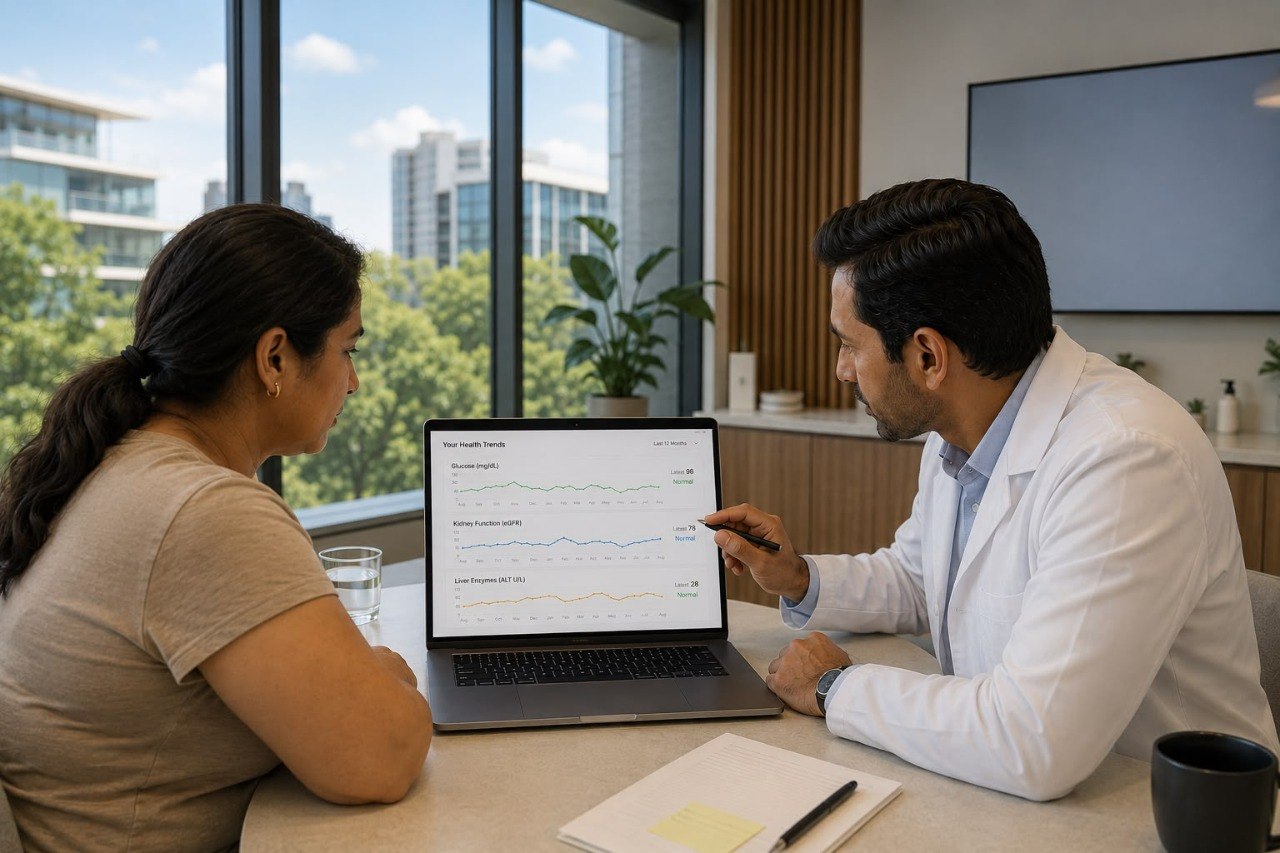
Semaglutide's Indian patent expired on 20 March 2026, and the forecast wave arrived on schedule: industry trackers counted more than forty companies lining up over fifty brands, and launches began within days.8 Getting hold of a GLP-1 pen has never been easier. Getting properly assessed before one still takes a blood draw, and here a common assumption needs correcting: there is no single, universally mandated GLP-1 blood-test panel. No drug label prescribes one. What doctors commonly order before semaglutide (Ozempic, Wegovy, Rybelsus) or tirzepatide (Mounjaro) is an assessment of glucose control, kidney and liver function and cardiovascular risk. Typically that means HbA1c, fasting glucose, a lipid profile, liver function tests (LFT), kidney function tests (KFT), with thyroid function (TSH), a complete blood count and nutritional markers added according to your history and the clinic's protocol. This page walks through what each test checks, which results change the plan or prompt a pause, and what gets rechecked once you start.
What goes into a baseline panel? Copy link
Seven tests, usually collectable in one sitting. To be plain about what this is: the comprehensive baseline many clinics use, shaped by the medicine's known risks, and one no regulator mandates. Your doctor may trim it or extend it. Each test does a specific job, and each is worth knowing by name, because these are the same numbers your progress will be measured against for as long as you take the medicine.
| Test | What it measures | What it can change before you start |
|---|---|---|
| HbA1c | Average blood sugar across roughly three months | Finds diabetes or prediabetes you did not know about, and sets the number treatment will be judged against |
| Fasting glucose | Blood sugar at this moment | Confirms what the HbA1c suggests; needs an 8–12 hour fast |
| Lipid profile | Cholesterol and triglycerides | Cardiovascular risk shifts as fat is lost; fasting and non-fasting samples both work for baseline risk assessment9 |
| LFT | Liver enzymes such as ALT and AST | Fatty liver rarely announces itself; raised enzymes are often the first hint |
| KFT | Creatinine and eGFR, your kidney filtration rate | The safety anchor, because vomiting and dehydration on treatment can stress the kidneys |
| TSH | Thyroid activity | Significant untreated thyroid disease changes the weight-management plan |
| CBC | Red cells, white cells, platelets | A general screen; anaemia is easier to correct before your appetite shrinks |
Depending on your history, a doctor may add lipase (if there is any past pancreas trouble), vitamin B12 and vitamin D. None of these is exotic. Many Indian diagnostic packages bundle several of them, including most full-body panels, and all can usually be collected in the same visit, at home, before breakfast.
Why does a weight-loss injection need blood tests at all? Copy link
Because the medicine does not act on your weight. It acts on your gut, your pancreas and the appetite circuits in your brain, and the reading on the scale sits downstream of all three. A doctor deciding whether a GLP-1 fits you is really asking what your metabolic picture looks like, and the panel is that picture.
India's 2025 obesity guideline made this official. The revised definition from Misra and colleagues, a consensus framework published in Diabetes & Metabolic Syndrome, stages obesity using waist measures and comorbid disease alongside BMI, precisely because Indians develop metabolic complications at lower body weights than Western populations do.7 You cannot read metabolic risk from a mirror. A waist measurement assesses abdominal adiposity; glucose, lipid and liver markers reveal some of its metabolic consequences.
What the panel finds before the first dose Copy link
Start with one figure. When the ICMR-INDIAB survey tested adults across fifteen states, roughly half of those found to have diabetes were learning it for the first time.2 Nationally, the same study group estimates 101 million adults with diabetes and another 136 million with prediabetes, from a cross-sectional survey of over 113,000 people.1 Prediabetes has no symptoms. Neither, usually, does fatty liver, which pooled Indian data puts at 38.6% of adults, though most of the underlying studies were hospital-based, so the true community figure is probably somewhat lower.3 Vitamin B12 deficiency reached 47% in one north-Indian laboratory cohort; that was retrospective data from a single region, so read it as a warning flare and expect the national figure to differ.4
Put those numbers next to each other and something becomes clear. For a meaningful share of people who walk in wanting a weight-loss prescription, the pre-treatment panel is the first time anyone has properly looked. The test you assumed was a formality becomes the finding.
And the finding changes the plan in useful ways. An HbA1c in the prediabetes range shifts the goal from kilograms to glucose. Raised liver enzymes put fatty liver on the agenda, where weight loss is itself the treatment. An abnormal TSH usually prompts confirmation with free T4 and a clinical review, because significant untreated thyroid disease changes the plan and an underactive thyroid drags on weight by itself; our guide to thyroid and weight covers what correcting it actually changes. Low B12 gets corrected before months of smaller meals make it worse. Finding any of this now, in a scheduled morning blood draw, beats finding it years later through a complication.
Which results change the plan before you start? Copy link
The panel is not only a green light. Some results reshape the plan, and a few tell a careful doctor to pause; that judgement is the point of doing this medically.
Markedly abnormal liver or kidney results deserve interpretation before treatment starts. They may change the diagnosis, the monitoring plan or the choice of treatment. An abnormal result does not by itself make GLP-1 therapy inappropriate, though; the current US label reports no clinically significant pharmacokinetic differences across the studied range of kidney and liver impairment.5 Significant untreated thyroid disease is usually confirmed and managed first. A history of pancreatitis deserves an individual risk discussion, since acute pancreatitis has occurred in people on semaglutide; if it is suspected during treatment, the label advises stopping the medicine and starting appropriate evaluation and management.5 If you are planning a pregnancy, the same label says to stop semaglutide at least two months beforehand for weight-loss use.5 People with diabetic retinopathy need eye monitoring, because complications have been reported in trials when blood sugar improves quickly.5
One screening question surprises people: a personal or family history of medullary thyroid carcinoma or MEN2 rules these medicines out under the US label. It is screened by asking, since no blood test in the baseline panel detects it; the label even notes that routine calcitonin or thyroid ultrasound monitoring is of uncertain value for early detection.5 Your doctor asking about your family's thyroid history is doing safety work the lab cannot. The full list of exclusions lives in our guide to who should not take a GLP-1.
What gets rechecked once you start, and when? Copy link
Follow-up testing is individual, and this is where the baseline earns its keep. In people with diabetes, HbA1c is commonly reassessed once treatment has had time to move the average, often around three months, since the test reflects roughly the previous two to three of them. The question being asked is specific: is the medicine improving what it is supposed to improve, or only the scale? Beyond that, what repeats and when depends on your baseline results, your comorbidities, your symptoms and the treatment goal; your doctor sets the schedule.
A few situations move the schedule up. If nausea tips into persistent vomiting or diarrhoea, kidney function gets rechecked early; there are post-marketing reports of acute kidney injury with semaglutide, most of them in people who became dehydrated from exactly those symptoms.5 So drink water like it matters, and read our guide to managing GLP-1 nausea before your first dose escalation, when it is most useful. If you also take insulin or a sulfonylurea, blood glucose is watched from the start, because the combination can push sugar too low.5 And if you take levothyroxine, mention it: in a drug-interaction study, oral semaglutide raised thyroxine exposure by 33%, so your thyroid dose may need rechecking.5 Severe, persistent abdominal pain is a cue for urgent clinical assessment, and that assessment commonly includes pancreatic enzymes such as lipase; it is not a book-a-test-and-wait situation. Mild enzyme rises without symptoms are another matter entirely: in weight-reduction trials lipase rose by an average of 39% on semaglutide, and the label calls the significance of such rises unknown when no other signs of pancreatitis are present.5 And since food intake often stays low for months on an appetite-suppressing medicine, B12 or vitamin D may be worth reassessing when a baseline deficiency, a vegetarian diet (which matters mainly for B12), persistently low intake or symptoms make deficiency more likely. The wider picture of what this class does, common and rare, sits in our class-wide guide to GLP-1 side effects.
Why so much emphasis on repetition? Because one value tells you where you stood on a Tuesday. The run of values against your baseline tells you whether the medicine is doing its job, and there is no run without a starting point. Skip the baseline and you have thrown away the only version of your before.
India, 2026: the pen is easy to buy, and that is the problem Copy link
This section exists because the ground shifted this year. Generic semaglutide is now on Indian pharmacy shelves at a fraction of the innovator price; our guide to generic semaglutide brands tracks who makes what and at what price. The Drugs Controller General of India responded with a formal advisory on 10 March 2026, then inspected 49 businesses, from online pharmacy warehouses to weight-loss clinics, over unauthorised sale and promotion. The Ministry of Health's note states these medicines are to be prescribed only by endocrinologists, internal-medicine specialists and cardiologists.6
Read that against the sourcing question. A channel that hands you a pen without a prescription has no reason to draw your blood, no reason to ask about your family's thyroid history, and no reason to check whether your kidneys can tolerate a rough fortnight of vomiting. The baseline panel is, in practice, the visible difference between supervised treatment and a self-experiment. It is also worth being plain about indications. Wegovy is approved in India for weight management, while Ozempic carries a type 2 diabetes indication. Generic semaglutide products have brand-specific approved indications: some are authorised for diabetes and others for chronic weight management, so the indication should be checked on the individual product rather than inferred from semaglutide itself. Where a brand's approval does not cover weight loss, prescribing it for that purpose is off-label, and that is something your doctor should discuss with you explicitly; a checkout page never will.
Do Ozempic, Mounjaro and Wegovy need different baseline tests? Copy link
Broadly, no. The baseline is the same panel because the safety considerations overlap, though semaglutide and tirzepatide are different molecules and your doctor will tailor monitoring to the one you take and to your results. If you are still choosing between them, the comparison that matters is efficacy, cost and side-effect profile, which we cover in Mounjaro vs Wegovy and across our guide to GLP-1 medications in India. What Ozempic specifically does and does not do is covered in our Ozempic in India guide, with its adverse effects detailed under Ozempic side effects.
Will a blood test show the medicine itself? Copy link
No. Standard panels measure what the medicine does, not the molecule. Your HbA1c, glucose, enzymes and counts move; the drug itself is invisible to routine testing, and the specialised assays that can detect it live in research laboratories. Notice what follows from that: no routine blood test on you can tell whether a grey-market pen contains what its label claims. Specialised analysis of the product itself exists, but it is not a practical authentication route for a patient. Authenticity is protected by buying through a licensed, traceable supply chain, or it is not protected at all.
Booking the panel without wasting a morning Copy link
If fasting glucose is on the order, fast for 8–12 hours before the draw; water is fine. HbA1c needs no fast, and many routine lipid checks no longer do either, though your doctor may ask for one when fasting triglycerides matter, so book everything as one early-morning sitting and eat straight after. Home collection covers all of it. Bring any previous reports you have, even old ones from an employer health check, because a doctor comparing today's ALT with one from 2023 learns more than either number alone can teach. Ask the lab for eGFR to be reported with the creatinine, and check that your thyroid result includes the actual TSH number, since a bare normal-or-abnormal flag gives your doctor nothing to trend. Costs vary by lab and city; our full-body checkup guide covers what panels cost and what padding to skip.
Frequently asked questions Copy link
Which blood tests are done before starting Ozempic or Mounjaro?
There is no universally mandated panel. A comprehensive baseline typically includes HbA1c, fasting glucose, a lipid profile, liver function (LFT), kidney function (KFT), thyroid (TSH) and a CBC, with lipase, vitamin B12 and vitamin D added when your history suggests them.
Do I need to fast before these tests?
Fasting glucose needs an 8–12 hour fast, with water allowed. Many routine lipid checks no longer require fasting, though your doctor may ask for it when fasting triglycerides matter. HbA1c and the rest need no fast, so labs usually draw everything in one fasted morning sitting.
How much does the baseline panel cost in India?
It varies by lab and city, and most of these tests come bundled inside standard metabolic or full-body packages; standalone pricing is rare. A doctor can point you to the smallest set that covers you, so nothing on the bill is padding.
Can I start a GLP-1 without any blood tests?
These are prescription-only medicines, and India's drug regulator has been acting against unsupervised sale since March 2026. A baseline helps assess whether treatment is appropriate for you, can uncover quiet conditions such as prediabetes or a fatty liver that change the plan, and gives every later result a reference point.
How often are blood tests repeated on a GLP-1?
There is no fixed schedule. In people with diabetes, HbA1c is often reassessed around three months after a treatment change; kidney function is checked earlier if persistent vomiting, diarrhoea or dehydration develops; other tests repeat according to your baseline results and comorbidities.
Will the tests explain why I could not lose weight before?
Sometimes. Testing can uncover conditions relevant to weight and metabolic health, such as thyroid disease, prediabetes or diabetes, dyslipidaemia and liver abnormalities, and all of these are common in India. Often its value is not a single explanation for past difficulty, but a clear picture of the metabolic risks treatment should address.
References Copy link
- Anjana RM, Unnikrishnan R, Deepa M, et al. Metabolic non-communicable disease health report of India: the ICMR-INDIAB national cross-sectional study (ICMR-INDIAB-17). Lancet Diabetes & Endocrinology. 2023;11(7):474–489. Cross-sectional national survey. pubmed.ncbi.nlm.nih.gov/37301218
- Anjana RM, Deepa M, Pradeepa R, et al. Prevalence of diabetes and prediabetes in 15 states of India: results from the ICMR-INDIAB population-based cross-sectional study. Lancet Diabetes & Endocrinology. 2017;5(8):585–596. Cross-sectional survey of 15 states, so national extrapolation carries uncertainty. pubmed.ncbi.nlm.nih.gov/28601585
- Shalimar, Elhence A, Bansal B, et al. Prevalence of non-alcoholic fatty liver disease in India: a systematic review and meta-analysis. Journal of Clinical and Experimental Hepatology. 2022;12(3):818–829. Pooled estimate weighted toward hospital-based studies. pubmed.ncbi.nlm.nih.gov/35677499
- Singla R, Garg A, Surana V, et al. Vitamin B12 deficiency is endemic in Indian population: a perspective from North India. Indian Journal of Endocrinology and Metabolism. 2019;23(2):211–214. Retrospective single-region records study. pubmed.ncbi.nlm.nih.gov/31161105
- Wegovy (semaglutide) US Prescribing Information. Novo Nordisk; February 2026 revision. Regulatory label; India-specific labelling may differ. accessdata.fda.gov (PDF)
- Press Information Bureau, Ministry of Health & Family Welfare, Government of India. GLP-1 drugs: use, risks, and regulation. April 2026. Government advisory. pib.gov.in
- Misra A, Vikram NK, Bhardwaj S, et al. Revised definition of obesity in Asian Indians living in India. Diabetes & Metabolic Syndrome: Clinical Research & Reviews. 2025;19:102989. Consensus guideline. sciencedirect.com
- Semaglutide patent expiry in India to trigger a wave of cheaper generics. Pharmacy Business, 20 March 2026, citing Pharmarack market-tracking estimates via AFP. Trade press reporting Pharmarack's pre-expiry market forecast, not a regulatory count; launches followed from 20–21 March 2026. pharmacy.biz
- Grundy SM, Stone NJ, Bailey AL, et al. 2018 AHA/ACC/multisociety guideline on the management of blood cholesterol. Circulation. 2019;139(25):e1082–e1143. Guideline; a fasting sample is still preferred where triglycerides are known to be raised. ahajournals.org
This article is general information, not medical advice, and is not a substitute for a consultation with a qualified doctor. GLP-1 receptor agonists are prescription-only medicines in India. If you develop severe abdominal pain, persistent vomiting or signs of dehydration on treatment, contact a doctor promptly. Report an error on this page.