Indian Diet Plan for Weight Loss: 7-Day Chart for Women and Men
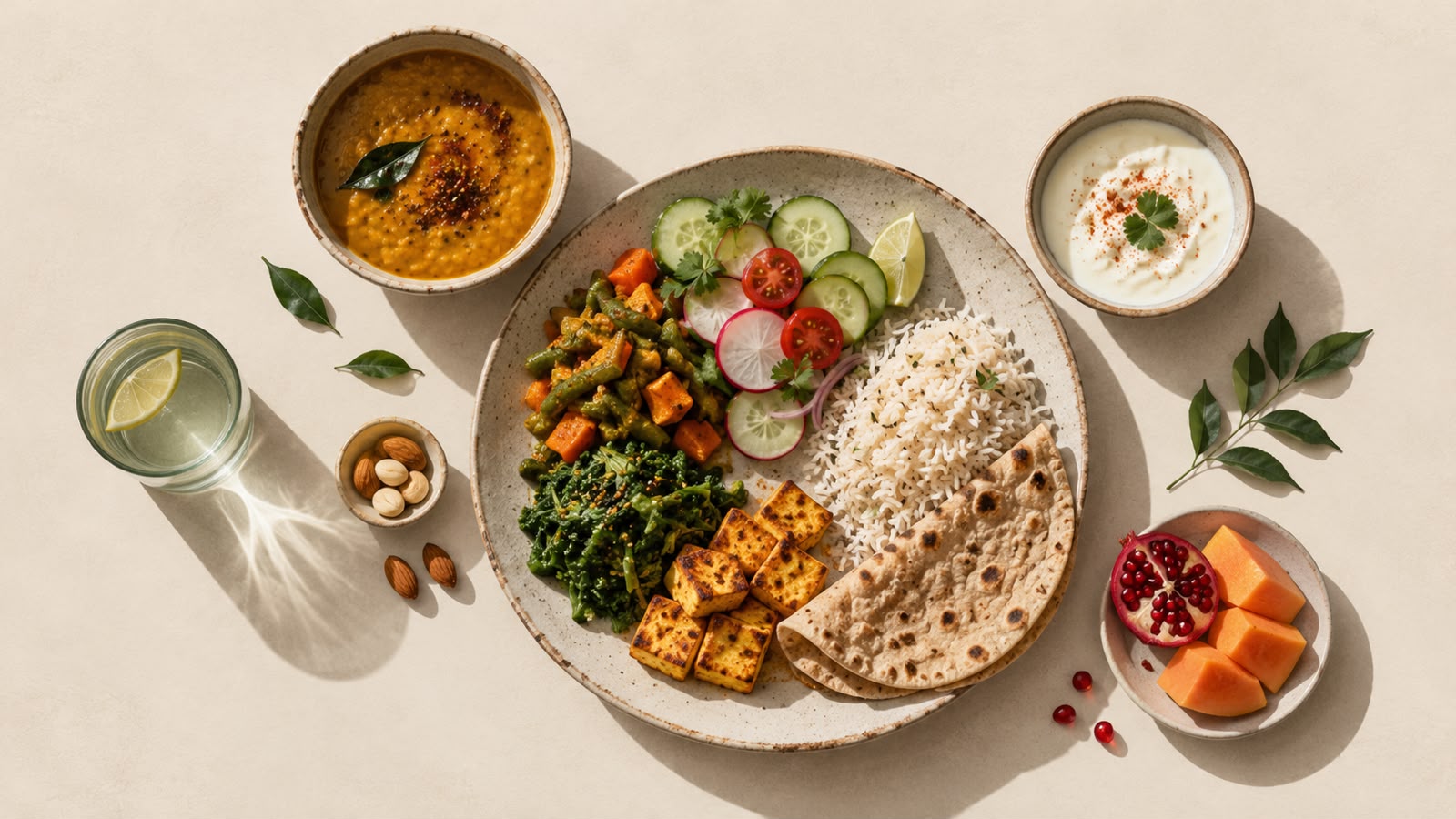
An Indian diet plan for weight loss is your usual thali at a smaller size, and the right size depends on your body. The charts here come in four sizes, from 1,200 to 2,100 kcal a day, each set about 500 kcal below what a person burns.1 Check first whether you need to lose weight. Then see an example level for your weight and age, and follow the 7-day chart in its roti or rice version, vegetarian or non-vegetarian.
A kcal is the calorie you see on a food label. Every portion here is written in raw grams, because that is how ICMR-NIN, India's national nutrition institute, sets out its tables. Treat the charts as examples to adapt to your own body, with your doctor's input if you have a medical condition.
Do you need to lose weight? Check your BMI and waist first Copy link
Your weight alone can't tell you. The same 60 kg sits in the normal range on a tall frame and above it on a short one, so start with your BMI, which is your weight set against your height. ICMR-NIN notes that Asian adults usually have more body fat at a given BMI. Its normal band for Indian adults is a BMI of 18.5 to 23, with 23 to 27.5 counted as overweight and obesity starting past 27.5.2
| Height | Overweight above (BMI 23) | Obese above (BMI 27.5) |
|---|---|---|
| 145 cm | 48 kg | 58 kg |
| 150 cm | 52 kg | 62 kg |
| 155 cm | 55 kg | 66 kg |
| 160 cm | 59 kg | 70 kg |
| 165 cm | 63 kg | 75 kg |
| 170 cm | 66 kg | 79 kg |
| 175 cm | 70 kg | 84 kg |
| 180 cm | 75 kg | 89 kg |
Then take a tape measure. ICMR-NIN treats fat carried around the abdomen as a risk in its own right, and it draws the line where the waist passes 80 cm in women or 90 cm in men. By its figures, abdominal obesity is present in 53% of urban adults and 19% of rural adults, so a person at a normal weight with a large waist still has a reason to act.2
If your BMI is between 18.5 and 23 and your waist is below 80 cm for women or 90 cm for men, these weight-loss calorie estimates are generally not meant for you. If your BMI is over 23 or your waist is above those limits, read on. No chart can choose where the fat comes off, so track your waist each month at the same spot, along with your weight.
How many calories should your Indian diet plan have? Copy link
About 500 kcal less than you burn in a day. MedlinePlus, the patient site of the US National Library of Medicine, calls a cut of about 500 calories a day a good place to start, and ICMR-NIN's 2024 guidelines go a little wider, with a daily deficit of 500 to 750 kcal.2 The plan works only while that daily calorie deficit exists.
So what do you burn? ICMR-NIN estimates it from your sex, age band and body weight. Its 2020 method takes a standard resting-energy equation from FAO, lowers the result by 10% for men and 9% for women, and multiplies it by 1.4 for a sedentary day.34 For its reference adults that comes to about 2,110 kcal for a sedentary 65 kg man and 1,660 kcal for a 55 kg woman.
The table below runs the same method across heavier bodies and both adult age bands. Treat it as an illustration, to use only after the check above.
| Body weight | Age 18 to 30 | Age 30 to 60 |
|---|---|---|
| Women | ||
| 50 kg | about 1,550 kcalexample plan: 1,200 kcal | about 1,600 kcalexample plan: 1,200 kcal |
| 60 kg | about 1,750 kcalexample plan: 1,200 kcal | about 1,700 kcalexample plan: 1,200 kcal |
| 70 kg | about 1,950 kcalexample plan: 1,500 kcal | about 1,800 kcalexample plan: 1,200 kcal |
| 80 kg | about 2,150 kcalexample plan: 1,800 kcal | about 1,900 kcalexample plan: 1,500 kcal |
| 90 kg | about 2,300 kcalexample plan: 1,800 kcal | about 2,000 kcalexample plan: 1,500 kcal |
| 100 kg | about 2,500 kcalexample plan: 2,100 kcal | about 2,100 kcalexample plan: 1,500 kcal |
| 110 kg | about 2,700 kcalexample plan: 2,100 kcal | about 2,200 kcalexample plan: 1,800 kcal |
| Men | ||
| 60 kg | about 2,000 kcalexample plan: 1,500 kcal | about 1,950 kcalexample plan: 1,500 kcal |
| 70 kg | about 2,200 kcalexample plan: 1,800 kcal | about 2,100 kcalexample plan: 1,500 kcal |
| 80 kg | about 2,400 kcalexample plan: 1,800 kcal | about 2,250 kcalexample plan: 1,800 kcal |
| 90 kg | about 2,600 kcalexample plan: 2,100 kcal | about 2,400 kcalexample plan: 1,800 kcal |
| 100 kg | about 2,750 kcalexample plan: 2,100 kcal | about 2,550 kcalexample plan: 2,100 kcal |
| 110 kg | about 2,950 kcalbeyond these charts | about 2,700 kcalexample plan: 2,100 kcal |
Age matters more as weight rises. For a 100 kg woman the estimate is about 2,500 kcal at 18 to 30 and about 2,100 kcal at 30 to 60, a gap of 400 kcal that a single figure for all adults would hide.
ICMR-NIN sets limits on any weight-loss diet. It should not fall below 1,000 kcal a day, should not cut more than 40% of your daily need, and should take off about half a kilogram a week.2 Every example in the table sits inside those limits.
Are you on your feet most of the day? Then your need is higher. ICMR-NIN's figure for moderate work is about 30% above its sedentary one, at 42 against 32 kcal per kg for men and 39 against 30 for women, which usually means one level up.3 After 60 the need falls. ICMR-NIN puts a sedentary 65 kg man past that age at about 1,700 kcal and a 55 kg woman at about 1,500, so the table runs high for older adults.3
These are estimates from weight and age alone. Muscle and daily movement shift the real number, which is why your scale's trend over four weeks is the test. Move one level if you need to.
Is a 1,200-calorie diet plan right for you? Copy link
For some smaller, sedentary women it can be. 1,200 kcal sits inside the low-calorie range commonly used for women, and it is about 460 kcal under the 1,660 that ICMR-NIN assigns its sedentary 55 kg woman. The right intake still depends on your body size and activity, along with your health and the energy need you start from.
Now set the same plan against the sedentary 65 kg man, whose 2,110 kcal turns it into an 910 kcal cut that removes 43% of his day and passes ICMR-NIN's 40% ceiling. The plan was sized for a smaller body.
The usual ranges reflect the gap. MedlinePlus gives about 1,200 to 1,500 kcal a day for women and 1,500 to 1,800 for men on a low-calorie diet, and says to follow one only with your health provider's help. A very-low-calorie diet, about 800 kcal a day, is a separate tool, meant for adults with obesity who need to lose weight for health reasons, under supervision, for no more than 12 weeks.5
A man, or a woman who is heavier or more active, may need a higher starting intake, such as 1,500, 1,800 or 2,100 kcal. Use the estimates table as a guide, then judge it against how your own weight moves.
What does a daily diet plan for weight loss look like at each size? Copy link
The same foods at four sizes. The table gives each level as a day's raw ingredients, beside ICMR-NIN's 2,000 kcal reference plate for an adult at a normal weight.
| Food group | 1,200 kcal | 1,500 kcal | 1,800 kcal | 2,100 kcal | ICMR-NIN plate, 2,000 kcal |
|---|---|---|---|---|---|
| Grain (atta, rice or millet) | 90 g | 135 g | 175 g | 225 g | 250 g |
| Pulses | 75 g | 90 g | 100 g | 110 g | 85 g |
| Milk and curd | 300 ml | 300 ml | 400 ml | 400 ml | 300 ml |
| Paneer | 30 g | 40 g | 40 g | 50 g | none listed |
| Vegetables, including 100 g green leafy | 400 g | 400 g | 400 g | 400 g | 400 g |
| Fruit | 100 g | 100 g | 150 g | 150 g | 100 g |
| Nuts | 10 g | 15 g | 15 g | 20 g | 35 g |
| Cooking oil | 10 g | 15 g | 20 g | 25 g | 27 g |
| Energy | about 1,200 kcal | about 1,500 kcal | about 1,800 kcal | about 2,100 kcal | about 2,000 kcal |
| Protein | about 53 g | about 64 g | about 74 g | about 85 g | about 72 g |
Protein supplies 16% to 18% of the energy at every level, above the 10% to 15% share in ICMR-NIN's balanced diet. As you'd expect, the grain takes most of the cut. The vegetables take none.
How much protein do you need at your weight? Copy link
About 1 g for every kilogram you weigh, each day, while you lose weight. ICMR-NIN's recommended allowance for healthy adults is 0.83 g per kg, rising to 1 g per kg where a cereal-heavy diet supplies protein of lower quality.3 During a weight-loss diet it says protein at 15% of energy may help preserve muscle.
Trials set the bar a little higher. A 2024 meta-analysis, a study that pools earlier trials, covered 47 studies and 3,218 adults living with overweight or obesity who were trying to lose weight. Eating more protein helped them keep muscle. Intakes under 1.0 g per kg a day were associated with a higher risk of muscle loss, and intakes above 1.3 g per kg with a gain, though the trials ranged from low to high risk of bias.6
| Body weight | ICMR-NIN allowance (0.83 g per kg) | Floor during weight loss (1.0 g per kg) | Higher target (1.3 g per kg) |
|---|---|---|---|
| 50 kg | 42 g | 50 g | 65 g |
| 60 kg | 50 g | 60 g | 78 g |
| 70 kg | 58 g | 70 g | 91 g |
| 80 kg | 66 g | 80 g | 104 g |
| 90 kg | 75 g | 90 g | 117 g |
| 100 kg | 83 g | 100 g | 130 g |
| 110 kg | 91 g | 110 g | 143 g |
Now compare your row with the charts. The vegetarian chart gives about 64 g of protein at 1,500 kcal, which reaches 1 g per kg only up to a body weight of about 64 kg. That figure describes this example menu and is no universal target. At 80 kg you would want about 80 g, so the chart leaves you roughly 15 g short.
How do you close the gap without adding calories? Trade grain for protein. One roti is 96 kcal and 3 g of protein, and the table shows what roughly the same calories buy elsewhere.7
| Food | Amount | Energy | Protein | Protein gained over one roti |
|---|---|---|---|---|
| Wheat roti | 30 g atta | 96 kcal | 3.2 g | baseline |
| White rice | 28 g raw | 100 kcal | 2.2 g | −0.9 g |
| Milk or curd | 140 ml | 101 kcal | 4.3 g | +1.2 g |
| Peanuts | 20 g | 104 kcal | 4.7 g | +1.6 g |
| Paneer | 35 g | 107 kcal | 6.6 g | +3.4 g |
| Moong dal | 30 g raw | 98 kcal | 7.2 g | +4.0 g |
| Egg | 75 g, about one and a half | 101 kcal | 10.0 g | +6.8 g |
| Soybean | 30 g raw | 114 kcal | 10.7 g | +7.5 g |
| Chicken breast | 60 g raw | 101 kcal | 13.1 g | +9.9 g |
| Prawns | 100 g raw | 91 kcal | 19.2 g | +16.1 g |
| Rohu | 100 g raw | 102 kcal | 19.7 g | +16.5 g |
Two swaps a day, taken from paneer downward in the table, add between 7 and 33 g of protein for almost no extra calories. Vegetarians get the most from soybean and dal. If you eat non-veg, one swap can do the work of two. How you spread those grams of protein a day across meals matters less than reaching them.
More is not always better. ICMR-NIN advises against protein powders for most people and notes that intakes above about 1.6 g per kg add nothing further for muscle. If you have kidney disease, set your protein with your doctor.2
7-day Indian vegetarian diet plan for weight loss (1,500-calorie chart) Copy link
Two versions follow, one built on roti and one on rice. Each day comes to about 1,450 to 1,500 kcal and about 58 to 65 g of protein, counted from raw weights with the Indian Food Composition Tables and ICMR-NIN's food-group averages, so treat every total as an estimate.7 Cooking oil is 3 teaspoons (15 g) a day and is already included. Tea and coffee take milk from the day's 300 ml and no sugar. Days can be swapped or repeated.
This is an example menu. Your calorie and protein targets can be higher or lower depending on your body size, activity, age, medicines and medical conditions.
Roti-based chart (North and West India)
| Day | Breakfast | Lunch | Snack | Dinner | Non-veg swap for the paneer |
|---|---|---|---|---|---|
| Day 1about 1,500 kcal, about 63 g protein | Vegetable poha (45 g poha, 50 g vegetables), 100 ml curd | 2 rotis (60 g atta), tur dal (30 g), bhindi sabzi (150 g), 100 ml curd | 1 fruit (100 g), roasted chana (30 g), 15 g peanuts, tea with 100 ml milk | 1 roti (30 g atta), palak paneer (100 g palak, 40 g paneer), moong dal (30 g), salad (100 g) | 2-egg bhurji |
| Day 2about 1,475 kcal, about 60 g protein | 2 besan chillas (45 g besan, 50 g vegetables), 100 ml curd | 2 rotis (60 g atta), rajma (30 g), salad with 40 g paneer (150 g vegetables), 100 ml curd | 1 fruit (100 g), 15 g almonds, tea with 100 ml milk | Vegetable khichdi (60 g rice, 15 g moong dal, 100 g vegetables), sauteed palak (100 g) | 75 g chicken breast, tandoori or curry |
| Day 3about 1,475 kcal, about 64 g protein | Vegetable dalia (45 g broken wheat, 50 g vegetables), 100 ml curd | 2 jowar bhakris (60 g jowar flour), chana masala (30 g chana), lauki sabzi (150 g), 100 ml curd | 1 fruit (100 g), sprouted moong (30 g), 15 g peanuts, tea with 100 ml milk | 1 roti (30 g atta), methi sabzi (100 g methi), 40 g paneer, tur dal (30 g), salad (100 g) | 100 g fish curry (rohu) |
| Day 4about 1,450 kcal, about 62 g protein | 2 moong dal chillas (45 g moong dal, 50 g vegetables), 100 ml curd | 2 rotis (60 g atta), chole (30 g chana), mixed vegetables (150 g), 100 ml curd | 1 fruit (100 g), 15 g peanuts, tea with 100 ml milk | Vegetable pulao (60 g rice, 100 g vegetables), 40 g paneer tikka, sauteed greens (100 g), masoor dal (15 g) | 75 g chicken tikka (breast) |
| Day 5about 1,500 kcal, about 64 g protein | 2 methi theplas (45 g atta, 50 g methi), 100 ml curd | 2 bajra rotlas (60 g bajra flour), moong dal (30 g), brinjal sabzi (150 g), chaas from 100 ml curd | 1 fruit (100 g), roasted chana (30 g), 15 g peanuts, tea with 100 ml milk | 1 roti (30 g atta), paneer bhurji (40 g paneer, 100 g vegetables), palak (50 g), tur dal (30 g), salad (50 g) | 2-egg curry |
| Day 6about 1,500 kcal, about 65 g protein | Rava upma (45 g rava, 50 g vegetables), 100 ml curd | 2 rotis (60 g atta), masoor dal (30 g), gobi sabzi (150 g), 100 ml curd | 1 fruit (100 g), sprouted moong (30 g), 15 g almonds, tea with 100 ml milk | 1 roti (30 g atta), palak (100 g) with 40 g paneer, lobia (30 g), vegetables (100 g) | 100 g fish, grilled or curried (rohu) |
| Day 7about 1,475 kcal, about 63 g protein | Dalia khichdi (30 g broken wheat, 15 g moong dal, 50 g vegetables), 100 ml curd | 2 rotis (60 g atta), rajma (30 g), salad and sabzi (150 g), 100 ml curd | 1 fruit (100 g), roasted chana (30 g), 15 g peanuts, tea with 100 ml milk | 1.5 rotis (45 g atta), 40 g paneer with capsicum (100 g), greens (100 g), tur dal (15 g) | 75 g chicken curry (breast) |
Rice-based chart (South and East India)
| Day | Breakfast | Lunch | Snack | Dinner | Non-veg swap for the paneer |
|---|---|---|---|---|---|
| Day 1about 1,500 kcal, about 61 g protein | 3 idlis (45 g rice, 15 g urad dal), sambar (15 g tur dal, 100 g vegetables) | Rice (50 g raw), sambar (30 g tur dal), beans poriyal (100 g), 150 ml curd | 1 fruit (100 g), 15 g peanuts, buttermilk from 100 ml curd, coffee with 50 ml milk | 1 ragi roti or mudde (30 g ragi flour), keerai kootu (100 g greens, 30 g moong dal), 40 g paneer, vegetables (100 g) | 100 g fish curry (mackerel) |
| Day 2about 1,500 kcal, about 60 g protein | 2 dosas (45 g rice, 15 g urad dal), sambar (15 g tur dal, 100 g vegetables) | Rice (50 g raw), pappu (30 g moong dal), cabbage poriyal (100 g), 150 ml curd | 1 fruit (100 g), 15 g almonds, buttermilk from 100 ml curd, coffee with 50 ml milk | 1 chapati (30 g atta), 40 g paneer with capsicum (100 g), greens (100 g), chana sundal (30 g) | 2-egg curry |
| Day 3about 1,475 kcal, about 60 g protein | 2 pesarattu (45 g whole moong, 50 g vegetables), 15 g peanut chutney, 100 ml curd | Rice (60 g raw), tur dal (30 g) with rasam, avial (150 g vegetables), 100 ml curd | 1 fruit (100 g), tea with 100 ml milk | Bisi bele bath (60 g rice, 15 g tur dal, 100 g vegetables), sauteed greens (100 g), 40 g paneer | 75 g chicken curry (breast) |
| Day 4about 1,475 kcal, about 60 g protein | Chirer pulao or aval upma (45 g poha, 50 g vegetables, 15 g peanuts), 100 ml curd | Rice (50 g raw), masoor dal (30 g), mixed vegetables (150 g), 100 ml curd | 1 fruit (100 g), roasted chana (30 g), tea with 100 ml milk | Rice (30 g raw), moong dal (30 g), saag (100 g greens), 40 g paneer or chhena, vegetables (100 g) | 100 g macher jhol (rohu) |
| Day 5about 1,500 kcal, about 61 g protein | Rava upma (45 g rava, 50 g vegetables), 100 ml curd | Rice (50 g raw), sambar (30 g tur dal, 50 g vegetables), thoran (100 g), 150 ml curd | 1 fruit (100 g), 15 g peanuts, lobia sundal (30 g), coffee with 50 ml milk | 2 idlis (30 g rice, 10 g urad dal), sambar (20 g tur dal, 100 g vegetables), keerai (100 g), 40 g paneer | 100 g prawn curry |
| Day 6about 1,500 kcal, about 58 g protein | 3 idlis (45 g rice, 15 g urad dal), sambar (15 g tur dal, 100 g vegetables) | Rice (50 g raw), kadala curry (30 g chana), cabbage thoran (100 g), 150 ml curd | 1 fruit (100 g), 15 g almonds, buttermilk from 100 ml curd, coffee with 50 ml milk | Ragi mudde (30 g ragi flour), soppu saaru (100 g greens, 30 g tur dal), 40 g paneer, vegetables (100 g) | 75 g chicken saaru (breast) |
| Day 7about 1,500 kcal, about 61 g protein | Aval upma (45 g poha, 50 g vegetables), 100 ml curd | Rice (50 g raw), tur dal (30 g), mixed vegetables (150 g), 100 ml curd | 1 fruit (100 g), 15 g peanuts, sprouted moong (30 g), tea with 100 ml milk | Rice (30 g raw), moong dal (30 g), greens (100 g), 40 g paneer, salad (100 g) | 100 g tawa fish (mackerel), cooked in the day's oil |
How are the portions counted?
One roti here means 30 g of atta, about 96 kcal, and one dal portion is 30 g of raw dal, about 99 kcal and 6.5 g of protein. Rice is weighed raw too, at about 107 kcal for 30 g. Weigh your own atta once. If your roti takes 45 g, count it as one and a half.
No kitchen scale? ICMR-NIN's household measures help. A level teaspoon holds 5 g and a tablespoon 15 g. A tablespoon of raw dal is about 15 g, half a medium 200 ml katori of raw rice is about 80 g, and a full one of chopped vegetables is about 100 g.2
Why raw? Cooked weight changes with the water you add. Raw weight stays put.
How do you change the chart to 1,200, 1,800 or 2,100 kcal?
For 1,200 kcal, take out 45 g of grain, 15 g of dal, 10 g of paneer, 5 g of nuts and one teaspoon of oil. For 1,800 kcal, add 40 g of grain, 10 g of dal, 100 ml of milk or curd, 50 g of fruit and one teaspoon of oil. For 2,100 kcal, add a further 50 g of grain, 10 g of dal, 10 g of paneer, 5 g of nuts and one more teaspoon of oil. Keep your vegetables at 400 g a day at every level.
What do you swap in a non-veg diet plan for weight loss? Copy link
Swap the paneer and keep everything else. The last column of each chart names one swap a day. ICMR-NIN lets non-vegetarians replace 30 g of the day's pulses with meat or eggs, and its own non-vegetarian plate carries 70 g of chicken or meat a day.2
The numbers favor fish and lean cuts. Per 100 g raw, rohu has 102 kcal with 19.7 g of protein, mackerel 101 kcal with 21.5 g, and prawns 91 kcal with 19.2 g. Skinless chicken breast has 168 kcal with 21.8 g, goat leg 160 with 22.1 g, and whole egg 135 with 13.3 g.7 Paneer has 305 kcal and 18.9 g. For the same protein, it costs about 3 times the calories of rohu.
So trading the day's 40 g of paneer for 100 g of rohu adds about 12 g of protein and removes 20 kcal, while two eggs, about 100 g, add 6 g for 13 kcal more. Count the cooking oil as before, at 45 kcal a teaspoon.
Does eating non-veg settle your protein? Rarely. In the ICMR-INDIAB survey, animal foods other than dairy supplied between 0.3% and 2.9% of energy as protein across India's regions.8 Portion and frequency decide it.
North Indian or South Indian diet plan for weight loss: what should change? Copy link
Your staple can stay. What needs trimming differs by region, and a national survey shows where. Among the 18,090 adults in ICMR-INDIAB, white rice was the main cereal in the Northeast (99%), South (87%) and East (78%), with whole-wheat flour ahead in the North (90%) and Central India (70%).8
| Region | What the survey found | What that suggests changing first |
|---|---|---|
| North | Whole-wheat flour is the staple for 90%. Highest added sugar (7.9% of energy), saturated fat (11.2%) and dairy protein (3.6%). Meat, fish and egg protein among the lowest (0.3%). | Trim sugar in tea and sweets first, measure the ghee, and keep the curd and milk. |
| South | White rice is the staple for 87%, and refined cereals supply 36% of energy. In Karnataka 47.7% eat whole millet flour, mostly jowar and ragi. | Shrink the rice portion before anything else. Keep the sambar and dal, and use ragi where it is already eaten. |
| East | White rice is the staple for 78%. Carbohydrate share is the highest (64.8% of energy) and dairy protein among the lowest (1.2%). | Shrink the rice and add a protein to each meal, such as dal, fish, egg or curd. |
| West | Total fat is the highest (27.9% of energy). In Gujarat and Maharashtra 35% eat whole millet flour, mainly bajra, jowar and maize. | Measure the oil. Keep the bajra and jowar. |
| Central | Whole-wheat flour is the staple for 70%, and milled whole grains supply 30.9% of energy. Meat, fish and egg protein among the lowest (0.3%). | Count the rotis and add dal, curd or egg to each meal. |
| Northeast | White rice is the staple for 99%, and refined cereals supply 51.7% of energy. Meat, fish and egg protein is the highest (2.9%) and added sugar the lowest (2.1%). | Shrink the rice portion and keep the protein. |
Of course, a survey taken at one point in time describes patterns, and every region varies widely inside itself, as in Tamil Nadu, where refined cereals supplied 51.5% of energy against the South's 36%. Use your row as a first guess about your own plate.
The two charts swap gram for gram. Use 30 g of raw rice wherever a chart says one roti. The reverse works too.
Diet plan for weight loss for female and male: what changes? Copy link
The basic food pattern can stay similar. Portions and some nutrient needs change. A woman's plan is usually smaller because her energy need is lower, about 1,660 kcal a day for ICMR-NIN's sedentary reference woman against 2,110 for the man.3 In these illustrative sedentary examples, many higher-weight men fall near the 1,800 or 2,100 kcal chart.
A smaller plan leaves less room. Each portion has to carry more. As the grain shrinks, hold on to the pulses and the green leafy vegetables. In ICMR-NIN's food tables they are among the iron-rich groups, at 6.25 mg per 100 g of raw pulses and 8.07 mg per 100 g of greens.2
Are you pregnant or breastfeeding? Then these charts are the wrong size. ICMR-NIN adds about 350 kcal a day in pregnancy and 600 kcal in the first six months of breastfeeding.3 Teenagers need more as well, around 2,400 kcal for girls of 13 to 15 and 2,860 for boys of the same age, so ask your doctor before you cut anything at these stages.3
Is roti or rice better for weight loss? Copy link
Roti edges it on calories, by less than most people expect. Per 30 g raw, wheat atta has 96 kcal and milled white rice 107, a gap of 11 kcal a portion.7 Ragi matches atta at 96 kcal, jowar has 100 and bajra 104.
Fiber and protein separate them more. Atta carries 11.4 g of fiber and 10.6 g of protein per 100 g. White rice carries 2.8 g and 7.9 g. Blood sugar follows the same order. In ICMR-NIN's tests, rice had a glycemic index of about 78 and wheat chapati about 66, the index being a score for how fast a food raises blood sugar. Each value came from ten volunteers.2
What moves your total is still the count. Three rotis are 288 kcal and two are 192. Switch all three to ragi and you save nothing. Leave one out and you save 96.
National data points the same way. In ICMR-INDIAB, replacing refined cereals with whole-wheat or millet flour, without lowering the amount of carbohydrate, was not associated with lower odds of type 2 diabetes (odds ratio 0.94, where 1.0 means no difference). The same held for abdominal obesity, meaning a large waist (1.08), while people in the highest carbohydrate group had 22% higher odds of generalized obesity than those in the lowest.8
The survey recorded diet through a questionnaire and cannot prove cause. In practice it tells you to count your rotis or weigh your rice before the flour gets any attention, though millets still earn a place and ICMR-NIN asks adults to take 20% to 30% of their grain as millets.
How many meals a day are best for weight loss? Copy link
Two or three meals are enough. ICMR-NIN's list of healthy eating habits includes restricting meal frequency to two to three times a day and not snacking in between.2 You do not have to eat every two hours.
Trials lean the same way, though weakly. A 2024 meta-analysis in JAMA Network Open combined 29 randomized trials of 12 weeks or longer in 2,485 adults, and lower meal frequency was associated with 1.85 kg more weight loss than the comparison diets. Eating more of the day's calories earlier was associated with 1.75 kg more, and time-restricted eating with 1.37 kg.9
How much should you lean on that? Very little. The authors called the effects small and of uncertain clinical importance, and they flagged high risk of bias across the trials. The charts use three meals and one snack. If two larger meals suit your day better, fold the snack into them and the totals stay the same.
Which Indian foods are best for weight loss? Copy link
The ones that give you the most protein and bulk for their calories. Per 100 kcal, prawns give about 21.2 g of protein, rohu 19.3 g, chicken breast 13.0 g, egg 9.9 g, soybean 9.3 g, moong dal 7.3 g and paneer 6.2 g. Milk and curd give 4.3 g. Atta gives 3.3 g and rice 2.2 g.7
Vegetables do a different job. The chart's 400 g a day adds only about 150 kcal, and ICMR-NIN wants vegetables and fruit to make up about half the plate.2
Why push protein at all? Indian diets run low on it. ICMR-INDIAB found protein supplying 12% of energy, most of it from plants, while carbohydrate supplied 62.3%, a pattern its authors describe as low in protein and high in low-quality carbohydrate. In the same survey, modeled swaps of carbohydrate for dairy protein were associated with lower odds of type 2 diabetes (odds ratio 0.89).8
Which foods should you cut first?
Oil and sugar. They add calories and no protein. ICMR-NIN counts cooking oils and fats at 900 kcal per 100 g and sugar at 400. One teaspoon of oil, 5 g, is 45 kcal. One teaspoon of sugar is 20.
Three cups of tea with two teaspoons of sugar each add 120 kcal a day, and those 30 g of sugar are already past ICMR-NIN's limit of 20 to 25 g a day for adults. Its limit for cooking oil is 25 to 30 g a day. The charts use 15 g, which is three level teaspoons.
Can you lose weight in 7 days with a diet plan? Copy link
Some, and less than the first week suggests. MedlinePlus treats 225 g to 500 g a week as the safest pace for most people, and it calls a diet rapid once the loss passes 1 kg a week for several weeks running. Gallstones are among the side effects it lists. Even under supervision, a very-low-calorie diet takes off up to 1.5 to 2 kg each week, so a promise of 10 kg in 7 days sits far outside the evidence.5
The scale often drops faster in week one, and the reasons sit with how fast weight comes off. So treat the seven days as a template. Shop for it once. Then repeat the week. If your waist is the main worry, the same charts apply, and deep belly fat has its own measurements to track.
When should you not follow a diet plan on your own? Copy link
See a doctor first if you are pregnant, breastfeeding or under 18, or if you take regular medicines or have a long-term illness such as diabetes, kidney disease or thyroid disease. MedlinePlus advises following a low-calorie diet only with a health provider's help, and it reserves the 800 kcal kind for supervised care.5
A scale that stops moving after early progress has a name, a plateau in weight loss, and its own fixes. If three months on a measured plan change little, book a review. Bring your food record. A doctor can look for a medical cause and, where it fits, discuss doctor-led weight loss treatment.
Common questions about Indian diet plans Copy link
What is the best diet plan for weight loss?
The best diet plan for weight loss is one sized to your own energy need and built from food you already eat. In this guide that means about 500 kcal under what you burn, at one of four sizes from 1,200 to 2,100 kcal a day, once your BMI or waist shows you need to lose weight. Put protein in every meal and fill half the plate with vegetables and fruit.
Is rice good for weight loss?
Rice fits a weight loss diet when the portion is measured. Milled white rice has 356 kcal per 100 g raw against 320 for wheat atta, so 30 g of rice is about 11 kcal more than one roti. It has less fiber and protein than atta, which is a reason to pair it with dal and vegetables.
Is poha good for weight loss?
Poha is flattened rice. A 45 g breakfast portion has about 159 kcal and 3 g of protein before oil, on Indian Food Composition Tables values. Cook it with vegetables and peanuts and eat it with a katori of curd, because the poha itself brings little protein.
Is paneer good for weight loss?
Paneer helps in measured amounts. It has 305 kcal and 18.9 g of protein per 100 g, so a 40 g serving gives about 122 kcal and 7.5 g of protein. Dal, eggs and fish give the same protein for fewer calories.
Is idli good for weight loss?
Idli suits a weight loss plan because it is steamed and already mixes rice with dal. Three idlis made from 45 g of rice and 15 g of urad dal come to about 209 kcal and 7.0 g of protein. Sambar adds more dal and vegetables to the same meal.
Is banana good for weight loss?
A banana can be the day's fruit. Ripe banana has about 105 kcal per 100 g, which is 46 kcal more than the average fruit the charts assume. Count it by weight, and treat a large banana as more than one fruit portion.
Is ghee good for weight loss?
Ghee is a cooking fat, and ICMR-NIN counts all cooking oils and fats at 900 kcal per 100 g. One teaspoon, 5 g, is 45 kcal. Ghee can stay in a weight loss diet if it comes out of the day's oil allowance, which is 15 g in the 1,500 kcal chart.
Which drink is best for weight loss?
Water, or any drink without sugar. Jeera water and lemon water are flavored water, and they help when they replace a sweet drink. Each teaspoon of sugar you leave out saves 20 kcal. ICMR-NIN's limit for added sugar is 20 to 25 g a day for adults.
What is the best dinner for weight loss?
A dinner in the 1,500 kcal chart is one roti or 30 g of raw rice with a 30 g portion of dal and 200 g of vegetables. Add 40 g of paneer or 100 g of fish. With paneer that comes to about 396 kcal and 23 g of protein before cooking oil.
Can vegetarians get enough protein on an Indian diet plan?
Yes, with planning. The vegetarian example chart provides about 64 g of protein a day at 1,500 kcal. That is what this menu supplies and is no universal target. Protein needs rise with body weight, at about 1 g per kg during weight loss, so heavier adults should swap some grain for soybean, dal, curd or paneer.
References Copy link
- MedlinePlus Medical Encyclopedia. 10 ways to cut 500 calories a day. US National Library of Medicine. Review date 30 April 2026.
- ICMR-National Institute of Nutrition. Dietary Guidelines for Indians. Revised Edition 2024. Hyderabad: ICMR-NIN. Guideline 1, pp. 2 to 11 (Tables 1.2, 1.3, 1.5, 1.6); Guideline 8, pp. 58 to 61; Guideline 9, pp. 62 to 66; Annexures I to III, pp. 111 to 126.
- ICMR-NIN Expert Group on Nutrient Requirement for Indians. Nutrient Requirements for Indians: Recommended Dietary Allowances and Estimated Average Requirements - 2020. Hyderabad: ICMR-National Institute of Nutrition; 2020. Chapter 4, pp. 42 to 64 (Tables 4.10, 4.11, 4.23, 4.23a, 4.23b); Table A3, p. 21; Chapter 5, p. 95.
- FAO. Human energy requirements. Report of a Joint FAO/WHO/UNU Expert Consultation, Rome, 17 to 24 October 2001. FAO Food and Nutrition Technical Report Series 1. Rome: FAO; 2004. Chapter 5, Table 5.2.
- MedlinePlus Medical Encyclopedia. Diet for rapid weight loss. US National Library of Medicine. Review date 18 May 2026.
- Kokura Y, Ueshima J, Saino Y, Maeda K. Enhanced protein intake on maintaining muscle mass, strength, and physical function in adults with overweight/obesity: A systematic review and meta-analysis. Clin Nutr ESPEN. 2024;63:417-426.
- Longvah T, Ananthan R, Bhaskarachary K, Venkaiah K. Indian Food Composition Tables 2017. Hyderabad: National Institute of Nutrition, Indian Council of Medical Research; 2017. Table 1.
- Anjana RM, et al. Dietary profiles and associated metabolic risk factors in India from the ICMR–INDIAB survey-21. Nat Med. 2025;31(11):3813-3824.
- Liu HY, Eso AA, Cook N, O'Neill HM, Albarqouni L. Meal Timing and Anthropometric and Metabolic Outcomes: A Systematic Review and Meta-Analysis. JAMA Netw Open. 2024;7(11):e2442163.
This article is general health information. It does not replace advice from a doctor or dietitian who knows your history. Talk to one before starting a low-calorie diet if you are pregnant, breastfeeding, under 18, living with a long-term illness or taking regular medicines.