Weight & Metabolic · Weight science
How to Lose Weight: What Works, How Fast, and How to Keep It Off
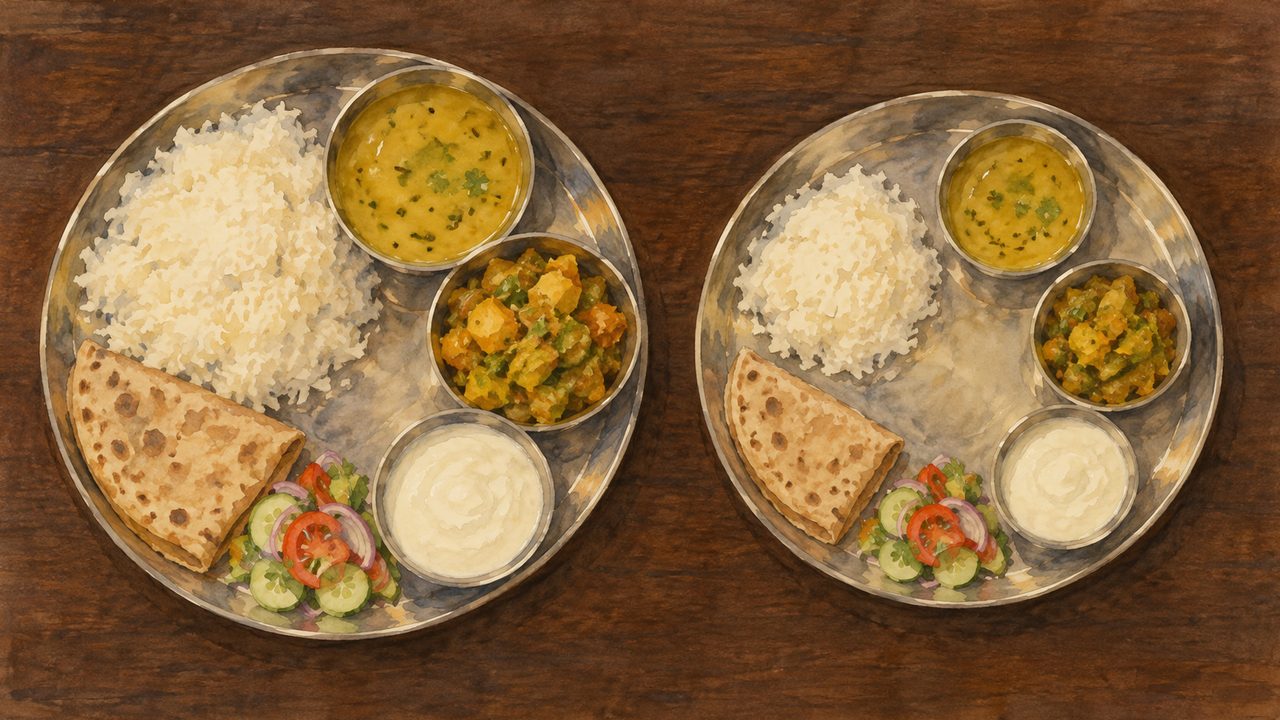
Eat roughly 500 to 750 kcal less each day than your body burns, with at least 15% of what you do eat coming from protein. Move on most days. About half a kilogram of weight loss a week is the pace ICMR-NIN’s 2024 dietary guidelines call safe.1 How much of that is fat differs from person to person.2
Start smaller than you think. In a controlled trial, people who lost just 5% of their body weight saw their liver and muscle respond better to insulin, and their fat tissue too.3 At 80 kg, that is 4 kg. The trial was small. Only 19 people were in the 5% group.
Treat the size as rough.
India’s cut-offs sit lower. ICMR-NIN counts a BMI, your weight for your height, of 23 to 27.5 as overweight and anything above 27.5 as obese. Those are Asian cut-offs. Risk climbs once a man’s waist passes 90 cm. For women the line is 80 cm.1
India’s 2025 definition goes further and treats a BMI above 23 as the entry point for obesity. Stage 1 means extra body fat that is not yet affecting your organs or your daily life.
Stage 2 adds a large waist, or a high waist-to-height ratio, along with an obesity-related illness or limits on everyday activity.4 So where you fall on the Indian BMI scale helps set how much to lose.
Excess weight is tied to fatty liver, high blood pressure and type 2 diabetes, which puts it at the centre of metabolic health.1
How do you lose weight, step by step? Copy link
Begin with the changes that remove the most calories for the least effort, then turn to the ones that protect your muscle and your sleep.
- Aim first for 5% of your weight. At half a kilogram a week that takes two to three months, and even that much already improves how your body handles insulin.3
- Eat 500 to 750 kcal a day below your needs. Keep above 1,000 kcal a day. Go lower only under a doctor. ICMR-NIN sets that floor for any reducing diet, and it advises against cutting more than 40% of what your body needs each day.1
- Make protein at least 15% of your calories. Dal, curd, paneer, eggs, fish or soya all count. It protects muscle in a deficit.1
- Drop sugary drinks and fried snacks first. Juice, sweets and biscuits come next. They carry plenty of calories and very few nutrients, which is exactly why the national guidelines tell you to avoid them.1
- Move 30 to 60 minutes a day. Do it on five days a week, with brisk walking as the simplest option and muscle-strengthening work on two of those days to protect muscle.1
- Sleep 6 to 8 hours. In one trial, short sleepers who added about 1.2 hours a night went on to eat around 270 kcal a day less, with no diet advice given.1,5
- Weigh once a week. Early drops are mostly water, so judge your progress by the trend across four weeks and let no single morning’s reading decide anything.6
How fast can you lose weight? Copy link
Aim for about 0.5 kg a week. ICMR-NIN’s guidelines call that pace safe, and they describe daily deficits of 500 to 750 kcal.1 A steady calorie deficit does not convert into a fixed amount of fat each week.
What comes off is a mix of fat, lean tissue and water, and the mix depends on how much body fat you start with.2 The familiar rule of about 7,700 kcal per kilogram roughly fits people who start with more than 30 kg of body fat.
In leaner people more of each lost kilogram is lean tissue, which stores less energy, so the same deficit moves the scale further while less of the loss is fat.2
Week one is different. Your muscles hold about 500 g of glycogen, a starch-like fuel store, and your liver keeps roughly 80 g more on top of that.6
Each gram carries at least 3 g of water, so when a hard cut in carbohydrate or calories drains the store, the water leaves too.6,7 Fully emptied, the store plus its water weighs roughly 2.3–2.9 kg. None of it is fat. It returns with carbohydrate.6
A 3 kg first week is mostly water. Losing more than 1 kg a week, week after week for several weeks, is what MedlinePlus classes as a rapid weight loss diet.8 On a very low calorie diet of about 800 kcal a day, people can lose 1.5 to 2 kg a week.
It needs medical supervision. Experts cap it at 12 weeks.8
Loss slows over the months. A lighter body burns less energy, so the same meals that once made a 500 kcal gap make a smaller one with every kilogram you lose.9
Unsurprisingly, many people then hit a weight loss plateau, a stretch of weeks with no change that has its own set of fixes.
What to eat to lose weight Copy link
More protein, vegetables and pulses, with far less of the food that adds calories without filling you up. No single food burns fat. Portions decide more than grains do.
Indian meals lean on carbohydrate. In ICMR-INDIAB, a national survey of 18,090 adults, carbohydrate supplied 62.3% of daily energy while protein supplied 12%, short of the 15% in national guidance.10
People who swapped refined cereal for whole-wheat or millet flour, but kept eating the same amount, had no lower odds of diabetes or abdominal obesity.10 It was a snapshot survey. That shows a link, not cause.
In practice it points at the size of the roti or rice portion on your plate, well ahead of which flour you happen to buy.
Protein is the part to raise. ICMR-NIN asks for at least 15% of calories from protein during a 500–750 kcal deficit, because protein helps you keep muscle while fat comes off.1 Your protein target depends on weight.
Ultra-processed foods make it harder. They go through extensive industrial processing, usually with a long list of additives, and the category takes in packaged biscuits, chips and sweetened drinks.1
In a 2025 English trial, 55 adults spent eight weeks on each of two diets that met national healthy-eating advice and differed only in how processed the food was. Weight fell 2.06% on the minimally processed diet. On the ultra-processed diet it fell 1.05%.11
An earlier inpatient study, with two weeks on each diet, found people ate about 508 kcal a day more when served ultra-processed meals.12 It had 20 adults.
Drinks are the easy start. ICMR-NIN’s swap list trades sugar-sweetened, health and energy drinks for buttermilk, tender coconut water or fresh lemon juice.1 Whole fruit replaces juice. Salads and sprouts replace deep-fried snacks.
Those swaps double as the short list of foods to avoid while you lose weight, and none of them costs you a meal.
Which diet is best for weight loss? Copy link
The one you can keep. When trials run popular diets against each other for a full year, low-carb, low-fat and time-restricted plans finish within about 2 kg of one another. A deeper cut pulled ahead. It came with a cost.
In DIETFITS, 609 adults spent 12 months on either a healthy low-fat or a healthy low-carb diet and lost 5.3 kg and 6.0 kg respectively.13 Chance could explain the gap. Genes did not predict the winner. Nor did insulin response.
In a Chinese trial, 139 adults with obesity ate 1,200 to 1,800 kcal a day, and one group also ate only between 8 am and 4 pm.14 The window group lost 8.0 kg. The rest lost 6.3 kg. That gap was not statistically significant either.
It is one reason to treat intermittent fasting as a way of eating less, with the clock adding little on its own.
The TEMPO trial tested depth. Postmenopausal women who cut 65–75% of their calories for four months, then eased off, lost 6.6 kg more at a year than women on a 25–35% cut.15 Hip bone density fell more.
The authors urged caution for women with weak bones, and a cut that deep also sits far beyond the 40% ceiling in ICMR-NIN’s guidelines.1 Plainly, it belongs in supervised care.
What is the best exercise to lose weight? Copy link
Whatever you will keep doing. Aim for 150 minutes a week or more, the level at which a 2024 analysis of 116 trials found clinically important drops in waist size and body fat.16
Each extra 30 minutes a week took off about 0.52 kg of body weight, and the effect kept building all the way up to 300 minutes a week. At 150 minutes the pooled estimate came to about 2.8 kg.16 That is real. It is smaller than hoped.
Every trial in that analysis ran at least 8 weeks with supervised sessions, so treat 2.8 kg as a best case for real life. Waist size fell by 0.56 cm for each 30 minutes a week, and visceral fat, the deep belly fat packed around the organs, fell as well.16
Effort is measured in METs. Sitting still counts as 1 MET, which works out to about 1 kcal per kilogram of body weight per hour, and harder activities scale up from there.17
The table below uses 2024 Compendium values for a 70 kg adult and counts only the calories burned above what sitting would have used.
| Activity | Effort (MET) | Extra kcal in 30 min |
|---|---|---|
| Hatha yoga | 2.3 | about 46 |
| Surya namaskar | 3.5 | about 88 |
| Walking, moderate pace (4.5–5.5 km/h) | 3.8 | about 98 |
| Walking, brisk (5.6–6.3 km/h) | 4.8 | about 133 |
| Cycling, leisurely (about 15 km/h) | 5.8 | about 168 |
| Swimming laps, slow freestyle | 5.8 | about 168 |
| Bodyweight circuit at home | 6.0 | about 175 |
| Jogging, own pace | 7.5 | about 228 |
| Skipping rope | 11.0 | about 350 |
A brisk 30-minute walk covers about a quarter of a 500 kcal daily deficit, while half an hour of skipping covers most of it. Heavier bodies burn more.
Strength work burns less per session. Its job is different. It keeps the muscle that a diet would otherwise take, which is why ICMR-NIN recommends muscle-strengthening exercise on at least two days a week.1
Which home exercises help you lose weight?
A circuit needs no equipment. Squats, lunges and push-ups done back to back rate 6.0 MET, close to the effort of leisurely cycling, and skipping rope rates 11.0.17 Mix them into strength days.
Yoga can help you lose weight too, but slowly, because hatha yoga rates only 2.3 MET and surya namaskar 3.5, both below a brisk walk.17
How can you lose weight without exercise? Copy link
Eating less does most of the work anyway, and the diet trials above, all built around food, produced 5 to 8 kg of loss in a year.13,14 Exercise alone is slower. You saw those numbers above.
Sleep is the lever people skip. In a 2022 trial, 80 adults with overweight who usually slept under 6.5 hours got one counselling session aimed at spending longer in bed each night.5
They slept about 1.2 hours more a night and ate about 270 kcal a day less, with no diet advice at all. That is half a standard deficit from sleep alone. It was one small trial.
Everyday movement counts too. ICMR-NIN suggests standing up every half hour at work, walking 5–10 minutes every few hours and taking phone calls on your feet, all of which add movement without a gym.1 Across a day, it mounts up.
Does losing weight fast make it come back? Copy link
Not in the trial that tested it. People who dieted for 12 weeks regained 70.5% of their loss over the next 144 weeks, and people who dieted for 36 weeks regained 71.2%.18 It ran in Melbourne.
Its 200 adults with obesity each aimed to lose 15% of body weight, in 12 weeks on a rapid programme or over 36 weeks on a gradual one. More fast dieters got there.
In the fast group, 81% lost at least 12.5% of their weight within the time allowed, against 50% in the slow group. Only those who reached that mark went on to the maintenance phase, which lasted almost three years.18
That runs against common advice. MedlinePlus says people who lose weight very quickly are much more likely to regain it, and ICMR-NIN recommends slow and steady loss.8,1 The Melbourne trial found no difference. It is one trial. Still, it tested this directly.
Speed has other costs. One person on the fast plan developed an inflamed gallbladder that had to be removed, and MedlinePlus lists gallstones among the risks of rapid loss.18 Muscle and bone loss join it.8 Very low calorie plans need supervision.
What the trial exposes is how ordinary regain is. In the STEP 1 trial, people stopped weekly semaglutide and the lifestyle programme after 68 weeks, and a year later 11.6 of their 17.3 percentage points of loss were back.19
As you’d expect, weight lost by any route tends to drift back once the habits or the treatment that produced it stop.
People who keep weight off do share habits. In registries from five countries, the most reported were keeping healthy food at home, eating breakfast, eating more vegetables and limiting sugary and fatty food.20 Activity was the most consistent link.
Registries only follow people who succeeded, so everything here is association, and none of it shows cause and effect on its own.
When does your weight need a doctor? Copy link
Go soon if weight climbs unexplained. Go sooner if the gain comes with constipation, hair loss, feeling cold, or swollen feet and breathlessness, since each calls for a check-up.21 Several conditions add weight.
An underactive thyroid, Cushing syndrome (a hormone disorder) and PCOS (polycystic ovary syndrome) are the usual ones, and some everyday medicines do the same. Corticosteroids and birth control pills are two.21 Some diabetes medicines do too. So can some drugs for depression or schizophrenia.
Where do medicines fit?
They are a separate decision, and Indian guidance differs by setting. ICMR-NIN’s dietary guidelines, which are written for the general public, advise against both anti-obesity drugs and approaches built on rapid weight loss.1 The 2025 clinical framework is narrower. Stage 1 obesity gets lifestyle change.
For stage 2, where extra weight comes with a large waist plus a related illness or limits on daily life, it supports starting medicine early.4,22
In its main trial, weekly semaglutide 2.4 mg lowered body weight by 14.9% on average across 68 weeks.23 Tirzepatide at 15 mg took off 20.9% over 72 weeks.24 The semaglutide trial added lifestyle support for all. The semaglutide loss did not hold after stopping.
In the STEP 1 follow-up, about two-thirds of it had returned a year after people stopped both the drug and the lifestyle programme.19
A doctor weighing medical weight-loss treatment for you will start from your obesity stage, your other medicines and what you have already tried. Part of that is checking whether weight-loss injections suit you at all.
More questions about losing weight Copy link
How can I lose weight in 7 days?
Expect the scale to fall faster than your fat. Cutting carbohydrate or calories hard can release up to 2 to 3 kg of water stored with glycogen within days, and it comes back when you eat carbohydrate again. The steady pace ICMR-NIN calls safe is about 0.5 kg a week. Bigger promises rely on severe restriction, which needs medical supervision.
Can I lose 1 kg in 10 days?
On the scale, often yes, because water leaves with stored glycogen in the first days. As steady loss, it runs ahead of the roughly 0.5 kg a week that ICMR-NIN calls safe, and how much of any drop is fat varies from person to person.
Can you lose 10 kg in a month?
Not safely, for most people. Ten kilograms in a month is far beyond ICMR-NIN's gradual pace of about 0.5 kg a week. Rapid-loss diets need medical supervision, and the early drop on the scale includes water and sometimes muscle.
Can walking alone reduce weight?
Yes, but slowly. For a 70 kg adult, a brisk 30-minute walk burns about 133 kcal above sitting, close to 4,000 kcal over a month with food unchanged. Pooled trials put 150 minutes a week at about 2.8 kg lower body weight. It works best with eating less.
Can swimming help you lose weight?
Yes. Slow freestyle laps rate 5.8 MET, about 168 kcal above rest in 30 minutes for a 70 kg adult, the same as leisurely cycling. Fast freestyle rates 9.8 MET. It works best alongside eating a little less, since half an hour in the pool covers only part of a 500 kcal deficit.
How do you lose water weight?
Water weight follows stored glycogen. Each gram of glycogen is held with at least 3 g of water, so cutting carbohydrate releases it within days and eating carbohydrate brings it back. So it misleads you. Judge fat loss by the four-week trend.
How much weight loss per week is healthy?
About 0.5 kg a week. That is the pace ICMR-NIN's 2024 guidelines call safe, and MedlinePlus puts the safest range for most people at 225 to 500 g a week. It treats more than 1 kg a week over several weeks as rapid weight loss, which needs supervision because of risks such as gallstones.
References Copy link
- ICMR-National Institute of Nutrition. Dietary Guidelines for Indians. Revised edition. Hyderabad: ICMR-NIN; 2024. Guideline 9, pp. 62–68, and Guideline 10, pp. 70–71. nin.res.in
- Hall KD. What is the required energy deficit per unit weight loss? Int J Obes (Lond). 2008;32(3):573-576. doi:10.1038/sj.ijo.0803720. PMID: 17848938
- Magkos F, Fraterrigo G, Yoshino J, et al. Effects of Moderate and Subsequent Progressive Weight Loss on Metabolic Function and Adipose Tissue Biology in Humans with Obesity. Cell Metab. 2016;23(4):591-601. doi:10.1016/j.cmet.2016.02.005. PMID: 26916363
- Misra A, Vikram NK, Ghosh A, Ranjan P, Gulati S; India Obesity Commission Members. Revised definition of obesity in Asian Indians living in India. Diabetes Metab Syndr. 2025;19(1):102989. doi:10.1016/j.dsx.2024.102989. PMID: 39814628
- Tasali E, Wroblewski K, Kahn E, Kilkus J, Schoeller DA. Effect of Sleep Extension on Objectively Assessed Energy Intake Among Adults With Overweight in Real-life Settings: A Randomized Clinical Trial. JAMA Intern Med. 2022;182(4):365-374. doi:10.1001/jamainternmed.2021.8098. PMID: 35129580
- Murray B, Rosenbloom C. Fundamentals of glycogen metabolism for coaches and athletes. Nutr Rev. 2018;76(4):243-259. doi:10.1093/nutrit/nuy001. PMID: 29444266
- Kreitzman SN, Coxon AY, Szaz KF. Glycogen storage: illusions of easy weight loss, excessive weight regain, and distortions in estimates of body composition. Am J Clin Nutr. 1992;56(1 Suppl):292S-293S. doi:10.1093/ajcn/56.1.292S. PMID: 1615908
- MedlinePlus Medical Encyclopedia. Diet for rapid weight loss. US National Library of Medicine. Review date 18 May 2026. medlineplus.gov
- Hall KD, Sacks G, Chandramohan D, et al. Quantification of the effect of energy imbalance on bodyweight. Lancet. 2011;378(9793):826-837. doi:10.1016/S0140-6736(11)60812-X. PMID: 21872751
- Anjana RM, Sudha V, Abirami K, et al. Dietary profiles and associated metabolic risk factors in India from the ICMR-INDIAB survey-21. Nat Med. 2025;31(11):3813-3824. doi:10.1038/s41591-025-03949-4. PMID: 41028544
- Dicken SJ, Jassil FC, Brown A, et al. Ultraprocessed or minimally processed diets following healthy dietary guidelines on weight and cardiometabolic health: a randomized, crossover trial. Nat Med. 2025;31(10):3297-3308. doi:10.1038/s41591-025-03842-0. PMID: 40760353
- Hall KD, Ayuketah A, Brychta R, et al. Ultra-Processed Diets Cause Excess Calorie Intake and Weight Gain: An Inpatient Randomized Controlled Trial of Ad Libitum Food Intake. Cell Metab. 2019;30(1):67-77.e3. doi:10.1016/j.cmet.2019.05.008. PMID: 31105044
- Gardner CD, Trepanowski JF, Del Gobbo LC, et al. Effect of Low-Fat vs Low-Carbohydrate Diet on 12-Month Weight Loss in Overweight Adults and the Association With Genotype Pattern or Insulin Secretion: The DIETFITS Randomized Clinical Trial. JAMA. 2018;319(7):667-679. doi:10.1001/jama.2018.0245. PMID: 29466592
- Liu D, Huang Y, Huang C, et al. Calorie Restriction with or without Time-Restricted Eating in Weight Loss. N Engl J Med. 2022;386(16):1495-1504. doi:10.1056/NEJMoa2114833. PMID: 35443107
- Seimon RV, Wild-Taylor AL, Keating SE, et al. Effect of Weight Loss via Severe vs Moderate Energy Restriction on Lean Mass and Body Composition Among Postmenopausal Women With Obesity: The TEMPO Diet Randomized Clinical Trial. JAMA Netw Open. 2019;2(10):e1913733. doi:10.1001/jamanetworkopen.2019.13733. PMID: 31664441
- Jayedi A, Soltani S, Emadi A, Zargar MS, Najafi A. Aerobic Exercise and Weight Loss in Adults: A Systematic Review and Dose-Response Meta-Analysis. JAMA Netw Open. 2024;7(12):e2452185. doi:10.1001/jamanetworkopen.2024.52185. PMID: 39724371
- Herrmann SD, Willis EA, Ainsworth BE, et al. 2024 Adult Compendium of Physical Activities: A third update of the energy costs of human activities. J Sport Health Sci. 2024;13(1):6-12. Activity values from pacompendium.com. doi:10.1016/j.jshs.2023.10.010. PMID: 38242596
- Purcell K, Sumithran P, Prendergast LA, Bouniu CJ, Delbridge E, Proietto J. The effect of rate of weight loss on long-term weight management: a randomised controlled trial. Lancet Diabetes Endocrinol. 2014;2(12):954-962. doi:10.1016/S2213-8587(14)70200-1. PMID: 25459211
- Wilding JPH, Batterham RL, Davies M, et al. Weight regain and cardiometabolic effects after withdrawal of semaglutide: The STEP 1 trial extension. Diabetes Obes Metab. 2022;24(8):1553-1564. doi:10.1111/dom.14725. PMID: 35441470
- Paixão C, Dias CM, Jorge R, et al. Successful weight loss maintenance: A systematic review of weight control registries. Obes Rev. 2020;21(5):e13003. doi:10.1111/obr.13003. PMID: 32048787
- MedlinePlus Medical Encyclopedia. Weight gain - unintentional. US National Library of Medicine. Review date 3 July 2025. medlineplus.gov
- Misra A, Anoop S, Sharma S. Obesity, abdominal obesity, and adipose tissue depots in South Asians with specific reference to Asian Indians: Implications of New Obesity Guidelines. J Clin Lipidol. 2025 (online ahead of print). doi:10.1016/j.jacl.2025.06.012. PMID: 41293937
- Wilding JPH, Batterham RL, Calanna S, et al. Once-Weekly Semaglutide in Adults with Overweight or Obesity. N Engl J Med. 2021;384(11):989-1002. doi:10.1056/NEJMoa2032183. PMID: 33567185
- Jastreboff AM, Aronne LJ, Ahmad NN, et al. Tirzepatide Once Weekly for the Treatment of Obesity. N Engl J Med. 2022;387(3):205-216. doi:10.1056/NEJMoa2206038. PMID: 35658024
This page explains general evidence and is not a substitute for a consultation with a doctor who knows your medical history. Calorie and activity figures are averages, and your own numbers will differ. If you have diabetes and take medicine that lowers blood sugar, are pregnant or breastfeeding, are under 18, or have ever had an eating disorder, plan any diet change with a clinician first. Consultations on Sapiens are provided by registered medical practitioners under the Telemedicine Practice Guidelines 2020. Spotted a mistake? Write to editorial@joinsapiens.in.
Written by Dr. Tarun Reddy, MBBS · Registered medical practitioner (TSMC/FMR/36195) at Sapiens · Published 29 September 2026 · Editorial standards