Labs & Reports · Hormone tests
Prolactin Test: Normal Range, High Prolactin Symptoms and Price in India
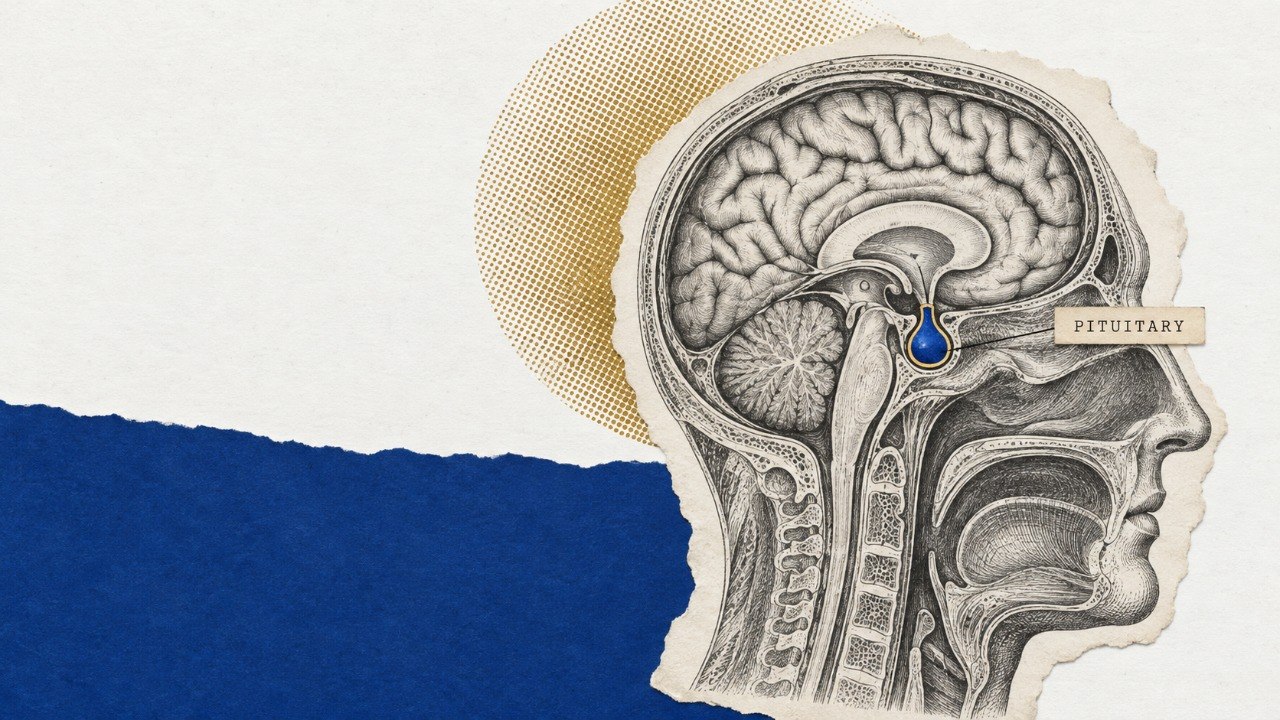
A prolactin test measures one pituitary hormone in a single blood sample. Normal ranges depend on the assay and on sex. Two widely used assays put the upper limit at 23.3 and 29.2 ng/mL for non-pregnant women, and at 15.2 and 17.7 for men. A result above your own lab's printed limit is called hyperprolactinemia.1
What does a prolactin test measure? Copy link
The test measures prolactin in serum, the clear part of blood. Prolactin is made in the pituitary, a gland at the base of the brain, and its main job is milk production after childbirth.
Levels run high in pregnancy and during breastfeeding. Outside those states they stay low, because dopamine from the hypothalamus, the brain region above the pituitary, holds prolactin release down. Anything that blocks dopamine pushes the level up.2
Doctors order it for irregular or absent periods, for milk discharge outside pregnancy, and for difficulty conceiving. In men the usual reasons are low sex drive, erectile difficulty and infertility. It also tracks a known prolactinoma, a noncancerous pituitary tumor that makes prolactin. These tumors make up roughly 40 percent of all pituitary tumors.2
Prolactin normal range for women, men and pregnancy Copy link
There is no single normal range, because each assay sets its own interval. The Endocrine Society notes only that normal values run higher in women than in men, and generally sit below 25 ng/mL.2 The table shows the manufacturer intervals for two widely used assays.1
| Assay | Non-pregnant women | Men |
|---|---|---|
| Roche Elecsys Prolactin II (cobas e801) | 4.8 to 23.3 | 4.0 to 15.2 |
| Siemens Prolactin (Atellica IM) | 2.8 to 29.2 | 2.1 to 17.7 |
The two assays disagree on the same blood. In that study, run at a US hospital laboratory, the Roche assay read about 55 percent higher than the Siemens assay. Its printed upper limits are still the lower pair.1 A result can therefore sit above the range on one assay and inside it on the other.
The study reviewed 298 people whose Roche result sat just above its printed limit, below 37.8 ng/mL for women or 22.8 for men. None had a disease driving the rise. Their results still led to 459 repeat tests, 39 pituitary MRI scans and 11 people starting prolactin-lowering medicine.1 The authors proposed 37.8 and 22.8 as better upper limits for the Roche assay.1
Pregnancy is a separate case. Prolactin rises about tenfold across a normal pregnancy, reaching 150 to 300 ng/mL by term, so non-pregnant intervals do not apply.2 Your lab report prints the interval that matches the assay your blood ran on, and that interval is the one to use.
Is your prolactin in ng/mL or µIU/mL? Copy link
Prolactin is reported in one of two units, and the numbers look nothing alike. Under the World Health Organization standard 84/500, 1 ng/mL equals 21.2 mIU/L.2 A normal 20 ng/mL is therefore 424 µIU/mL on a report that uses the other unit.
Someone reading 424 against a remembered ceiling of 25 can panic over a result that sits comfortably inside the range. Find the unit beside your result first, then compare it with the interval printed in the same column. The usual upper limit of about 25 ng/mL works out at roughly 530 µIU/mL. Note that µIU/mL and mIU/L carry the same value.
What a high prolactin result means at each level Copy link
How far the number sits above your lab's limit changes what happens next. The bands below combine the Endocrine Society guideline with the 2023 Pituitary Society consensus, as summarized in a 2026 review.2,3,4
Just above the upper limit. A mild rise is repeated before anything else, particularly when there are no symptoms. The consensus advises a repeat whenever prolactin is below five times the lab's upper limit.3,4 For a limit of 25 ng/mL, that covers everything up to 125.
Up to about 200 ng/mL. A prolactinoma is possible here, and so are several other causes. Stress at the blood draw, medicines and an underactive thyroid all belong on the list. So do kidney or liver disease, pregnancy, macroprolactin and pressure on the pituitary stalk.4,2
Above about 200 ng/mL. Fewer other causes can explain a level this high, and a prolactinoma becomes more likely.3,4 Dopamine-blocking drugs still matter, because risperidone and metoclopramide can push prolactin past 200 in people with no tumor.2
Above 500 ng/mL. A level this high very strongly suggests a macroprolactinoma, a prolactinoma 1 cm or larger. The older Endocrine Society guideline called it diagnostic, and placed a prolactinoma as the usual cause above 250.2 Prolactin usually rises with tumor size, though not always, so the number is read alongside the scan and the medication history.2
The reverse trap is the hook effect, an assay artifact that reads falsely low. It can happen when a large pituitary tumor comes with only a mildly raised prolactin. The guideline asks the lab to repeat the sample at a 1:100 dilution before the modest value is read as evidence against a prolactinoma.2
High prolactin symptoms in women and men Copy link
In women the usual complaints are periods that become irregular or stop, and difficulty getting pregnant. Around 90 percent of pre-menopausal women with a prolactinoma have irregular or absent periods. Roughly 80 percent have milk discharge outside pregnancy.4 Reduced sex drive is common too, because high prolactin lowers estrogen.1,4
In men, reduced sex drive, erectile difficulty and infertility are the typical signs. Breast enlargement can occur. Milk discharge is uncommon, affecting about 10 percent of men with a prolactinoma.4
Headache and loss of side vision can affect either sex. They come from pressure on the optic nerves above the pituitary, so they signal the tumor itself. Between 29 and 66 percent of people with a macroprolactinoma develop a visual field defect.4 Plenty of people with a raised prolactin have no symptoms at all.2
Bone is the slow cost. Spinal bone density runs about 25 percent lower in women with hyperprolactinemia, and it is not always restored once prolactin returns to normal.2
Why a raised prolactin is often not a raised hormone Copy link
Some prolactin circulates stuck to an antibody. The resulting complex is called macroprolactin. It is much less active than the free hormone, and it lingers in the blood because the kidneys clear it slowly.2,5 Routine immunoassays, the antibody-based tests labs run, pick it up to varying degrees and cannot separate it from the active hormone. The report can then come back high.5
The largest Indian series looked at 1,229 people whose prolactin exceeded their lab's limit of 18 ng/mL. Macroprolactin explained 168 of them, or 13.7 percent. That left 1,061 with a truly raised hormone. It was commoner in women than men, at 15.03 against 6.28 percent. In 134 of the 168, prolactin fell back inside the normal range once the large complex was removed.5
The most striking row concerns people with no symptoms. In that series, 14 patients had their raised prolactin picked up incidentally on a health-package blood panel. All 14 turned out to be macroprolactin.5
The check is cheap. Polyethylene glycol precipitation, a lab step that strips macroprolactin out, costs little, and the Endocrine Society suggests it when hyperprolactinemia comes without symptoms.2 It adds little when a medicine or an underactive thyroid already explains the number.5 Where prolactin stays raised after the check and no other cause is found, pituitary imaging usually follows.4
Does an underactive thyroid raise prolactin? Copy link
It does, often enough to belong in the first round of tests. A slow thyroid raises thyrotropin-releasing hormone, a brain signal that also pushes the pituitary to release prolactin.2
A Delhi study of 2,848 people put numbers on it. Subclinical hypothyroidism means a raised TSH, the pituitary's thyroid signal, with normal thyroid hormones. Among women with it, hyperprolactinemia was present in 25.56 percent when TSH sat between 5 and 7.5 mIU/L. It reached 49.07 percent between 7.5 and 10, and 61.43 percent above 10.6
The rise reverses. Treating the thyroid with levothyroxine brings prolactin down and shrinks the pituitary enlargement that long-standing hypothyroidism can cause.2 A TSH on the same request form is one of the first results worth having. The medication history, pregnancy status where relevant, and kidney and liver function sit beside it.4
Which medicines raise prolactin? Copy link
Medicines are the commonest cause that is not a tumor. Antipsychotics lead the list. Raised prolactin affects 40 to 90 percent of people on the older agents and 50 to 100 percent of those on risperidone.2 Metoclopramide, used for nausea, works the same way. Verapamil, a heart and blood-pressure drug, causes it in about 8.5 percent of users, and opiates produce a mild rise.2
Drug-induced levels usually land between 25 and 100 ng/mL. Metoclopramide, risperidone and the phenothiazines, an older antipsychotic class, are the ones that can pass 200.2
When it is clinically appropriate, the prescribing doctor may stop or swap the suspected medicine and repeat the prolactin. Levels take about three days to settle.2 Do not stop a prescribed dopamine-blocking drug on your own to take the test. That applies to antipsychotics, anti-nausea drugs and everything else on this list.
Is prolactin high in PCOS? Copy link
Usually not. A 2026 review describes mild prolactin rises as common in polycystic ovary syndrome (PCOS).4 A 2025 Spanish study with a comparison group found otherwise. Among 647 women, raised prolactin turned up in 6.0 percent. It was no more common in the 350 with PCOS than in the 297 without it.7
Most mild rises in that study had an ordinary cause. Stress at the blood draw explained 18 of the 31 raised results among referred women, and macroprolactin explained 9 more.7 A raised prolactin in someone with PCOS therefore still needs explaining.
Sometimes the explanation is a tumor. A Korean series of 657 women with PCOS found raised prolactin in 76. Of the 56 who had pituitary MRI, 13 had an adenoma.8 The authors proposed imaging above 52.9 ng/mL, a cutoff that still missed about a quarter of the adenomas in their data.8
PCOS was also the commonest reason for a prolactin test in the Indian series, at 402 of 1,229 referrals. Among those PCOS patients, 16.41 percent carried macroprolactin instead of a true hormone rise.5 That figure describes women already found to have a raised prolactin, not women with PCOS in general.
How the test is done, and what preparation actually changes the result Copy link
One blood sample is drawn from a vein in the arm. The Endocrine Society guideline sets no fasting rule and allows the sample at any time of day, provided the blood draw itself is not stressful.2 Laboratories set their own collection instructions, which may include a morning sample or rest beforehand. Follow the instructions that come with your booking.
Repeat sampling is sometimes the right answer. Where the first result sits below five times the upper limit, the 2023 consensus advises repeating it.3,4 The older guideline suggests a repeat on another day, with samples 15 to 20 minutes apart, when a result is in doubt.2 That differs from dynamic testing, where a drug is given to provoke the pituitary, which the guideline advises against.2
Biotin can distort the result. Biotin supplements sold for hair, skin and nails can hold 20 to 100 mg a pill. The daily allowance is 0.03 mg, an amount that does not usually interfere.9 The US Food and Drug Administration warns that high doses can push some results falsely high or falsely low, depending on the test. Hormone tests are among those at risk.9 Some test makers have reduced the problem and others have not.9 The Siemens assay in the 2024 study is built so that biotin does not interfere.1
The FDA has not set a standard pause before testing. It says there is not enough information to know whether stopping biotin for any number of hours before a test prevents a wrong result.9 Tell the laboratory and your doctor what you take before the sample is drawn.
Prolactin test price in India Copy link
The clearest public benchmark is what the Central Government Health Scheme, the central employees' health scheme, pays private laboratories. From 13 October 2025, it pays ₹400 for a prolactin test at an accredited laboratory in Tier I cities, its costliest band. A non-accredited laboratory there gets ₹340.10 Tier II and Tier III cities are paid 10 and 20 percent less.10
Private list prices vary with the city, the laboratory and whatever discount is running, so treat the government rate as a reference point. Macroprolactin screening, if your doctor wants it, is a separate request. Panels that bundle prolactin with LH and FSH cost more than prolactin alone.
How high prolactin is treated Copy link
Treatment depends on the cause. A drug cause reverses when the drug is changed, and a thyroid cause reverses with levothyroxine. Roughly 30 percent of people with idiopathic hyperprolactinemia, a raised prolactin with no cause found, see the level settle on its own.2
Someone with a microprolactinoma, a prolactinoma under 1 cm, and no symptoms is often left untreated.2 When treatment is needed, cabergoline, a prolactin-lowering drug, is first-line in both the Endocrine Society guideline and the 2023 Pituitary Society consensus.2,3
The trial numbers are strong. In a placebo-controlled study of prolactin-secreting microadenomas, cabergoline at 0.125 to 1.0 mg twice weekly normalized prolactin in 95 percent. Periods returned in 82 percent of the women who had stopped menstruating.2 Across the wider evidence, which is largely observational, the median normalization rate was 68 percent. Milk discharge stopped in a median 86 percent.2
Treatment is not always permanent. In selected patients, cabergoline can be tapered after at least two years, once prolactin is normal and no tumor is visible on MRI.2 Hyperprolactinemia came back in 26 to 69 percent across the withdrawal studies, so prolactin is rechecked for a long time afterward.2
When a prolactin result needs urgent attention Copy link
New loss of side vision, or new double vision, needs urgent assessment. So does a new or worsening headache in someone with a known or suspected pituitary tumor. These point at pressure from the tumor itself.2,4
A sudden, severe headache with an abrupt change in vision is an emergency. It can mean a sudden expansion of a pituitary tumor, called pituitary apoplexy.4
Absent periods with milk discharge are evaluated in a planned visit to a general doctor or gynecologist.4 A confirmed level above 200 ng/mL also needs proper evaluation, and pituitary imaging usually follows where no other cause is found.4
During pregnancy, serum prolactin stops being useful for tracking a known prolactinoma. Because it climbs steeply in normal pregnancy, the guideline recommends against measuring it in these women. Symptoms and visual fields guide care instead.2
Frequently asked questions Copy link
What is a normal prolactin level for a woman?
It depends on the assay. Two widely used assays put the upper limit for non-pregnant women at 23.3 and 29.2 ng/mL. The Endocrine Society puts normal values generally below 25 ng/mL. Pregnancy raises prolactin about tenfold, to 150 to 300 ng/mL by term. Compare your result with the range printed on your own report.
Does high prolactin mean a brain tumor?
Not necessarily. Medicines, pregnancy, an underactive thyroid, kidney or liver disease, stress and macroprolactin can all raise prolactin. A prolactinoma becomes more likely as the level climbs above 200 ng/mL, but a blood result on its own does not diagnose a pituitary tumor. Imaging and the medication history settle the question.
Do you need to fast for a prolactin test?
Fasting is not part of the Endocrine Society guidance for a prolactin test. It allows the sample at any time of day, as long as the blood draw itself is not stressful. Laboratories set their own collection instructions, which may include a morning sample or rest beforehand, so follow the ones that come with your booking.
Can stress cause high prolactin?
Yes. Stress is listed among the physiological causes of raised prolactin, alongside sleep, exercise, sex and breastfeeding. A difficult blood draw can lift a result on its own. In one 2025 study, stress at the blood draw explained 18 of 31 raised results among referred women. Mild rises are usually repeated before any scan.
How do you lower prolactin naturally?
The Endocrine Society guideline recommends no diet or supplement for high prolactin. What lowers it is removing the cause. That can mean changing a dopamine-blocking medicine, treating an underactive thyroid, or finding macroprolactin, which usually needs no treatment. Where a prolactinoma is driving the level, cabergoline is the treatment with trial evidence behind it.
References Copy link
- Earll E, Javorsky BR, Sarvaideo J, Straseski JA, Nerenz RD. Clinical Impact of New Reference Intervals for the Roche Prolactin II Immunoassay. Journal of the Endocrine Society. 2024;8(6):bvae069. doi:10.1210/jendso/bvae069
- Melmed S, Casanueva FF, Hoffman AR, Kleinberg DL, Montori VM, Schlechte JA, Wass JAH. Diagnosis and Treatment of Hyperprolactinemia: An Endocrine Society Clinical Practice Guideline. Journal of Clinical Endocrinology & Metabolism. 2011;96(2):273–288. Recommendations 1.1–6.2, pp. 273–283. doi:10.1210/jc.2010-1692
- Petersenn S, Fleseriu M, Casanueva FF, et al. Diagnosis and management of prolactin-secreting pituitary adenomas: a Pituitary Society international Consensus Statement. Nature Reviews Endocrinology. 2023;19(12):722–740. doi:10.1038/s41574-023-00886-5
- Bauer MJ, Pelsma ICM, Geer EB, Biermasz NR. Diagnostic delay of prolactinoma: Focus on clinical manifestations. Best Practice & Research Clinical Endocrinology & Metabolism. 2026;40(2):102106. doi:10.1016/j.beem.2026.102106
- Sharma LK, Dutta D, Sharma N, Kulshreshtha B, Lal S, Sethi R. Prevalence of Macroprolactinemia in People Detected to Have Hyperprolactinemia. Journal of Laboratory Physicians. 2021;13(4):353–357. doi:10.1055/s-0041-1732490
- Sharma LK, Sharma N, Gadpayle AK, Dutta D. Prevalence and predictors of hyperprolactinemia in subclinical hypothyroidism. European Journal of Internal Medicine. 2016;35:106–110. doi:10.1016/j.ejim.2016.07.012
- Luque-Ramírez M, Quintero-Tobar A, Martínez-García MÁ, de Lope Quiñones S, Insenser M, Nattero-Chávez L, Escobar-Morreale HF. Mild hyperprolactinemia in women with polycystic ovary syndrome. Insights from a large cross-sectional study. Journal of Clinical & Translational Endocrinology. 2025;41:100412. doi:10.1016/j.jcte.2025.100412
- Kim SI, Yoon JH, Park DC, Yang SH, Kim YI. What is the optimal prolactin cutoff for predicting the presence of a pituitary adenoma in patients with polycystic ovary syndrome? International Journal of Medical Sciences. 2023;20(4):463–467. doi:10.7150/ijms.80891
- US Food and Drug Administration. UPDATE: The FDA Warns that Biotin May Interfere with Lab Tests: FDA Safety Communication. Issued 5 November 2019.
- Directorate General of CGHS, Ministry of Health and Family Welfare, Government of India. Office Memorandum F.No.5-16/CGHS(HQ)/HEC/2024(PartI), dated 3 October 2025. Revised CGHS rates effective 13 October 2025, X (Tier I) cities, code LB164.
This article is general health information for readers in India and is not a diagnosis or a prescription. Every laboratory sets its own prolactin reference interval, and the two assays compared above disagree by about 55 percent on the same blood, so the interval printed on your own report comes first. Do not start, stop or change a prescribed medicine, including any dopamine-blocking drug, on the strength of this page. The ₹400 and ₹340 figures are Central Government Health Scheme rates for Tier I cities effective 13 October 2025, not private list prices, and rates change. Sapiens is operated by Pangaea Sciences Private Limited, Hyderabad. Editorial standards: joinsapiens.in/editorial-standards. Report an error on this page.