Women's Health · PCOS
PCOS or PCOD (Now PMOS): Symptoms, Causes and Treatment
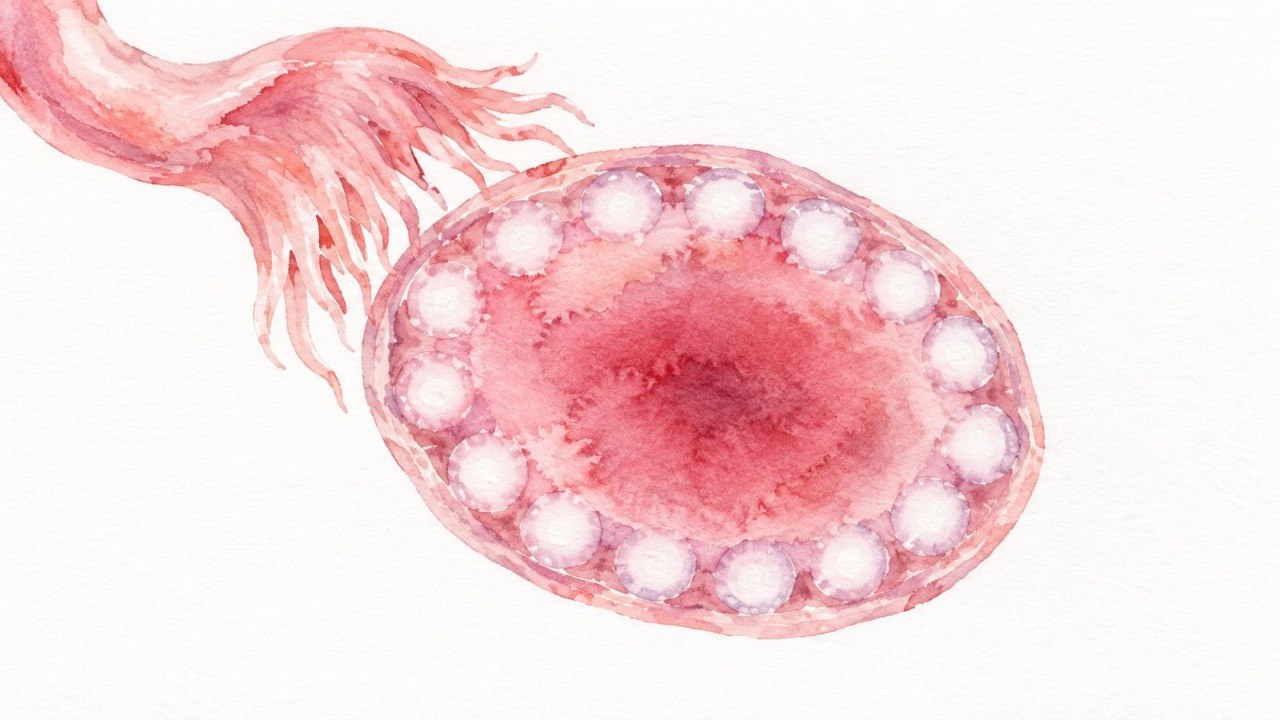
PCOS is a long-term hormonal and metabolic condition. Ovulation becomes irregular, androgens (hormones such as testosterone) run high, and insulin often works less well. A national Indian study found it in 19.6% of women aged 18 to 40 by the widest criteria.1 There is no permanent cure.2 In May 2026 it was renamed PMOS, polyendocrine metabolic ovarian syndrome.3
What is PCOS? Copy link
PCOS, polycystic ovary syndrome, is a condition in which the hormone signals that run your cycle fall out of step. Eggs mature less often, so periods come late or not at all; higher than normal androgen levels drive much of this, showing up as facial hair, acne or thinning at the parting.2
Insulin matters here. For many women it sits near the middle of the problem. When your cells respond poorly to insulin, your pancreas makes more of it to compensate, and that extra insulin also acts directly on the ovary, where it helps regulate hormone production. Androgens then feed back. They worsen insulin resistance.4 That two-way loop helps explain why weight, periods and skin so often change together.
Nobody yet knows what switches it on. It runs in families, and a family history of PCOS or type 2 diabetes raises your odds; it can begin in adolescence, but many women first hear the word when they try to get pregnant.2 Does that mean it only matters for fertility? It doesn't, and the new name was chosen partly to make that point.
Why was PCOS renamed PMOS? Copy link
On 12 May 2026, an international group published a new name in The Lancet, polyendocrine metabolic ovarian syndrome, or PMOS.5 The process drew on 14,360 survey respondents and 56 patient and professional organizations across world regions.3
Each word carries a job. Polyendocrine says several hormone systems are involved, reproductive hormones among them. Metabolic points to insulin resistance and its effects. Ovarian keeps the ovary in view, because disrupted ovulation remains central.6
The old name caused real harm. The Endocrine Society says it shrank a long-term hormonal disorder to “a misunderstanding about ‘cysts’ and a focus on ovaries”, which contributed to missed diagnoses.5
So what changes for you this year? Very little. Doctors look for the same combination of features, with more attention on blood sugar, blood pressure and heart risk,6 while a three-year transition runs its course before the new name enters the international guideline in its 2028 update.5 Your reports may say PCOS, PCOD or PMOS for a while. They describe the same condition.
Is PCOD the same as PCOS? Copy link
For practical purposes, yes. PCOD, short for polycystic ovarian disease, is a name widely used in India; the 2023 international guideline, reviewed across 39 partner and collaborating organizations, does not use the term at all and describes one condition.7
You may be told that PCOD is the milder version, a problem of the ovaries alone. No diagnostic criteria define it that way. None. If your report says PCOD, the useful questions stay the same. Are your cycles irregular? Are androgens raised? What do your ovaries show on a scan, or what does your AMH level show? AMH, anti-Müllerian hormone, is a blood test that tracks how many small follicles your ovaries hold.
PCOS symptoms: what are the first signs? Copy link
Watch your cycle first. The first sign is usually a change there. Periods drift further apart, more than 35 days, or you have fewer than eight in a year.7 Some women notice the opposite, with bleeding that is heavy, long or painful.2
- Irregular or missing periods. Once you are a year past your first period, any single cycle longer than 90 days counts as irregular.7
- Hair on the chin, upper lip, chest or lower belly. Doctors call it hirsutism. In adults it predicts high androgens on its own.7
- Acne or oily skin that lingers past your teens.2
- Thinning on the scalp, usually a parting that looks wider in photos. This is female pattern hair loss, driven by the same androgens.2
- Weight gain, often around the belly, the pattern many people call a PCOS belly.2
- Trouble getting pregnant.2
- Low mood or anxiety. Both are common enough that the guideline advises screening every woman diagnosed.7
- Snoring and daytime sleepiness. Obstructive sleep apnea, repeated pauses in breathing during sleep, is more common in PCOS, independent of weight.7
Symptoms differ from woman to woman and shift over the years.2 Keep a simple log of your period start dates for a few months. It turns a vague “irregular” into numbers your doctor can use. One clue hides easily, though. Hair removal. If you thread your upper lip every two weeks, mention it when your doctor asks about hair growth, because self-treatment is common and can limit the examination.7
Can you have PCOS with regular periods? Copy link
You can. In a large 2024 national study funded by ICMR, India’s medical research council, the most common phenotype (phenotype simply means type) had high androgens and polycystic ovarian morphology, meaning ovaries with many small follicles on a scan, despite regular cycles. This was phenotype C, at 40.8% of PCOS cases in that study.1
Naturally, most women expect late periods to be the giveaway. In practice, a normal cycle is no reason to dismiss chin hair, stubborn acne or a scan report. The other types split this way in the same study: D, irregular cycles with polycystic ovaries, 24.6%; A, all three features, 20.2%; and B, irregular cycles with high androgens, 14.3%.1
One caveat belongs to the scan. The study used abdominal ultrasound and counted more than 12 follicles as polycystic, a lower bar than today’s threshold of 20 follicles in one ovary.1,7 Its authors say this could have overestimated how often ovaries looked polycystic.1
Regular bleeding also doesn’t prove you ovulate. The guideline notes that ovulation problems can occur with regular cycles, and a progesterone blood test can check if needed.7
Can thin women have PCOS?
They can. In a clamp study, the most precise way to measure insulin sensitivity, insulin resistance was present in 75% of lean women with PCOS and 95% of those who were overweight.8 Only 40 women with PCOS took part, so read those percentages as rough, and a 2012 review adds that some lean women with PCOS have normal insulin sensitivity.4 Being slim, in other words, neither confirms nor excludes the condition.
What causes PCOS? Copy link
No single cause has been found.2 Several things add up. Inherited risk, insulin resistance and excess androgen each feed into it, and each tends to strengthen the others.4
Insulin resistance in PCOS seems to be partly built in. In the clamp study, extra weight worsened it more steeply in women with PCOS than in women without.8
Newer work suggests PCOS may be several conditions sharing one label, and a 2025 Nature Medicine study that clustered data from 11,908 women described four subtypes. One is led by high androgens, one by obesity, one by high SHBG (a protein that carries testosterone in blood) and one by high LH, a pituitary hormone that triggers ovulation, together with high AMH.9 Each followed a different course over a median of 6.5 years. Most participants came from Chinese fertility centers, so the split still needs testing in Indian women.9
How do you know if you have PCOS? The diagnosis and tests Copy link
In adults, once other causes are excluded, two of three features support a PCOS diagnosis: irregular ovulation, high androgens on symptoms or blood tests, and polycystic ovaries on ultrasound or an AMH level above an assay-specific cut-off.7 AMH can take the scan’s place in adults. It should not be used as the only test for PCOS.7 If you already have irregular cycles and high androgens, you do not need a scan.7
Scans need care. A scan can mislead in both directions, because polycystic-looking ovaries alone do not make the diagnosis while some women with PCOS have ovaries that look normal.2
| Test | What it answers | Worth knowing |
|---|---|---|
| Cycle history | Is ovulation irregular? | From 3 years after your first period: cycles under 21 or over 35 days, or fewer than 8 a year |
| Total and free testosterone | Are androgens high in blood? | Most accurate by LC-MS/MS; if you take the pill, it may need stopping for 3 months first |
| Pelvic ultrasound | Do the ovaries look polycystic? | 20 or more follicles in one ovary (volume of 10 mL or more on older machines); transvaginal is most accurate; not used in teenagers |
| AMH blood test | An alternative to the scan for polycystic ovarian morphology | Adults only; judged against assay-specific cut-offs; use AMH or ultrasound, not both; never a diagnosis on its own |
| TSH, prolactin, 17-OH progesterone, FSH | Is something else causing this? | Rules out conditions that mimic PCOS |
| 75 g oral glucose tolerance test | Diabetes or prediabetes? | Most accurate in PCOS; fasting glucose or HbA1c if it cannot be done |
| Lipid profile | Heart risk | Advised at diagnosis for every woman, at any weight |
Other conditions can mimic PCOS, so they are checked first. A raised prolactin level or an abnormal TSH result points somewhere else, which is why both sit on the first request form, and a testosterone result far above the lab range sends doctors looking for other causes, including ovarian and adrenal tumors.7
Two tests add little here. Fasting insulin and similar insulin assays are inaccurate for this purpose, and the guideline recommends against them in routine care.7 Skip them. An LH-to-FSH ratio isn’t part of the criteria either.
Before your appointment
- Keep a log of your period start dates for three months, or longer if you can.
- Bring any old ultrasound, hormone or sugar reports, even ones done elsewhere.
- Note how often you thread, wax or shave, and where.
- If you take the pill, ask your doctor whether your testosterone should be tested off it first.7
Diagnosing PCOS in teenagers
The rules are stricter before adulthood. Irregular cycles are normal in the first year after the first period.7 A teenager needs both irregular cycles and high androgens, because ultrasound and AMH are not recommended at this age.7 A girl with some features can be marked as at increased risk and reassessed at or before 8 years after her first period.7 If a scan report has already labeled your daughter with PCOD, ask your doctor whether she meets these criteria. Often she won’t yet.
How common is PCOS in India? Copy link
Between 7.2% and 19.6% of Indian women aged 18 to 40 have PCOS, depending on the criteria used.1 The strictest, the NIH 1990 criteria, require irregular cycles plus high androgens and give 7.2%, while the broad Rotterdam 2003 criteria, which accept regular cycles, give 19.6%, with the AE-PCOS criteria in between at 13.6%.1 Same women. Different rulers.
Worldwide, the figure is 10% to 13%, and the WHO estimates that up to 70% of women with PCOS do not know they have it.2 The guideline adds that prevalence may run higher in South East Asian and Eastern Mediterranean regions.7 In the Indian study, urban women and those in Central and North India had the highest rates.1
Is PCOS dangerous? Copy link
The main risks of PCOS build slowly, and most of them are metabolic. Among Indian women with PCOS in the national study, 91.9% had abnormal cholesterol or triglycerides, 43.2% had obesity by Asian cut-offs and 32.9% had fatty liver.1
Read that first number again. The women were aged 18 to 40, so diabetes itself was still uncommon at 3.4%, with impaired glucose tolerance, a step before diabetes, in another 9.1%. Metabolic syndrome, a cluster of raised waist, blood pressure, sugar and blood fats, affected 24.9%, and 8.3% already had high blood pressure.1 Fatty liver turned up in a third of them, which is worth raising with your doctor if your weight has crept up.1
Over the longer term, the guideline flags these risks:
- Type 2 diabetes and prediabetes, at any age and any weight. Blood sugar should be checked at diagnosis and every one to three years after.7
- Heart disease, although the absolute risk before menopause is low.7 A lipid profile is advised at diagnosis for every woman with PCOS.7
- Endometrial hyperplasia and cancer, meaning thickening and cancer of the womb lining. The risk is markedly higher, although of course the overall chance stays low and routine screening is not recommended; long gaps without a period, higher weight and diabetes add to it.7
- Pregnancy complications, including gestational diabetes, high blood pressure, preeclampsia (a pregnancy blood pressure disorder) and preterm birth.7
- Depression, anxiety and sleep apnea.7
Check your numbers early. Each of these can be tested for.
Can PCOS be cured permanently? Copy link
Plainly, no. The WHO states that there is currently no cure for PCOS.2 Treatment can still ease symptoms, restore ovulation and protect your long-term health.2
For some women the features fade with time, and in the 2025 subtype study many participants no longer showed every diagnostic feature at follow-up, with how often that happened depending on the subtype.9 The obesity-led subtype had the highest remission, yet those women went on to the most diabetes and high blood pressure.9
A calmer cycle, then, is good news with a footnote. A big one. The metabolic side needs watching even after periods settle. And since no cure exists, a product that promises one, whether a supplement, a tea or a 90-day program, is promising something medicine cannot yet deliver.2 The same goes for claims that you can cure PCOS naturally. Lifestyle change helps control symptoms, and it remains the base of every treatment plan.7
PCOS treatment: what helps each symptom Copy link
Treatment follows your main goal, and it can change as your goals do. Healthy eating and regular activity help every woman with PCOS, even when the scale doesn’t move.7
Irregular periods
The combined oral contraceptive pill regulates cycles and also treats excess hair.7 Low-dose pills, with under 30 μg of ethinylestradiol (the estrogen in the pill), work as well as higher doses for hirsutism.7 If you are not on the pill and go months without bleeding, your doctor may add a regular course of progestogen, a progesterone-like hormone, to protect the lining of the womb.7 If the pill is also your contraception, check with your doctor before you stop it for any test.
Facial hair and acne
For hirsutism, the pill usually comes first. Laser and light hair removal reduce facial hair, and the guideline links them to better mood and quality of life too.7 If six months of the pill and cosmetic treatment fall short, an anti-androgen, a drug that blocks androgen effects, could be considered, together with effective contraception.7 For scalp thinning, the guideline says an anti-androgen with the pill could be tried, while noting the evidence is thin.7
Weight and insulin resistance
Metformin, a diabetes tablet that improves insulin resistance, should be considered for adults with PCOS and a BMI of 25 kg/m² or more, to improve weight, glucose and cholesterol.7 You should know that metformin and active lifestyle change work about equally well.7 Stomach upset is common early on; starting low, with 500 mg steps every one to two weeks, and choosing extended-release tablets helps.7
GLP-1 medicines such as semaglutide can be considered for adults with PCOS and higher weight, alongside lifestyle care, under the same rules as for anyone else.7 The results specific to PCOS are modest so far. Modest is the right word. A 2026 meta-analysis, which pooled the results of 11 randomized trials, found that BMI fell 1.38 kg/m² more than with comparison treatments, a short-term effect rated low certainty, and evidence on periods, hirsutism and blood sugar was too thin to judge.10
Two cautions apply if you could become pregnant. Both are practical. Pregnancy safety data are lacking, so effective contraception is needed while taking these drugs, and weight tends to return after stopping.7 The eligibility rules for weight loss injections are the same with or without PCOS.7
Inositol and other supplements
Then there is inositol. It is the supplement you will hear about most. The guideline says it could be considered on personal preference, with little harm but limited benefit for ovulation, hirsutism or weight, and for hirsutism and waist size, metformin does better.7 No specific type, dose or combination can be recommended yet, and it’s worth telling your doctor if you take one.7
What should you eat with PCOS, and how much exercise helps? Copy link
Start with the myth. There is no special PCOS diet. The guideline found no evidence that any one diet composition beats another for weight, hormones, fertility or mood; any eating pattern that fits general healthy-eating advice will help, tailored to what you like and can keep up.7 As you’d expect, the plan you stick with does more than the perfect one you abandon.
A 7-day PCOS diet plan or chart can make planning easier. Treat any chart that bans whole food groups with caution, because the guideline warns against unduly restrictive, unbalanced diets.7 Lists of foods to avoid with PCOS circulate widely too. The guideline’s recommendations name no such foods; the advice is general healthy eating that you can sustain.7 If you want to lose weight with PCOS, a calorie deficit set to your own needs is the tool, and your waist measurement is worth tracking alongside the scale.7
How much can weight loss do? In a trial of 149 women with PCOS who were trying to conceive, losing about 6% of body weight over 16 weeks raised the ovulation rate to 60%, against 46% with the pill alone. Live births were 26% against 12%, but in a trial that size the gap was not statistically significant.11
For activity, aim for 150 to 300 minutes of moderate exercise a week, or 75 to 150 minutes of vigorous exercise, plus muscle strengthening on two non-consecutive days.7 For weight loss, the target rises to 250 minutes moderate or 150 vigorous; no single type of exercise has proven better for PCOS, so yoga, brisk walking, dance and weights, at home or in a gym, all count.7 Short on time? Fine. Some activity beats none, and cutting sitting time helps by itself.7
PCOS and pregnancy: can you get pregnant with PCOS? Copy link
Yes. Worth saying plainly, a PCOS diagnosis does not close that door. PCOS is the most common cause of anovulation, meaning cycles without an egg, and a leading cause of infertility.2 Ovulation can be restarted with medicine in many women.12
For anovulatory infertility due to PCOS, letrozole is the first-line medicine for inducing ovulation when no other infertility factor is present.7 In a trial of 750 women, cumulative live births were 27.5% with letrozole against 19.1% with clomiphene, and ovulation occurred in 61.7% of treatment cycles against 48.3%.12 Letrozole came out ahead on both counts.
Letrozole use for ovulation is off-label, meaning outside its licensed use, in many countries, and it should not be taken if you might already be pregnant; metformin alone can improve pregnancy rates, though more effective ovulation drugs exist.7 If tablets do not work, a fertility specialist can move to hormone injections or IVF.7
PCOS can affect pregnancy too. Before you try, the guideline suggests an oral glucose tolerance test ahead of conception, since PCOS raises the risk of gestational diabetes, preeclampsia and preterm birth.7
When should you see a doctor about PCOS? Copy link
See a gynecologist or an endocrinologist if any of these apply to you:
- No period for more than 90 days, after a negative pregnancy test.7
- Irregular cycles together with new facial hair, persistent acne or scalp thinning.7
- Hair growth or acne that comes on quickly or keeps getting worse, since rapid progression calls for tests for an androgen-secreting tumor.7
- Difficulty conceiving when your cycles are irregular.2
- Low mood, anxiety, or loud snoring with daytime sleepiness.7
Frequently asked questions Copy link
Is PMOS different from PCOS?
No. PMOS, polyendocrine metabolic ovarian syndrome, is the new name for the same condition, published in May 2026. Doctors still look for the same combination of features, with more attention on blood sugar, blood pressure and heart risk. Both names will be used during a three-year transition.
What are the first signs of PCOS?
Usually a change in your cycle, such as periods more than 35 days apart, fewer than eight a year, or a gap longer than 90 days. Excess hair on the chin or upper lip, acne that lingers past your teens and thinning at the parting often come with it. Weight gain around the belly is common too.
Does masturbation cause PCOS?
No. Masturbation is not among the factors research links to PCOS. The known contributors are inherited risk, insulin resistance and excess androgen, and a family history of PCOS or type 2 diabetes raises the odds. Worry about this is common, and nothing in the evidence supports it.
How long can PCOS delay your period?
Cycles in PCOS can stretch well past 35 days, and some women go months without bleeding; once you are more than a year past your first period, any single cycle longer than 90 days counts as irregular. Take a pregnancy test first, then see a doctor if the gap passes 90 days.
Is PCOS genetic?
It runs in families. A mother or sister with PCOS, or a family history of type 2 diabetes, raises your risk. Genes are only part of it, though. Research published in 2025 suggests PCOS may be several related subtypes, each with its own mix of hormones and its own long-term course.
Can thin women have PCOS?
Yes. In a small clamp study, insulin resistance was present in 75% of lean women with PCOS, though some lean women have normal insulin sensitivity. In a large 2024 Indian study, the most common phenotype had high androgens and polycystic ovarian morphology despite regular cycles. Neither a normal weight nor regular periods rules PCOS out.
Does PCOS cause hair loss?
It can. In PCOS, high androgens can cause thinning of scalp hair in a female pattern, usually seen as a wider parting, while increasing hair growth on the chin, lip and body. The pill and anti-androgens are used, and the guideline notes that the evidence for anti-androgens in scalp thinning is still limited.
Can PCOS cause cancer?
PCOS raises the risk of endometrial cancer, which starts in the lining of the womb, and the guideline describes that risk as markedly higher. The overall chance still stays low, so routine screening is not advised. Weight management, regular cycles and progestogen treatment are the preventive steps it recommends.
References Copy link
- Ganie MA, Chowdhury S, Malhotra N, Sahay R, Bhattacharya PK, Agrawal S, et al. Prevalence, Phenotypes, and Comorbidities of Polycystic Ovary Syndrome Among Indian Women. JAMA Network Open. 2024;7(10):e2440583. doi:10.1001/jamanetworkopen.2024.40583
- World Health Organization. Polycystic ovary syndrome. Fact sheet, 22 January 2026. Accessed 23 September 2026.
- Teede HJ, Bahri Khomami M, Morman R, Laven JSE, Joham AE, Costello MF, et al. Polyendocrine metabolic ovarian syndrome, the new name for polycystic ovary syndrome: a multistep global consensus process. The Lancet. 2026;407(10545):2329–2339. doi:10.1016/S0140-6736(26)00717-8
- Diamanti-Kandarakis E, Dunaif A. Insulin resistance and the polycystic ovary syndrome revisited: an update on mechanisms and implications. Endocrine Reviews. 2012;33(6):981–1030. doi:10.1210/er.2011-1034
- Endocrine Society. Polyendocrine Metabolic Ovarian Syndrome: New name to improve diagnosis and care of condition affecting 170 million women worldwide. News release, 12 May 2026. Accessed 23 September 2026.
- University of Rochester Medical Center. PCOS Is Now PMOS: Why This Name Change Matters. Health Matters, 2026. Accessed 23 September 2026.
- Teede HJ, Tay CT, Laven JJE, Dokras A, Moran LJ, Piltonen TT, et al. Recommendations From the 2023 International Evidence-based Guideline for the Assessment and Management of Polycystic Ovary Syndrome. Journal of Clinical Endocrinology & Metabolism. 2023;108(10):2447–2469. Recommendations 1.1–1.11, 2.2, 3.1–3.4, 4.2–4.11 and 5.3–5.4. doi:10.1210/clinem/dgad463
- Stepto NK, Cassar S, Joham AE, Hutchison SK, Harrison CL, Goldstein RF, et al. Women with polycystic ovary syndrome have intrinsic insulin resistance on euglycaemic-hyperinsulaemic clamp. Human Reproduction. 2013;28:777–784. doi:10.1093/humrep/des463
- Gao X, Zhao S, Du Y, Yang Z, Tian Y, Zhao J, et al. Data-driven subtypes of polycystic ovary syndrome and their association with clinical outcomes. Nature Medicine. 2025;31:4214–4224. doi:10.1038/s41591-025-03984-1
- Forslund M, Wändell P, Forsberg L, Österberg M, Dagerhamn J, Wernersson E, et al. GLP-1 receptor agonist treatment in women with polycystic ovary syndrome-a systematic review and meta-analysis. European Journal of Endocrinology. 2026;194(3):25–39. doi:10.1093/ejendo/lvag033
- Legro RS, Dodson WC, Kris-Etherton PM, Kunselman AR, Stetter CM, Williams NI, et al. Randomized Controlled Trial of Preconception Interventions in Infertile Women With Polycystic Ovary Syndrome. Journal of Clinical Endocrinology & Metabolism. 2015;100:4048–4058. doi:10.1210/jc.2015-2778
- Legro RS, Brzyski RG, Diamond MP, Coutifaris C, Schlaff WD, Casson P, et al. Letrozole versus clomiphene for infertility in the polycystic ovary syndrome. New England Journal of Medicine. 2014;371:119–129. doi:10.1056/NEJMoa1313517
This article is general health information for readers in India and is not a diagnosis or a prescription. PCOS is diagnosed by a doctor after other causes are ruled out, and reference ranges for hormone tests vary by laboratory. Do not start, stop or change the pill, metformin, letrozole or a GLP-1 medicine on the strength of this page. Sapiens is operated by Pangaea Sciences Private Limited, Hyderabad. Editorial standards: joinsapiens.in/editorial-standards. Report an error on this page.